

Top 10 Breast Cancer Myths and Facts You Need to Know





Last updated on 05 Oct 2026
Breast cancer is the most commonly diagnosed cancer among women in India. In 2022, about 192,020 new cases were reported in the country, according to the International Agency for Research on Cancer.
But knowing how common breast cancer is does not always mean knowing what is true about it. Questions about breast cancer symptoms, family history, screening and treatment often come with conflicting answers. Some of these beliefs have been around for years, while others spread through social media and word of mouth.
Key Takeaways
|
Why Does Breast Cancer Awareness Matter?
Breast cancer is easier to treat when it is found before it has spread. Breast cancer screening can find some cancers before they cause noticeable symptoms, while knowing the breast cancer warning signs can prompt someone to seek medical advice when a change appears.
India's public health programme recommends clinical breast examination for women aged 30 to 65 years once every five years. Screening is only one part of early detection. Assess any new breast change, even if it appears between scheduled examinations.
Risk awareness matters too. Breast cancer risk factors include age, inherited gene changes, reproductive factors and some lifestyle factors. Some risks cannot be changed, while others can be reduced.
Accurate information also matters after a diagnosis. Knowing what a test or treatment is for can make it easier to have a useful conversation with the treating team.
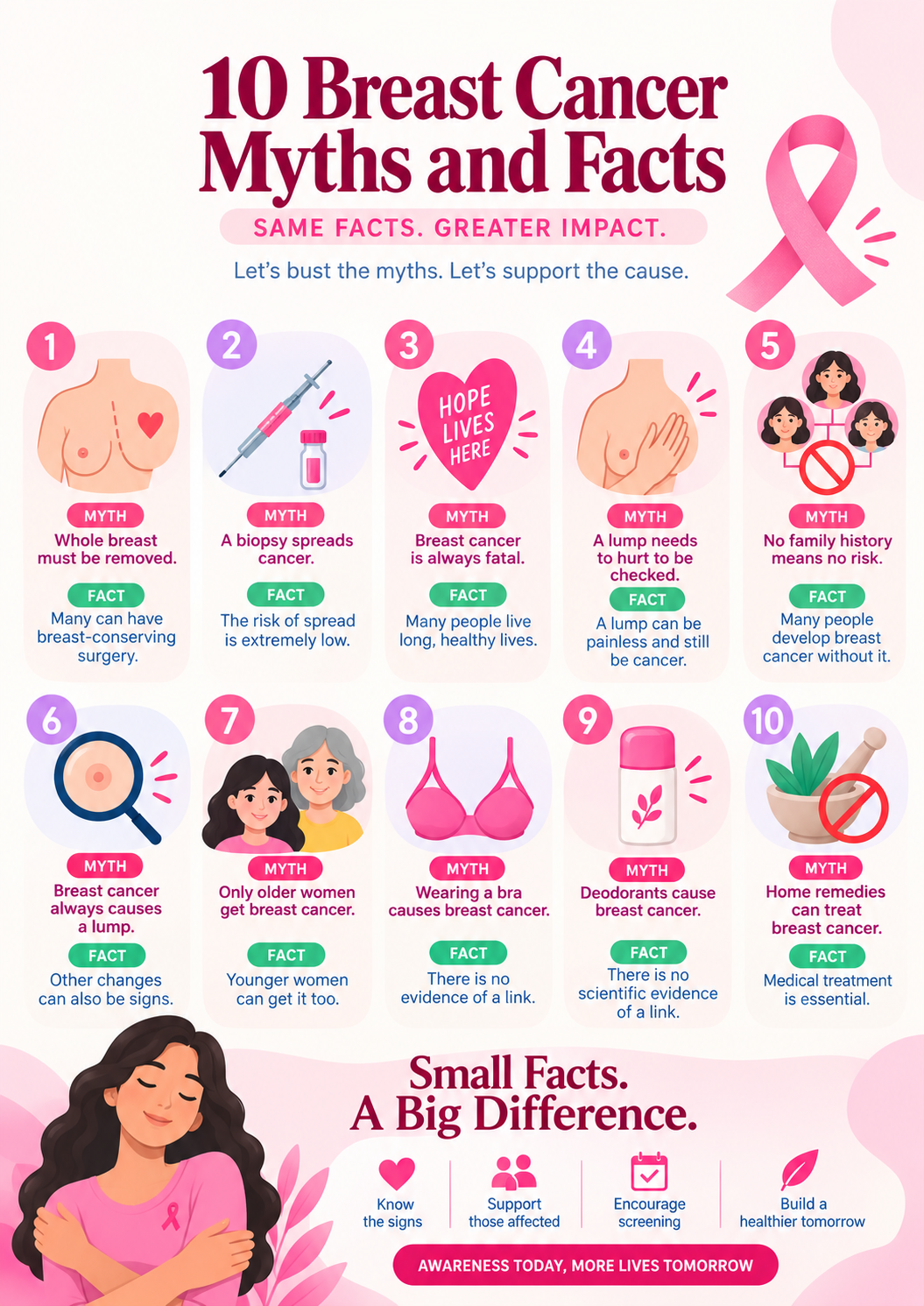
Myth 1: Breast Cancer Means the Whole Breast Has to Be Removed
Not necessarily. Some people with breast cancer can have breast-conserving surgery, such as a lumpectomy. This removes the tumour and some surrounding tissue while leaving most of the breast intact. Others may need a mastectomy, depending on the cancer and other clinical factors.
The fear of losing the whole breast has also been reported in India. A study of women in Delhi found that some participants associated breast cancer with complete breast removal and concerns about femininity.
Myth 2: A Biopsy Can Make Breast Cancer Spread
If a needle is going into a tumour, it can seem reasonable to worry that disturbing it might make the cancer spread.
A biopsy takes a small tissue sample so it can be examined and the diagnosis confirmed. The chance of cancer spreading because of a biopsy or surgery is extremely low.
This fear has also been reported in India. A biopsy recommended to investigate a suspicious breast change should not be avoided because of this concern.
Myth 3: Breast Cancer Is Always Fatal
A breast cancer diagnosis does not tell you what the outcome will be.
There are different types and stages of breast cancer. The stage, tumour characteristics and response to treatment all affect the outlook. Cancer that is still confined to the breast generally has a different outlook from cancer that has spread to distant organs.
Fatalistic beliefs about breast cancer have been reported in Indian research too. Some women in a Delhi study believed that the disease could not be cured and would eventually spread through the body.
Myth 4: A Breast Lump Needs to Hurt Before It Needs to Be Checked
A painless lump can be easy to dismiss, but breast cancer can cause a lump without pain. Pain is not a reliable way to judge whether a breast lump is cancerous.
This misconception has also been reported among women in India. In one Delhi study, some women associated breast cancer with pain and were less concerned about a lump that did not hurt.
Most breast lumps are not cancer. A doctor should still check a new or unusual lump.
Myth 5: No Family History Means You Cannot Get Breast Cancer
Family history can increase the risk of breast cancer, but it is not the only factor.
Inherited changes in genes such as BRCA1 and BRCA2 can increase risk. Age, reproductive history, alcohol use and other factors also play a part. Some people develop breast cancer without a known family history or another obvious risk factor.
Your family history is still useful information for a doctor, including cancers on your father's side of the family.
Myth 6: Breast Cancer Always Causes a Lump
A lump is one possible breast cancer sign, but it is not the only one.
Changes in breast size or shape, skin dimpling, nipple changes, unusual discharge or swelling in the breast or under the arm can also occur. Some early breast cancers cause no noticeable symptoms.
These are some of the possible breast cancer warning signs, but not every breast change is cancer. A new or unusual change should still be assessed.
Myth 7: Breast Cancer Only Affects Older Women
Breast cancer becomes more common with age, but younger women can develop it too. Inherited breast cancer risk can also lead to diagnosis at a younger age.
Breast cancer is not limited to women either. Men can develop it, although it is much less common.
Myth 8: Wearing a Bra, Especially an Underwired Bra, Causes Breast Cancer
This claim has been around for years, usually linked to the idea that tight or underwired bras restrict lymphatic flow.
There is no good evidence that wearing a bra causes breast cancer, including underwired bras.
A poorly fitting bra may cause discomfort or irritation. That is different from increasing the risk.
Myth 9: Deodorants and Antiperspirants Cause Breast Cancer
There is no scientific evidence that using deodorants or antiperspirants causes breast cancer. Concerns about aluminium and other ingredients have been studied, but no clear link with breast cancer risk has been established.
Some people are asked to avoid deodorant before a mammogram because aluminium-containing products can show up on the X-ray. This is about image quality, not cancer risk.
Myth 10: Breast Cancer Can Be Treated With Home Remedies Alone
A breast lump may have many causes, and there is no way to tell what it is from a home remedy.
Once breast cancer is diagnosed, breast cancer treatment is chosen according to the type and stage of the cancer. It may include surgery, radiotherapy, chemotherapy, hormone therapy, targeted therapy or a combination of these.
Traditional or complementary practices may be used alongside medical treatment, but they should not replace it.
Indian research has also documented delays in seeking medical care when people turned to local healers or other treatments before getting a proper diagnosis.
FAQs
Q1.Can breast cancer be painless?
Yes. A breast cancer lump can be painless, so the absence of pain does not rule out breast cancer.
Q2.Can breast cancer occur without a family history?
Yes. Having no family history does not mean you cannot develop breast cancer. Family history is only one of several breast cancer risk factors.
Q3.Does every breast lump mean breast cancer?
No. Breast lumps can have many causes, and many are not cancerous. A doctor should still assess a new or unusual lump.
Q4.Can a biopsy make breast cancer spread?
The chance of cancer spreading because of a biopsy is extremely low. A biopsy is often needed to confirm a breast cancer diagnosis.
Q5.Does breast cancer always require a mastectomy?
No. Some people can have breast-conserving surgery, while others may need a mastectomy. The choice depends on the individual cancer.
Q6.Can men get breast cancer?
Yes. Men can develop breast cancer, although it is much less common than in women.
Q7.Can breast cancer be prevented?
Not every case can be prevented. Some breast cancer risk factors can be changed, while others, such as age and inherited genetic factors, cannot.
Q8.When should a breast change be checked?
A new lump, nipple change, unusual discharge, skin change or other unusual breast change should be assessed by a doctor.
Conclusion
Breast cancer myths can affect how people understand symptoms, risk and treatment. A painless lump can still be cancer. A biopsy does not usually spread the disease. And a breast cancer diagnosis does not automatically mean that the whole breast has to be removed.
Reliable medical advice is a better source for decisions about breast health than information passed around online or by word of mouth.
Read Also
References
https://www.who.int/news-room/fact-sheets/detail/breast-cancer
https://www.cancer.gov/about-cancer/causes-prevention/risk/myths
Disclaimer: This article is for general awareness and does not replace medical advice, diagnosis or treatment. If you notice a new or unusual breast change, speak with a qualified healthcare professional.
















Comments