

How To Spot Fake Medicines: A Consumer's Guide





Last updated on 10 Jul 2026
In June 2025, authorities in Lebanon uncovered a drug syndicate selling fabricated cancer treatment drugs that did not contain any active ingredients. In November 2025, the medicine regulator of the UK warned that organised crime gangs are starting to produce counterfeit semaglutide injections with packaging similar to that of the original drugs. CDSCO in India identified as many as 185 counterfeit samples in June 2025, while in July 2025 it confirmed 8 fraudulent batches of counterfeit medicines sold by branded pharmaceutical companies.
This problem is not remedial; it is occurring in Indian drugstores, e-commerce sites, and supply chains as I speak. It is extremely important to learn how you can recognise counterfeit medicines, as it could save your life when the moment arises.
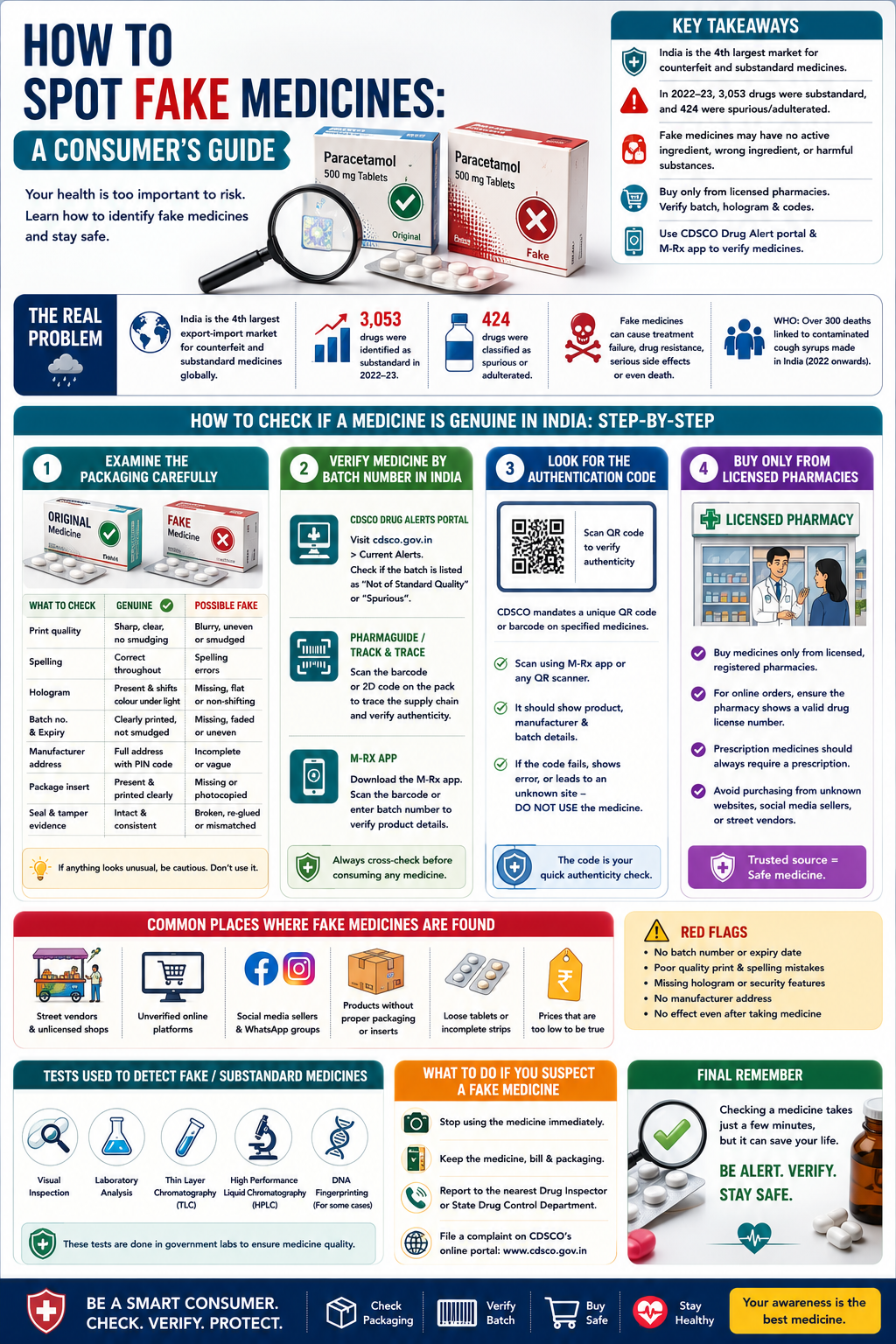
Key Takeaways
|
Why Fake Medicines Are Dangerous and Common
A 2025 PMC review of India's pharmaceutical regulation landscape confirmed that since 2022, the WHO has issued seven international alerts about contaminated liquid oral medicines, almost all manufactured in India, reporting serious adverse events, including over 300 deaths. The review noted that despite strengthened penalties under the Drugs and Cosmetics Act, enforcement remains inadequate.
A counterfeit tablet or an improper injection is not merely ineffective. They can inflict real damage. Fake medications can be empty (leading to non-treatment), have insufficient doses (allowing disease to progress or causing drug resistance), contain wrong active substances (leading to incorrect pharmacological action), or have dangerous impurities.
The CDSCO SFFC classifies these substances into three types: A (spurious/adulterated; deliberately fraudulent), B (substandard substances failing quality tests but made by a licensed company), and C (non-standard substances because of a mistake in marking). All three kinds are available to Indian consumers, and most cannot tell by sight which is which.
How to Check If a Medicine Is Genuine in India: A Step-by-Step Guide
Step 1: Examine the Packaging Carefully
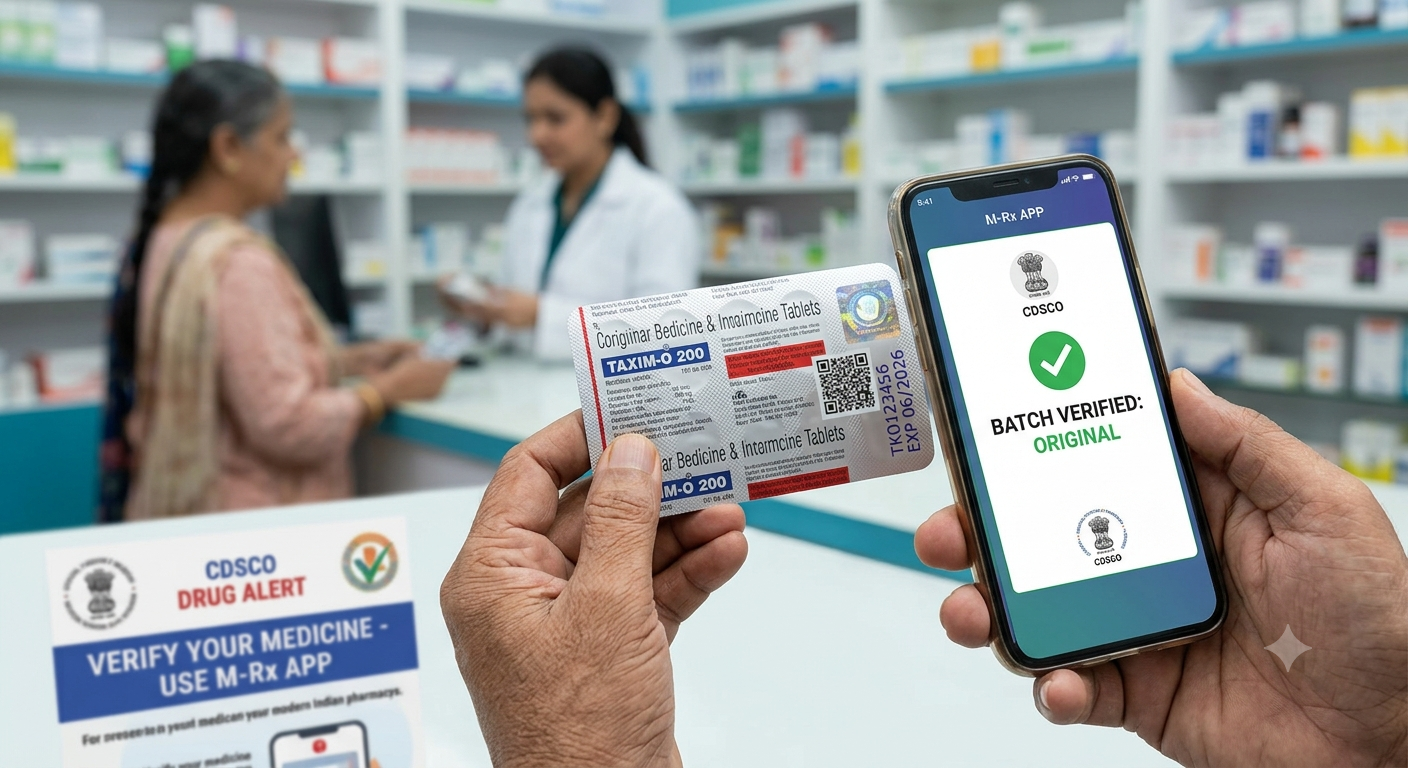
How to check if medicine is original or fake starts with the physical packaging. A medicine's original or duplicate can often be identified before the box is even opened.
Look for:
What to Check | Genuine Medicine | Possible Fake |
Print quality | Sharp, clear, no smudging | Blurry, uneven fonts, poor colour |
Spelling | Correct throughout | Errors in the brand or generic name |
Hologram | Present on CDSCO-mandated medicines; shifts colour under light | Missing, flat, or non-shifting |
Batch number and expiry | Clearly printed, not smudged | Missing, faded, or printed inconsistently |
Manufacturer address | Full address including PIN Code | Incomplete or vague |
Package insert | Present, printed clearly | Missing or photocopied |
Seal and tamper evidence | Intact, consistent across the box | Broken, re-glued, or mismatched |
Step 2: Verify Medicine by Batch Number in India
This is one of the most underused but most powerful tools available to Indian consumers. How to check the authenticity of medications using official government platforms:
CDSCO Drug Alerts Portal: Go to the website cdsco.gov.in and see if you can find some alerts on the page named Current Alerts. If any batch of the product you have used is listed in CDSCO alerts under the Not of Standard Quality or Spurious category, make sure to stop using it and inform the authorities.
Pharmaguide / Track and Trace: Pharmaceutical firms registered with the Government of India’s track-and-trace initiative can provide consumers with access to track the supply chain history of their medicines using the barcode or 2D barcode information on the packaging.
M-Rx App: Consumers in India can check the Ministry of Health's M-Rx mobile application by entering the medicine's batch number after scanning the barcode to retrieve related product and batch information.
Step 3: Look for the Authentication Code
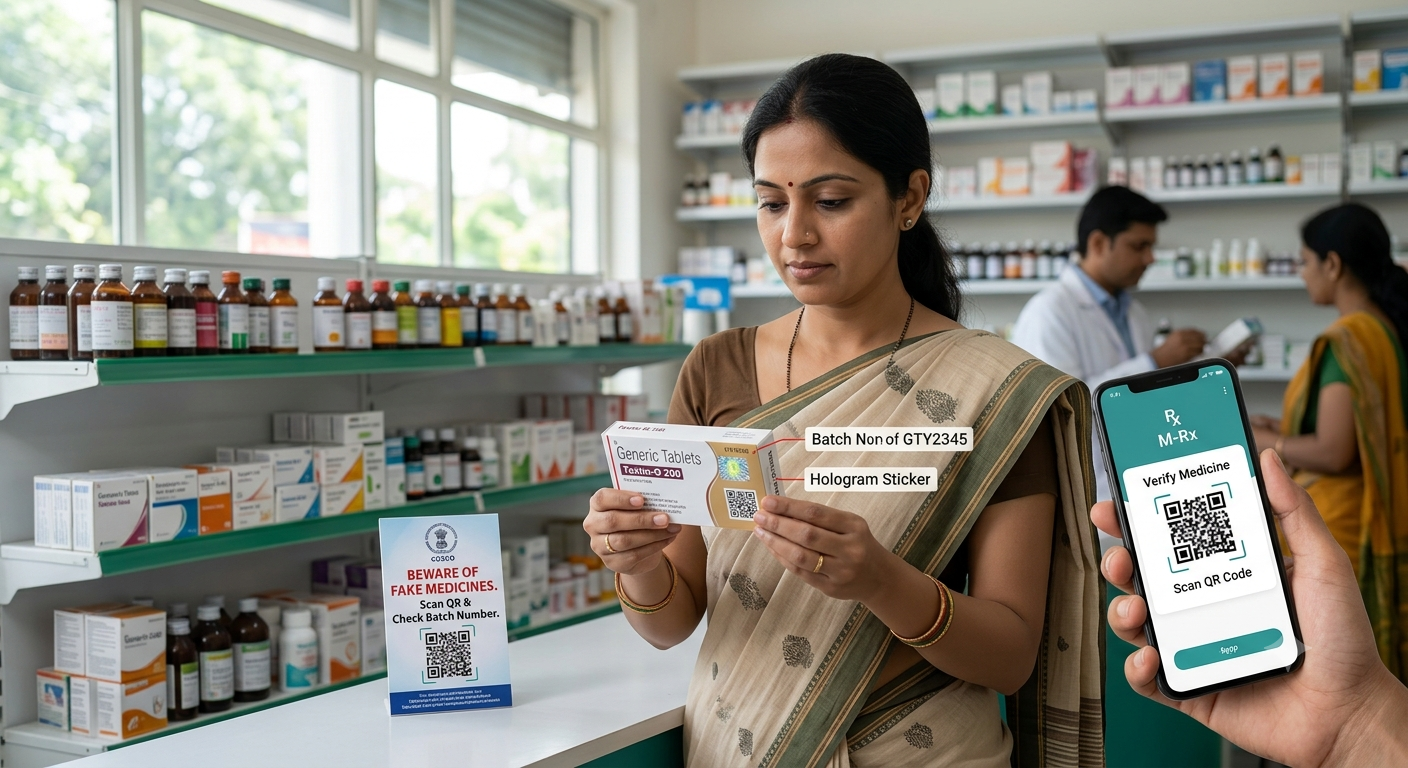
What is the authentication code on medicine? According to regulations imposed by the CDSCO, specified drugs in the scheduling must have a unique validation code, in the form of a QR code or barcode that can be scanned to verify product information. The validation code on the packaging must link through the M-Rx application or a QR reader to the confirmed manufacturer or the CDSCO registration page.
If scanning the code fails to deliver results, returns an error message, or redirects to an unrelated link, it should be treated as a warning, and one should refrain from using the drug.
Step 4: Buy Only from Licensed Pharmacies
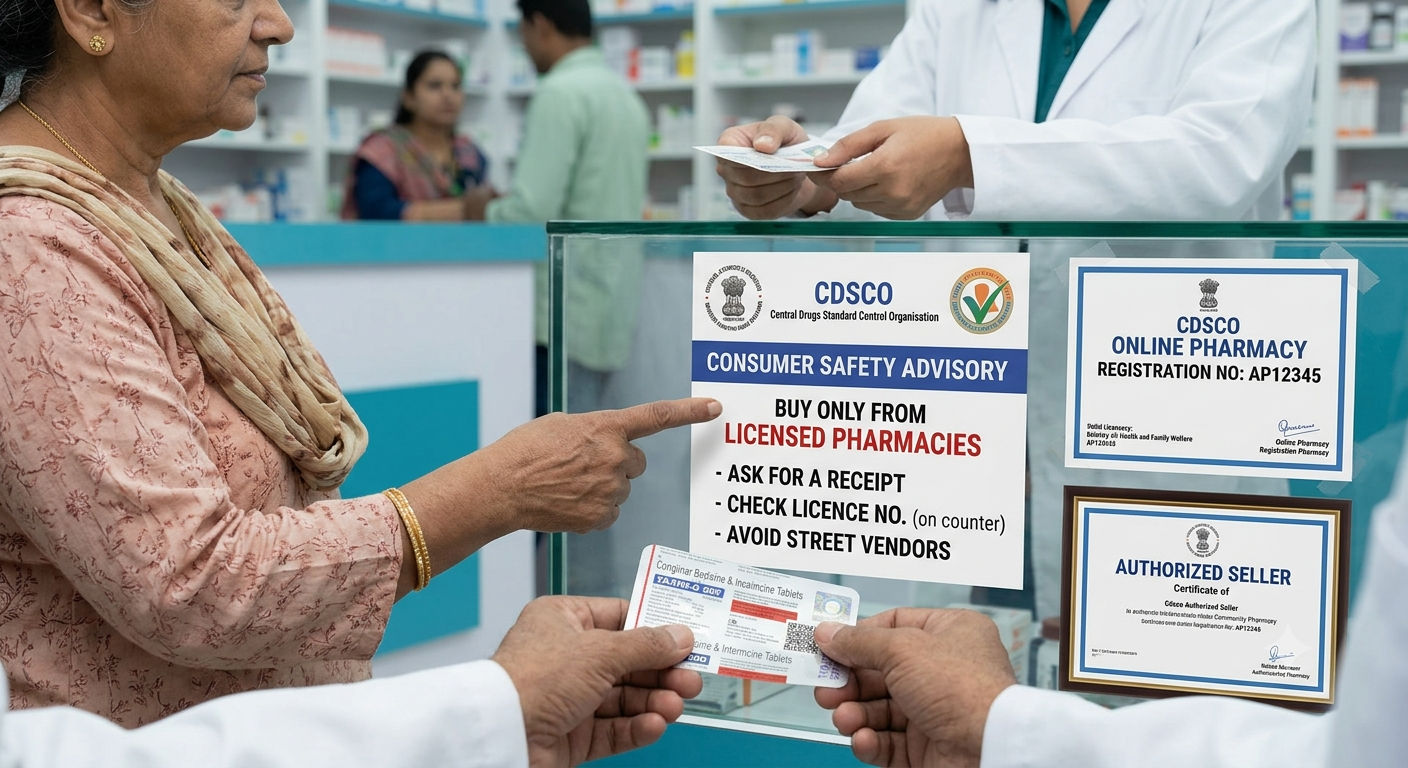
Rajiv Singhal, General Secretary of the All India Organisation of Chemists and Druggists (AIOCD), remarked: "We advocate getting medicines via offline pharmacies that have the required license for drugs". For any online purchases, make sure the pharmacy displays a license number for selling drugs online, is registered with the CDSCO online pharmacy system, and requires a prescription for prescription-only medicines.
Authentic medicines should come with a receipt at any time. If a pharmacy cannot issue a receipt, it is a warning sign.
Red Flags That Suggest a Medicine May Be Fake
Here is a quick checklist of red flags that suggest you may have bought a fake tablet medicine or substandard product:
The price is significantly lower than what you normally pay
The packaging looks slightly different from previous purchases of the same brand
The tablet colour, shape, size, or texture differs from what you usually receive
The medicine tastes or smells different from previous batches
There is no package insert, or it is photocopied rather than printed
The seal was loose or appeared to have been previously opened
You purchased it from an unlicensed street vendor, an online marketplace without a drug licence, or from a source outside a licensed pharmacy
The batch number or expiry date appears printed separately from the main packaging text, a common sign that a fake batch date has been added over an original one
How to Check Medicine Original or Duplicate: Brand-Specific Tools
Several major Indian pharmaceutical companies have added their own verification tools:
Company / Category | Verification Method |
Anti-tuberculosis drugs | CDSCO's dedicated TB medicine authentication portal |
CDSCO Track and Trace for oncology products; verify with the hospital pharmacy | |
Branded medicines | The company's customer care number on the packaging calls to verify batch number |
Verify the manufacturer's licence at CDSCO's manufacturing licence database | |
Online purchases | Confirm pharmacy licence number at eaushadhi.cdsco.gov.in |
Fake Medicine News: What CDSCO Has Flagged Recently
The pattern is consistent. CDSCO's April 2026 monthly drug alert identified 169 medicines as Not of Standard Quality and confirmed one spurious batch of Ursodeoxycholic Acid, a liver medicine, falsely produced under another manufacturer's name and traced to Bihar.
Fake medicine news from CDSCO's most recent alerts is worth being aware of:
June 2025: Taxim-O 200 (antibiotic), Rosuvas F10 and F20 (cholesterol medicine), and Thrombophob ointment were all identified as counterfeit batches circulating in the Indian market.
July 2025: Eight spurious medicine batches were confirmed, seven from Bihar and one from Ghaziabad, falsely marketed under the names of legitimate pharmaceutical companies.
April 2025: Carboxymethylcellulose Sodium Eye Drops, Compound Sodium Lactate Injection, and a Vitamin D3 supplement were flagged as substandard or spurious after CDSCO quality tests.
Checking the CDSCO alerts portal at cdsco.gov.in before using a new batch of any critical medicine takes under a minute and could prevent harm.
FAQs
Q1. How to check if medicine is original or not?
Check packaging quality, holograms, batch numbers, and authentication codes. Scan the QR code on the packaging using the M-Rx app. Buy only from licensed pharmacies and always ask for a bill.
Q2. How to identify fake medicines without a lab?
Check for print quality, spelling, hologram, tamper seals, and whether the batch number appears on CDSCO's drug alerts list. Any visible inconsistency from your usual brand warrants a report to the pharmacist.
Q3. What is the authentication code on medicine?
It is a CDSCO-mandated QR code or barcode on the packaging of certain scheduled medicines that, when scanned, links to verified product and manufacturer data. If scanning returns no result or an error, do not use the medicine.
Q4. How do I verify medicine by batch number in India?
Visit cdsco.gov.in and check the drug alerts section. Use the M-Rx app to scan the barcode on your medicine's packaging. You can also call the manufacturer's customer care number printed on the pack.
Q5. Are online medicines more likely to be fake?
Not if purchased from a licensed online pharmacy with a valid drug licence, prescription requirement, and CDSCO registration. The risk is higher on unregulated marketplaces and social media sellers.
Final Thoughts
The issue of counterfeiting drugs is prevalent in India, and it is a pressing issue which is being regularly monitored by the CDSCO. On the brighter side, consumers can help prevent counterfeiting. They can do this by carefully examining medicines’ packaging, scanning codes to verify, checking batch numbers on official portals, and buying from authorised sellers.
The company sells medicines obtained only from authorised dealers and manufacturers; it also provides complete batch details for every medicine package supplied.
Read Also
References
Business Today [Internet]. Mumbai: Business Today; 2024 Oct 5 [cited 2026 Jul 09]. Counterfeit drugs in the market: what you should know. Available from: https://www.businesstoday.in/industry/pharma/story/counterfeit-drugs-in-the-market-what-you-should-know-448878-2024-10-05
The South First [Internet]. 2025 May 25 [cited 2026 Jul 09]. CDSCO flags 60 medicines as substandard, including drugs linked to blindness and maternal deaths. Available from: https://thesouthfirst.com/health/cdsco-flags-60-medicines-as-substandard-including-drugs-linked-to-blindness-and-maternal-deaths/
Central Drugs Standard Control Organisation [Internet]. New Delhi: CDSCO, Ministry of Health and Family Welfare; [cited 2026 Jul 09]. Drug alerts. Available from: https://cdsco.gov.in/opencms/opencms/en/Notifications/Alerts/
Disclaimer: This article is for general informational and awareness purposes only. If you suspect a medicine you have purchased is counterfeit or substandard, stop using it and report it to the CDSCO portal at cdsco.gov.in or to your State Drug Controller. Consult a qualified physician before making any changes to your medication.











Comments