

International Stuttering Awareness Day





Last updated on 02 Jan 2026
The International Stuttering Awareness Day (ISAD) 2025 is observed worldwide on October 22. Also known as International Stammering Awareness Day, The history of International Stuttering Awareness Day dates back to 1998 in the UK and Ireland. Since then, it has grown into a global movement to raise awareness and reduce stigma for people who stutter.
The 2025 theme focuses on “Voices That Matter”, highlighting the importance of listening to and empowering people who stutter. This year, ISAD events are planned globally, including awareness campaigns, workshops, and social media initiatives in India.
The Purpose of International Stuttering Awareness Day
ISAD aims to:
Enhance the self-esteem and communication opportunities for individuals who stutter.
Reduce social discrimination and change public perceptions about stuttering.
Encourage collaboration among researchers, clinicians, parents, and stuttering individuals.
Promote community support networks and knowledge sharing.
What Is Stuttering?
Stuttering is a speech disorder characterized by disruptions in speech flow. It can be neurological, inherited, or caused by brain injury. Common symptoms include repeated words, syllables, prolonged sounds, or abnormal pauses. The disorder affects both children and adults, impacting communication and self-confidence.
The International Stuttering Awareness Day 2025 aims to promote speech disorder awareness globally, helping people understand stuttering, its types, and management strategies.
Types Of Stuttering
Type | Description | Common Age/Occurrence | Key Notes |
Developmental | Occurs as children learn to speak | Under 5 years, more common in males | Often resolves naturally |
Caused by brain injury or abnormal neural signals | Any age | Requires medical evaluation | |
Psychogenic | Linked to emotional trauma or mental health issues | Any age | Less common, therapy-focused |
A study conducted in Dakshina Kannada district found that 1.68% of school-going children aged 6–15 years exhibited stuttering. This indicates a notable presence of the condition among the younger population.
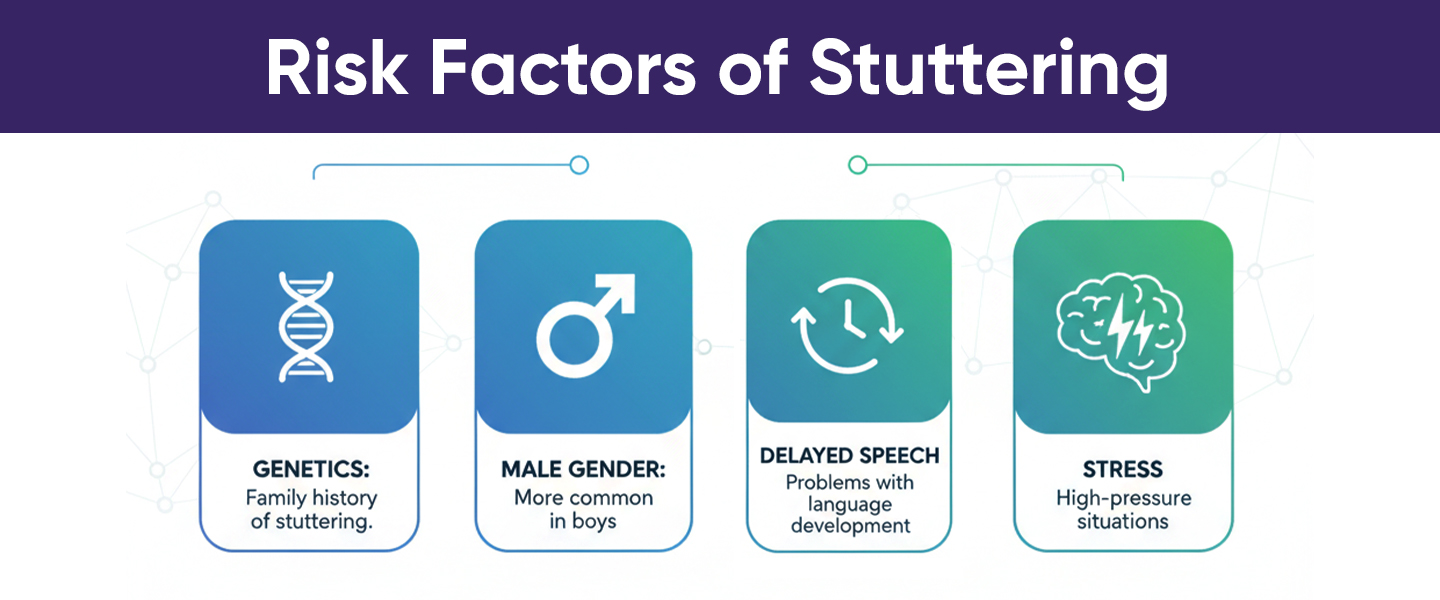
Risk Factors Of Stuttering
Several factors increase the likelihood of stuttering:
Gender: Males are more prone than females.
Delayed speech development: Children with speech or developmental delays may be at higher risk.
Family history: Genetics play a significant role; relatives with stuttering increase the risk.
Stress and environmental pressure: Family stress, high expectations, or trauma can worsen stuttering.
According to NIH among individuals who stutter, 56% had a family history of the condition, highlighting the genetic component of stuttering.
Symptoms Of Stuttering
Watch for these signs:
Repetition of sounds, words, or phrases.
Hesitation or pauses before speaking.
Adding extra sounds like “um” or “uh.”
Facial tension, eye blinking, or lip tremors.
Avoid speaking or showing frustration.
Rearranging words or making prolonged sounds.
Treatment For Stuttering
While treatments may not fully eliminate stuttering, they significantly improve communication and confidence.
1. Speech Therapy
Speech-language therapists help patients:
Speak slowly and clearly.
Identify triggers and patterns of stuttering.
Progress to a natural speech flow over time.
2. Electronic Devices
Devices like Delayed Auditory Feedback (DAF) can improve fluency by slowing speech. Consult a therapist before use.
3. Cognitive Behavioural Therapy (CBT)
CBT addresses anxiety, negative self-perceptions, and stress that worsen stuttering.
4. Parent-Child Interaction
Parental support is crucial, especially in children. Follow guidance from speech-language professionals to foster a positive environment.
A pilot study evaluating the "Eloquent" digital speech therapy app demonstrated a 52.7% reduction in overall stuttering severity among participants, with significant improvements in reading, speaking, and physical concomitants.
Awareness Without Action Is Worthless
Raising awareness about stuttering is only the first step real change happens when awareness turns into action. This ISAD 2025, take the initiative to educate yourself and others about stuttering, its types, symptoms, and management strategies. Share this knowledge with your friends, family, and communities to foster understanding and empathy.
Encourage participation in local ISAD events in India, including workshops, speech therapy sessions, and community meetups, where individuals who stutter can feel supported and empowered. Use social media campaigns to spread accurate information, bust common myths, and highlight inspiring stories of people who stutter. By actively promoting inclusivity and reducing stigma, you help improve not only awareness but also the quality of life for those affected, allowing them to communicate confidently and participate fully in society.
Dr. Jyothi Lal Das, Audiologist and Speech Therapist at Rainbow Children’s Hospitals, emphasizes early intervention: “Stuttering is becoming more common due to genetic, neurogenic, and psychological factors. It can be effectively treated if addressed early.”
How to Celebrate Stuttering Awareness Day 2025
Participate in ISAD 2025 events and workshops.
Organise speech awareness campaigns in schools and workplaces.
Share inspiring stories of individuals who stutter on social media.
Engage with ISA stuttering awareness campaigns 2025 in online.
Support local initiatives to create inclusive environments.
Facts About Stuttering Disorder
Stuttering affects 1% of adults worldwide and 5–8% of children.
Males are 3–4 times more likely to stutter than females.
Early intervention improves outcomes significantly.
Psychological support is as essential as speech therapy.
Common Myths About Stuttering
Myth | Fact |
People stutter because they are nervous | Anxiety can worsen stuttering but is not the cause |
Stuttering is a sign of low intelligence | People who stutter have normal or above-average intelligence |
Stuttering always disappears with age | Some cases persist into adulthood without therapy |
Talking fast helps stuttering | Slow, controlled speech is more effective |
How Stuttering Affects Daily Life
Stuttering can impact:
Education: Fear of speaking may affect learning participation.
Employment: Public speaking roles can be challenging.
Social life: Individuals may avoid conversations, leading to isolation.
Mental health: Anxiety, frustration, and low self-esteem are common.
International Stuttering Awareness Day 2025 Theme
Theme: “Voices That Matter”
This emphasises:
Listening to stutterers’ perspectives.
Encouraging expression without judgment.
Promoting inclusivity in schools, workplaces, and social platforms.
Events for Stuttering Awareness Day 2025
People around the world celebrate World Stuttering Day alongside ISAD, organising workshops, webinars, and social media campaigns to empower those who stutter.
Workshops & Seminars led by speech therapists.
Social media campaigns (#ISAD2025, #StutteringAwareness).
Local ISAD events in India: Community meetups, free speech therapy sessions, and awareness drives.
International Stuttering Awareness Day (ISAD), observed annually on October 22, raises awareness about stuttering through workshops, seminars, and online campaigns across India to educate the public and support individuals who stutter.
Tips to Support Someone Who Stutters
Be patient and avoid interrupting.
Maintain eye contact while they speak.
Encourage conversation, not correction.
Celebrate progress, no matter how small.
Avoid finishing their sentences.
Social Media Campaigns for Stuttering Awareness
Share facts, myths, and personal stories.
Use hashtags like #WorldStutteringDay #ISAStutteringAwareness #ISAD2025.
Promote online workshops and webinars.
FAQs
1: What is International Stuttering Awareness Day?
ISAD is observed on October 22 to raise awareness about stuttering and support individuals affected by this speech disorder.
2: How can I celebrate ISAD 2025?
Participate in workshops, share awareness posts, support campaigns, and attend local events in India.
3: Who is most at risk of stuttering?
Children under five, males, and those with a family history or developmental delays are at higher risk.
4: Can stuttering be treated?
Yes. Speech therapy, CBT, parent-child support, and electronic devices can improve fluency and confidence.
5: How does stuttering affect daily life?
It may impact education, work, social interactions, and mental health, causing anxiety or frustration.
Wrapping Up
International Stuttering Awareness Day 2025 reminds us that every voice matters. By understanding stuttering, breaking myths, and supporting those who stutter, we can create a more inclusive and empathetic society. Awareness alone is not enough, action is key.
This ISAD 2025, take concrete steps to make a difference: educate yourself and others about stuttering, support individuals by listening patiently and encouraging conversation, participate in local or online awareness campaigns in India, and advocate for inclusivity in schools, workplaces, and social platforms. Every effort counts, by spreading awareness, providing support, and challenging stigma, we empower people who stutter to communicate confidently and live without fear. Be a voice for change this International Stuttering Awareness Day 2025, because every voice deserves to be heard.
Read Also
References
https://www.stutteringhelp.org/content/international-stuttering-awareness-day
https://www.nidcd.nih.gov/news/2017/learn-about-stuttering-international-stuttering-awareness-day
Disclaimer: The content in this blog is for general informational purposes only and is not a substitute for professional medical advice, diagnosis, or treatment. Always consult your doctor or a registered dietitian before making any changes to your diet, especially if you have a medical condition or are taking prescribed medication. While the information is based on trusted sources, individual needs and results may vary. MrMed does not promote or endorse any specific food or treatment mentioned unless explicitly stated.












Comments