

Strengthen Your Bones With 5 Simple Yoga Tips All Is About Osteoporosis





Last updated on 30 Jun 2026
Most people don’t realise that by the time a fracture occurs, there has been a long, methodical build-up of damage to the bone. Osteoporosis is a condition that silently degrades the strength of a bone, causing little or no pain, and because it isn’t visible, there can be minimal signs until a fall occurs and the person sustains a broken bone instead of just bruising an area.
Fortunately for those suffering from osteoporosis, bones respond well to the right types of movement. Yoga is not just a gentle exercise activity; when done properly, yoga is one of the best ways to improve balance, decrease the risk of fractures, and, in many cases, provide the ability to safely build bone density back up through natural means.
This article will discuss the causes of osteoporosis, provide a definition of osteoporosis and provide five simple but targeted yoga exercises you can do to help improve your overall bone health, regardless of where you are starting from.
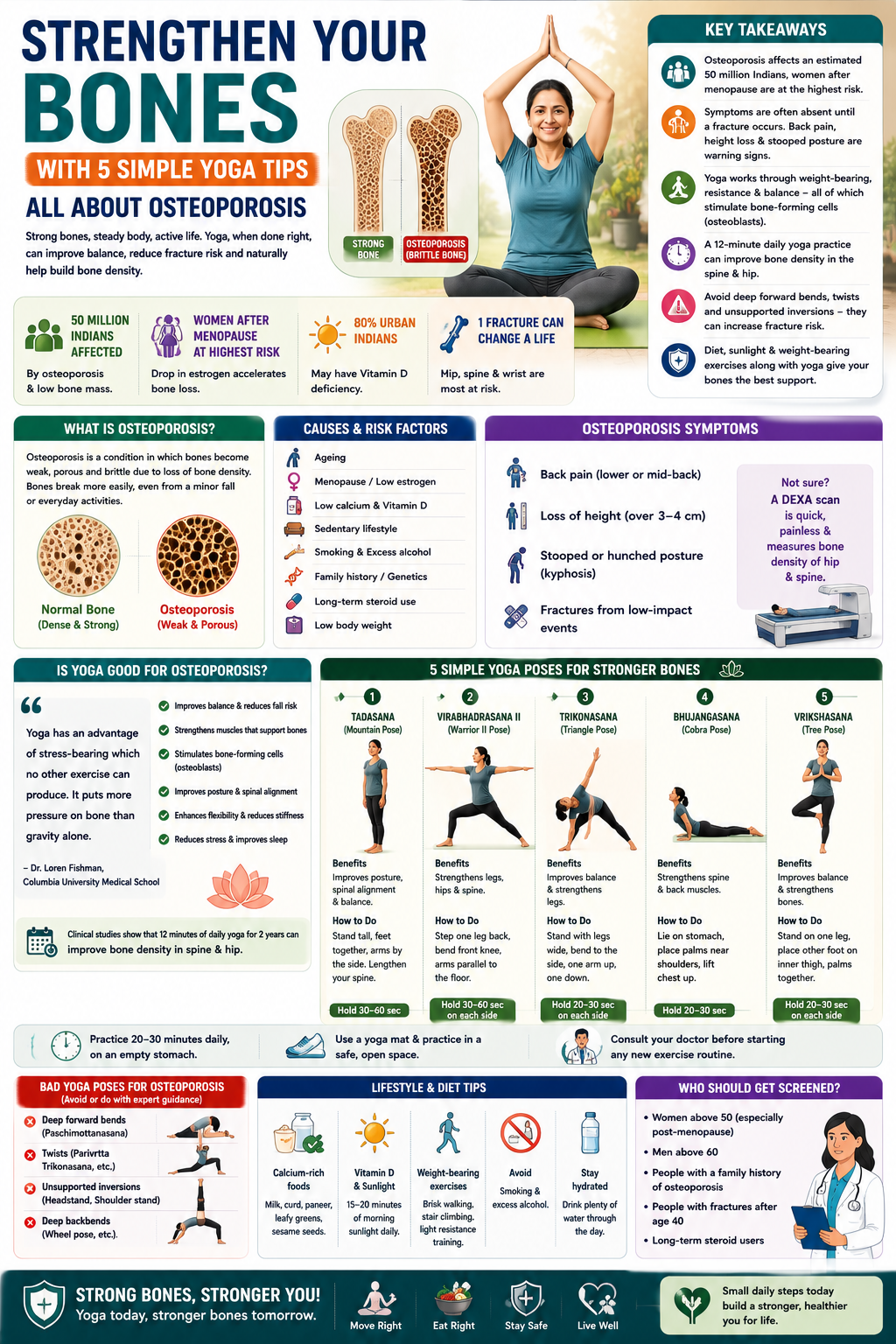
Key Takeaways
|
What Is Osteoporosis?
The skeleton is not a fixed body part. It is tissue, which is in a constant state of reabsorption and rebuilding. In healthy adult bodies, this process is balanced. In cases of osteoporosis, the reabsorption exceeds the regrowth so that after a period of time, bones actually become more porous, brittle and susceptible to fractures following minor trauma (activity) than are younger skeletons.
The term "osteoporosis" literally means "porous skeleton". When viewed microscopically, bones with an osteoporotic appearance show a 'honeycomb' pattern rather than a solid, dense appearance. The areas at increased risk of fracture are the wrist, hip, and spine; among these, hip fractures pose a serious risk in the elderly population.
Osteoporosis Causes and Risk Factors
Understanding what causes osteoporosis makes it much easier to address:
Risk Factor | Why It Matters |
Age | Bone density peaks at around 30, then declines steadily |
Menopause | Oestrogen protects bones; its loss accelerates bone loss sharply |
Low calcium and Vitamin D | The two most essential nutrients for bone formation |
Sedentary lifestyle | Bones need mechanical load to stay dense |
Smoking | Reduces bone-forming cell activity and oestrogen levels |
Excessive alcohol | Interferes with calcium absorption and bone metabolism |
Family history | Genetics account for a significant share of peak bone mass |
Long-term steroid use | Corticosteroids directly suppress bone formation |
Low Body Weight | Less mechanical load on bones; also associated with lower oestrogen |
The scale in India is striking: a PMC review of Indian osteoporosis epidemiology estimates that 50 million Indians had low bone mass as of 2013, with approximately 23 crore people above 50 already affected by osteoporosis, and that vitamin D deficiency affects up to 80 per cent of the urban population.
Osteoporosis Symptoms: What to Watch For
Osteoporosis is called a silent disease for a reason. Most people have no idea their bones are thinning until a fracture happens. But there are earlier signals worth paying attention to:
Back pain, particularly in the lower or mid-back, caused by small vertebral compression fractures
Gradual loss of height of more than 3 to 4 cm over several years is a red flag
A stooped or hunched posture, known as kyphosis, is caused by compression in the upper spine
Fractures from low-impact events, such as breaking a wrist in a minor fall, or a rib from a cough
If any of these describe you or someone close to you, a DEXA scan is the right first step. It is quick, painless, and gives a precise measurement of bone density at the hip and spine.
Is Yoga Good for Osteoporosis?

Dr Loren Fishman, Assistant Clinical Professor at Columbia University Medical School and Medical Director of Manhattan Physical Medicine and Rehabilitation the physician who has dedicated two decades to studying yoga's effect on bone, summarises what makes yoga special for osteoporosis: "Yoga has an advantage of stress-bearing which no other exercise can produce. It puts more pressure on bone than gravity alone."
A systematic review of randomised controlled trials of yoga in healthy individuals, published in Osteoporosis International, demonstrated that yoga safely improves balance, reduces fall risk, and positively affects markers of bone metabolism. Importantly, the review reported that yoga can safely be practised by people with osteoporosis when omitting a number of specific poses where the risk of injury is significantly higher.
A previous study conducted by Dr Loren Fishman of Columbia University, one of the most frequently cited studies in this area, evaluated the effects of a daily regimen of yoga practised for 12 minutes each day over a two-year period on the bone density of men and women whose average age was 68 and who frequently had a diagnosis of osteoporosis or osteopenia. This study effectively answers the question Can yoga increase bone density naturally? In appropriately selected individuals following safe parameters, the answer is most likely affirmative.
Yoga can be said to have three synergistic benefits when treating osteoporosis; these include: (1) weight-bearing (poses whereby an individual's body weight is placed on their bones due to the forces of gravity); (2) muscle-resistance (poses where the muscle pulls on the associated bone to promote restructuring); and (3) improved proprioception (the ability to be aware of one's body position relative to the surrounding environment, which reduces the fall risk, the greatest threat to persons with osteoporosis)
5 Simple Yoga Tips for Osteoporosis
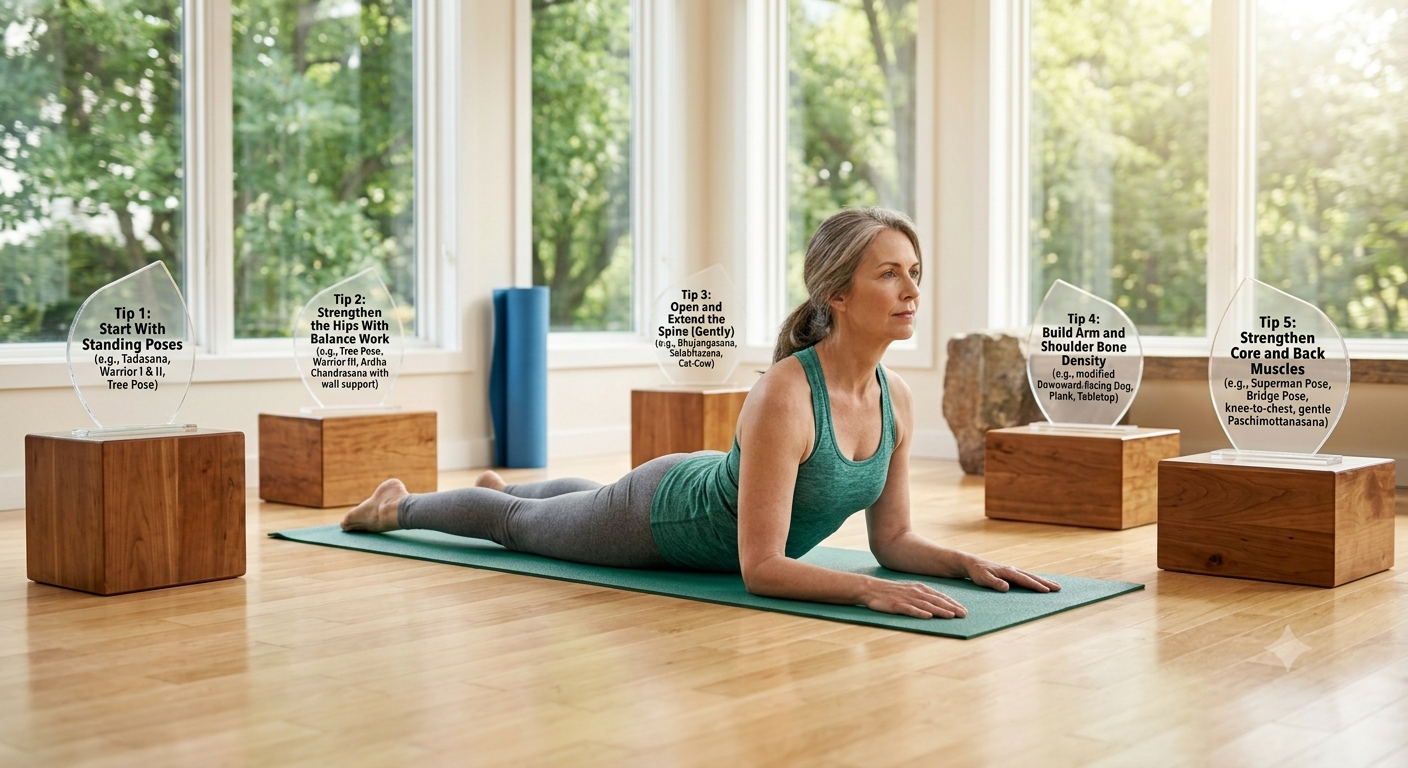
These are not five isolated poses. There are five practical principles, each with specific postures attached, that form the foundation of safe, effective hatha yoga for osteoporosis.
Tip 1: Start With Standing Poses (Weight-Bearing Foundations)
Standing poses are the cornerstone of yoga for bone health. Standing with your own weight causes osteoblasts (the cells that create new bone) to build more bone density through mechanical loading.
Best poses: Tadasana (Mountain Pose), Virabhadrasana I and II (Warrior I and II), Trikonasana (Triangle Pose), Vrksasana (Tree Pose).
Hold the position of each pose through 5 - 8 breaths, while actively trying to "push" your feet down into the ground and fully activate your legs. These 12 poses for preventing osteoporosis, as recommended by physical therapists treating patients with osteoporosis, are the most commonly used to achieve this purpose.
Tip 2: Strengthen the Hips With Balance Work
The most severe consequence associated with osteoporosis includes hip fractures. Most fractures occur after a fall, rather than from a spontaneous break. Practising and enhancing one's balance will directly reduce the risk of falling and sustaining an injury.
Best poses: Vrksasana (Tree Pose), Virabhadrasana III (Warrior III), Ardha Chandrasana (Half Moon Pose) using a wall for support.
Practice against a wall until proficient in balance. Performing balance practices frequently and consistently, even as little as 10 minutes per day for four to six weeks, can yield measurable results. They are the most important bone-strengthening exercises you can do without any equipment.
Tip 3: Open and Extend the Spine (Gently)
The thoracic spine (the area referred to as the "mid-back") is highly susceptible to osteoporotic fractures. Gentle extension of the spine strengthens the muscles along the spine's back and counteracts the humped forward posture typically caused by osteoporosis.
Best poses: Bhujangasana (Cobra Pose) in a low, gentle version, Salabhasana (Locust Pose), Marjaryasana-Bitilasana (Cat-Cow) as a warm-up.
Use slow, controlled movement when performing spine extensions; you should extend your spine upwards and backwards, not push into deep compression. This makes a perfect choice of osteoporosis exercises for beginners who want to regain mobility after a lengthy period of inactivity.
Tip 4: Build Arm and Shoulder Bone Density
Your natural inclination to extend your arms to break a fall will likely result in a fracture of your wrist or forearm due to the speed and force with which your hand will hit the ground. While doing so, you also create bone density in the arm where you will need support.
Best poses: Adho Mukha Svanasana (modified Downward-Facing Dog with knees down if needed), Plank Pose, and tabletop position holds.
These poses load the wrists and forearms in a controlled way and are among the best exercises to increase bone density in the upper body. If you have arthritis in either your wrist or forearm, the forearm plank (resting on elbows) relieves stress from both areas while still loading your shoulders.
Tip 5: Strengthen Core and Back Muscles Around the Spine
Fractures are prevented by more than just bone density alone. Developing strong muscles around the spinal column and core helps create a framework to absorb the energy generated by an impact before it reaches the vertebral column.
Best poses: Viparita Shalabhasana (Superman Pose), Setu Bandha Sarvangasana (Bridge Pose), gentle Apanasana (knee-to-chest), and seated Paschimottanasana only in very mild versions with a straight spine.
The key principle here is: lead with the spine long and neutral, not rounded.
Bad Yoga Poses for Osteoporosis: What to Avoid
This matters as much as the good list. Several common yoga poses carry a real fracture risk for people with osteoporosis and must be avoided or significantly modified.
Pose to Avoid | Why It Is Risky | Safer Alternative |
Paschimottanasana (full seated forward bend) | Flexes and compresses the spine under load, fracture risk | Sit tall, hinge forward only slightly with a straight back |
Ardha Matsyendrasana (seated spinal twist) | Deep rotation compresses vertebrae | Gentle seated rotation with hands on knees only |
Sarvangasana / Halasana (shoulder stand/plough) | Extreme cervical spine flexion | Supported Bridge Pose as a substitute |
Uttanasana (standing forward fold, unsupported) | The weight of the upper body compresses the lumbar spine | Gentle forward fold with hands on thighs or a chair |
Full Navasana (boat pose) | Aggressive hip flexor load stresses the lumbar spine | Half boat with feet on the floor |
Osteoporosis Diet: What Your Bones Need From Your Plate

Yoga for osteoporosis works best when your diet provides your bones with the raw materials they need to rebuild. The three non-negotiables are:
Calcium: 1,000 to 1,200 mg daily. Indian sources include dairy products, ragi (finger millet, one of the richest plant sources of calcium), sesame seeds, amaranth, and dried figs.
Vitamin D: 800 to 1,000 IU daily. Sunlight exposure for 15 to 20 minutes between 10 am and 2 pm, plus dietary sources such as eggs and fortified milk. Many Indians need supplementation.
Protein: Adequate protein intake supports bone matrix synthesis. Legumes, dairy, eggs, and soy are good options for a variety of dietary preferences.
The osteoporosis diet in India should be built around ragi-based foods, dairy (or calcium-fortified alternatives), and adequate protein at every meal.
What Exercises Should People with Osteoporosis Avoid?
Beyond the yoga-specific list, people with osteoporosis should be cautious about:
High-impact activities running on hard surfaces, jumping, and skipping if bone density is very low
Contact sports with collision risk
Any exercise that involves bending forward rapidly at the spine, such as certain gym machines, loaded crunches
Heavy overhead lifting without spinal support
The shift is not from exercise to rest it is from high-impact to weight-bearing exercises for osteoporosis that load the skeleton gently but consistently.
How Often Should You Do Yoga for Osteoporosis?
Research indicates that for optimal results, you should practice your exercises every day—even when they're only done for short amounts of time. In his groundbreaking study, Dr. Fishman had patients perform their exercises for just 12 minutes each day. Nevertheless, the majority of physiotherapists agree that 20 - 30 minutes of exercise should be performed 5 - 6 days per week, with at least one day between sessions for rest.
The most important element of this process is consistency over intensity. Practising for 15 minutes per day over a 6-month period will help your bones much more than one hour of exercise once per week.
Yoga can help to prevent osteoporosis; however, this will not happen overnight. It takes time and dedication to achieve positive results from yoga, such as increased bone density, improved balance, better posture, greater strength, and increased confidence while performing everyday movements.
FAQs
Q1. Is yoga good for osteoporosis?
Yes, when the right poses are chosen. Standing, balancing, and gentle spinal extension poses build bone density and reduce fall risk. Avoid deep forward folds and aggressive twists.
Q2. Which yoga poses are best for osteoporosis?
Warrior I and II, Tree Pose, Triangle Pose, Cobra Pose, Bridge Pose, and Downward-Facing Dog (modified) are the most consistently recommended. These load bones safely without spinal compression.
Q3. Can yoga increase bone density naturally?
Evidence suggests yes. A 12-minute daily yoga programme practised over two years improved bone density in the spine and hips in adults with osteoporosis in a clinical study by Dr Loren Fishman.
Q4. What exercises should people with osteoporosis avoid?
Avoid high-impact exercise, deep forward bends, aggressive spinal twists, and unsupported inversions. These compress or rotate the spine in ways that increase the risk of vertebral fracture.
Q5. How often should you do yoga for osteoporosis?
Daily practice of 12 to 30 minutes is the most effective approach. Consistency matters more than duration; five to six days per week sustained over months produces the best results.
Final Thoughts
For long-term health, yoga is most effective when we use it in ways that stimulate bone growth through movement. Your bones will respond positively to purposeful and repetitive movement over time. The five principles of yoga for osteoporosis listed in this blog will provide you with starting places for creating a home yoga practice; remember to progress slowly and to reference the Bad Yoga Principles for Osteoporosis.
Reference: Yoga for Osteoporosis, Bad Yoga Positions for Osteoporosis; six principles for practising yoga safely, or how to practice yoga safely.
Read Also
References
Bajaj P, Nagendra L, Bajaj A, Samuel M, Chandran M. Effect of yoga on balance, falls, and bone metabolism: a systematic review of randomised controlled trials in healthy individuals. Osteoporos Int [Internet]. 2025 Feb [cited 2026 Jun 24];36(2):193-224. Available from: https://pubmed.ncbi.nlm.nih.gov/39607489/
Husain S. A study on the effect of yoga on osteoporosis in postmenopausal women. J Acad Med Sci [Internet]. 2023 [cited 2026 Jun 24];5(6):77-81. Available from: https://academicmed.org/Uploads/Volume5Issue6/17.%20%5B1821.%20JAMP_Shaik%20Husasin%5D%2077-81.pdf
Cramer H, Quinker D, Schumann D, Wardle J, Dobos G, Lauche R. Effectiveness of Pilates and yoga to improve bone density in adult women: a systematic review and meta-analysis. PLoS One [Internet]. 2021 May 12 [cited 2026 Jun 24];16(5):e0251391. Available from: https://pmc.ncbi.nlm.nih.gov/articles/PMC8104420/
Disclaimer: This article is for general informational purposes only and is not a substitute for professional medical advice. If you have been diagnosed with osteoporosis or osteopenia, always consult a qualified physician or physiotherapist before beginning any new exercise programme.


















Comments