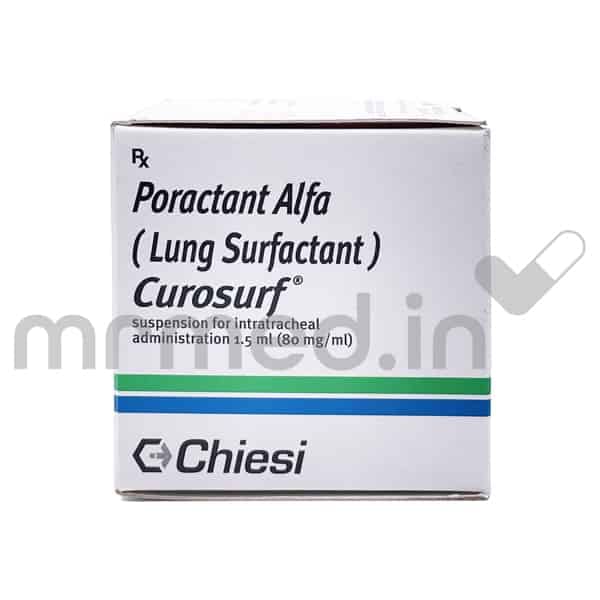
Quick Summary
Curosurf 240mg Injection


Last updated on 26 Sep 2026 | 08:44 AM (IST)
₹19230
MRP: ₹20253.24
(You Save ₹1023.24)
1 VIAL(s) OF 3ML


Curosurf 240mg Injection

Salt Composition
PORACTANT ALFAMarketer
PAVIOUR PHARMACEUTICALS PVT LTD
Prepaid Only. Non-Returnable.

5% OFF
₹19230
MRP: ₹20,253.24
Inclusive of all taxes
5% Off


Salt Composition
PORACTANT ALFAMarketer
PAVIOUR PHARMACEUTICALS PVT LTD
Prepaid Only. Non-Returnable.

Dispatch: Today
Care delivered without the wait. Your order is prioritized for rapid dispatch to ensure it reaches your doorstep on time.
Better Service Satisfied Customers
Introduction
Curosurf 240mg Injection contains poractant alfa, a natural pulmonary surfactant prepared from porcine lung. It is used in newborn babies, particularly premature infants, to treat Respiratory Distress Syndrome (RDS), including early rescue treatment. It can also be used prophylactically in premature infants who require intubation for stabilisation and are at risk of RDS or have evidence of surfactant deficiency.
Each 3 mL vial contains 240mg of poractant alfa at a concentration of 80mg/mL. It is supplied as a sterile suspension for endotracheopulmonary instillation and must be administered by healthcare professionals experienced in the care and stabilisation of premature infants.
Uses of Curosurf 240mg Injection
Curosurf 240mg Injection is used for:
Treatment, including early rescue treatment, of Respiratory Distress Syndrome (RDS) or hyaline membrane disease in newborn babies
Prevention of RDS in premature infants requiring intubation for stabilisation who are at risk of RDS or have evidence of surfactant deficiency
How Curosurf 240mg Injection works
Pulmonary surfactant forms a layer over the inner surface of the alveoli and reduces surface tension. This helps keep the alveoli open during breathing and supports effective gas exchange.
Premature infants may have insufficient natural surfactant, causing the alveoli to become unstable and collapse, which contributes to RDS. Poractant alfa replaces deficient surfactant and helps restore surface activity in the lungs. This can improve lung expansion, pulmonary compliance and oxygenation.
Interactions of Curosurf 240mg Injection with other medicines
No specific medicine interactions are known for Curosurf.
However, the infant may be receiving several medicines and forms of respiratory support as part of neonatal intensive care. The treating team should be informed about all medicines being given so that treatment can be appropriately coordinated.
Storage Conditions
Store in a refrigerator at 2°C to 8°C.
Keep the vial in the original package to protect it from light.
Do not freeze.
The vial should be warmed to room temperature before administration.
Once warmed, an unopened unused vial can be returned to refrigerated storage within 24 hours if required.
Do not warm the vial and return it to refrigeration more than once.
Curosurf is supplied in single-dose vials. Discard any unused suspension after opening.
How to Use Curosurf 240mg Injection
Curosurf 240mg Injection is administered directly into the infant's lungs through the endotracheopulmonary route. It should only be given by healthcare professionals trained and experienced in the care, resuscitation and stabilisation of premature infants.
For rescue treatment, the recommended starting dose is 100 to 200mg/kg, equivalent to 1.25 to 2.5mL/kg, given as soon as possible after RDS is diagnosed. Additional doses of 100mg/kg may be given at approximately 12-hour intervals when RDS continues to cause persistent or worsening respiratory problems. The maximum total dose is 300 to 400mg/kg.
For prophylaxis, a dose of 100 to 200mg/kg should be given as soon as possible after birth, preferably within 15 minutes. Further doses may be considered in infants with persistent RDS who remain ventilator-dependent.
The medicine may be administered through an endotracheal tube, including while the infant remains connected to a ventilator. It may also be administered using techniques such as INSURE or Less Invasive Surfactant Administration (LISA), depending on the clinical setting and expertise available.
After administration, lung compliance and oxygenation may improve rapidly. Ventilator settings and inspired oxygen concentration may therefore need prompt adjustment to avoid excessive oxygen exposure. Continuous monitoring of oxygen saturation and other vital parameters is required.
Safety Advice

Pregnancy
Curosurf is intended for administration to newborn babies. Pregnancy-related use does not apply to the infant receiving this medicine.

Breast Feeding
Curosurf is administered directly to the newborn infant's lungs. Breastfeeding-related precautions do not apply to the infant receiving this medicine.
Lungs
Curosurf is specifically used to manage surfactant deficiency and RDS in premature infants. The infant must be closely monitored during and after administration because oxygenation and lung compliance can change rapidly. Ventilator settings may need prompt adjustment.
Liver
The safety and efficacy of Curosurf in infants with hepatic impairment have not been evaluated. The neonatal team will assess the infant's overall condition before administration.

Alcohol
Alcohol consumption is not relevant to administration of this medicine in newborn babies.

Driving
Curosurf is administered to newborn babies in a neonatal care setting. Driving-related precautions do not apply.
Side Effects
Curosurf may cause temporary changes during or shortly after administration. These can include:
Bradycardia
Hypotension
Reduced oxygen saturation
Apnoea
Endotracheal tube obstruction
Pneumothorax
Pulmonary haemorrhage
Intracranial haemorrhage
Hyperoxia
Cyanosis
Bronchopulmonary dysplasia
Sepsis
If bradycardia, hypotension or reduced oxygen saturation occurs during administration, treatment may need to be temporarily stopped and appropriate supportive measures provided. Rapid changes in lung compliance and oxygenation can also require adjustment of ventilator settings.
Expert Tips
Curosurf should only be administered by trained neonatal healthcare professionals.
The infant's general condition should be stabilised before administration, including correction of significant acidosis, hypotension, anaemia, hypoglycaemia and hypothermia where appropriate.
Monitor heart rate and oxygen saturation continuously during administration.
Lung compliance and oxygenation can improve rapidly, so ventilator and oxygen settings may need prompt adjustment.
If bradycardia, hypotension or oxygen desaturation occurs during administration, the procedure may need to be stopped until the infant is stabilised.
Do not shake the vial. Gently turn it upside down several times after warming to room temperature to obtain a uniform suspension.
Curosurf is for single use. Discard any unused suspension after administration.
If the response is inadequate or RDS rapidly returns, the neonatal team should assess for other complications of prematurity or other lung conditions before giving another dose.
FAQs
Q1.
What is Curosurf 240mg Injection used for?
Curosurf 240mg Injection is used to treat Respiratory Distress Syndrome (RDS) in newborn babies, including early rescue treatment. It can also be used to prevent RDS in selected premature infants who require intubation for stabilisation and are at risk of surfactant deficiency.
Q2.
How is Curosurf 240mg Injection given?
It is administered directly into the infant's lungs through the endotracheopulmonary route. It may be given through an endotracheal tube or using an appropriate less-invasive surfactant administration technique in suitable infants. Administration requires trained neonatal healthcare professionals and continuous monitoring.
Q3.
What is the dose of Curosurf 240mg Injection?
The dose is calculated according to the infant's birth weight. For rescue treatment, the recommended starting dose is 100 to 200mg/kg, equivalent to 1.25 to 2.5mL/kg. Additional doses of 100mg/kg may be given at approximately 12-hour intervals when clinically indicated.
Q4.
Can Curosurf 240mg Injection be given more than once?
Yes. Additional doses may be given when RDS continues to cause persistent or worsening respiratory problems. The dose and timing are determined by the neonatal team, with the maximum total dose depending on the indication and dosing regimen.
Q5.
Does Curosurf 240mg Injection improve breathing immediately?
Curosurf can produce rapid improvements in lung compliance and oxygenation. Because these changes can occur quickly, ventilator settings and inspired oxygen may need to be adjusted promptly after administration.
Q6.
How should Curosurf 240mg Injection be stored?
Store Curosurf in a refrigerator at 2°C to 8°C and protect it from light by keeping it in the original package. Do not freeze or shake the vial. The vial should be warmed to room temperature before use.
Q7.
Can Curosurf 240mg Injection be given at home?
No. Curosurf must be administered in a neonatal care setting by healthcare professionals trained in the care and stabilisation of premature infants. The infant requires continuous monitoring during administration.
Fact Box
Molecule name | Poractant alfa |
Therapeutic class | Pulmonary surfactant |
Pharmacological class | Lung surfactant |
Indications | Treatment and early rescue of Respiratory Distress Syndrome (RDS), and prophylaxis in selected premature infants at risk of RDS |
References
Disclaimer
MrMed’s primary intention is to ensure that its consumers get information that is reviewed by experts, accurate and trustworthy. The information and contents of this website are for informational purposes only. They are not intended to be a substitute for professional medical advice, diagnosis, or treatment. Please seek the advice of your doctor and discuss all your queries related to any disease or medicine. Do not disregard professional medical advice or delay in seeking it because of something you have read on MrMed. Our mission is to support, not replace, the doctor-patient relationship.
Did you find this information helpful?
Author Details

Written By
Dr. Archana Gupta
BDS

Reviewed By
Dr. Tejashwin Adiga
MBBS
Last updated : 26 Sep 2026 | 08:44 AM (IST)

Want to know more?
Read Our Editorial Policy