

Will AI Replace Doctors? Experts Explain How Artificial Intelligence Is Transforming Healthcare





Last updated on 20 Mar 2026
Artificial Intelligence is assisting physicians with analysing healthcare data, early detection of medical issues, and treatment planning. Experts suggest that doctors will use AI for assistance and that AI will help physicians complete tasks faster and more efficiently; however, the continuing importance of human knowledge and experience guarantees that AI will complement physician practice rather than replace it.
Key Takeaways
|
AI is already transforming many sectors worldwide, and healthcare is one of them. AI-powered healthcare solutions are playing a crucial role in modern medicine, from analysing medical images to assisting doctors with earlier disease detection.
On the flip side, there's a concern that every innovative technology in medicine raises an important question: Is Artificial Intelligence going to replace doctors?
Most healthcare professionals do not see artificial intelligence replacing doctors but rather assisting in delivering better, faster, and more accurate care. Understanding how artificial intelligence is involved in healthcare can help both patients and medical professionals understand the tech's role in this industry.
What Is the Role of AI in Healthcare?
The principal function of contemporary health care is to support physicians, scientific investigators, and health care systems by enabling swift, precise analysis of extensive medical data.
AI employs sophisticated data analysis techniques and machine learning algorithms to uncover patterns that human beings have difficulty detecting. This technology is used worldwide in hospitals, diagnostic facilities, and research centres.
AI has a huge array of potential uses within the realm of medicine, including:
Medical Imaging
Diagnosis of Diseases Early
Medication Discovery and Development
Healthcare Predictive Analytics
Development of an Individualised Treatment Plan
AI enables collaboration between health care providers and patients, allowing providers to focus more on delivering quality health care and making prudent clinical decisions.
How Is Artificial Intelligence Transforming Healthcare?
Artificial intelligence in healthcare: transforming the practice of medicine is evident in the way hospitals and health systems now use advanced technologies to improve diagnosis, patient safety, and treatment outcomes.
Health organisations today use AI to improve patient safety, enhance efficiency in health service delivery, and utilise data to incrementally improve patient outcomes, leveraging evidence-based practices.
1. Faster and more Accurate Diagnosis
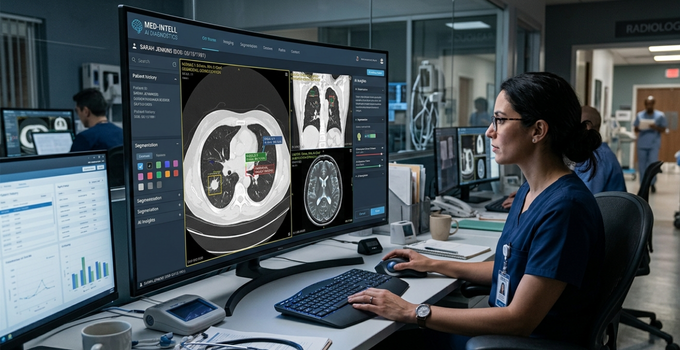
AI can assist clinicians in accomplishing this goal by performing analyses of medical imaging (e.g., plain radiography, CT, and MRI) to detect abnormalities significantly faster than current methods and with greater accuracy than traditional methods.
2. Predictive Healthcare
AI is helping physicians by using a patient's medical history and/or clinical data from the patient profile to identify potential health risks.
3. Drug Discovery and Development
Pharmaceutical companies are utilising an array of AI tools to analyse data and develop and bring new drugs to the marketplace more quickly than previously possible.
AI is aiding clinicians in developing individualised treatment plans by incorporating patients' genetic history, lifestyle, and clinical data.
5. Administrative Efficiency
AI solutions can help alleviate the burden on hospital administrators by automating scheduling and appointment management, managing patient records, and generating electronic documentation.
The above examples reflect how AI is changing the face of Healthcare by improving overall efficiency and the quality of care through data-driven decision-making.
How Does Artificial Intelligence Help Doctors in Clinical Practice?
Several individuals are concerned about whether machines will ultimately replace doctors in a health care setting; however, the reality is that AI should be considered an adjunct rather than a substitute for practising physicians. Examples of how artificially intelligent technologies offer support to physicians include:
Producing rapid analyses of large amounts of complex clinical data; assisting radiologists in radiology and imaging interpretation; enhancing the physician's evidence-based decision-making process; improving the ability of wearable technology to monitor patients' health status; improving the accuracy of diagnoses, etc.
Physicians remain the most important component of the decision-making process through their ability to interpret test results, discern symptoms, and deliver final treatment plans. There is no way that machines will be able to replace human judgment, compassion, and actual clinical experience.
What Are the Applications of AI in Healthcare Today?
The applications of AI in healthcare continue to expand across different medical specialities.
Medical Area | AI Application |
Radiology | Image analysis and tumour detection |
Predicting heart disease risk | |
Cancer detection and treatment planning | |
Neurology | Detecting neurological disorders |
Primary care | AI-powered virtual assistants and symptom checkers |
These AI-powered healthcare solutions help healthcare providers improve accuracy, reduce workload, and enhance patient care.
What Are the Benefits of AI in Medical Diagnosis?
The role of AI in diagnostics is among its most important applications. Benefits of AI in medical diagnosis include faster diagnosis, greater diagnostic consistency, and improved data analysis capabilities.
10 benefits of artificial intelligence in healthcare
1. Quicker identification of disease
2. Greater accuracy when making diagnoses
3. Ability to detect serious medical conditions sooner
4. Improved ability to monitor patients
5. Ability to develop more effective, personalised treatment strategies
6. Reduced costs associated with delivering medical care
7. More efficient hospitals
8. Greater capacity to conduct medical research
9. Support for providing medical care remotely
10. Decreased number of administrative responsibilities for physicians.
These benefits illustrate why the transformation of medicine through artificial intelligence is an important topic in current healthcare discussions.
AI vs Doctors in Healthcare: Can Technology Replace Human Expertise?
People are often confused about the difference between an artificial intelligence (AI) system and a doctor in healthcare. An AI system has many advantages over a doctor; however, it will collect, store, and retrieve large amounts of data faster than a human can. An AI system also does not possess emotions, nor does it make ethical or clinical decisions.
A doctor does far more than just analyse data; they also communicate with their patients, understand their emotional state, and make difficult decisions based on clinical judgment.
Many experts believe that in the future, AI and doctors will work together to provide improved patient care rather than compete with one another.
An AI system will generate insights and reduce repetitive administrative tasks, allowing doctors to focus more on the quality of care and treatment for their patients.
What Is the Future of AI in Medicine?
Future advancements in medicine from technology will include even more advanced artificial intelligence (AI) products and tools.
Possible examples are:
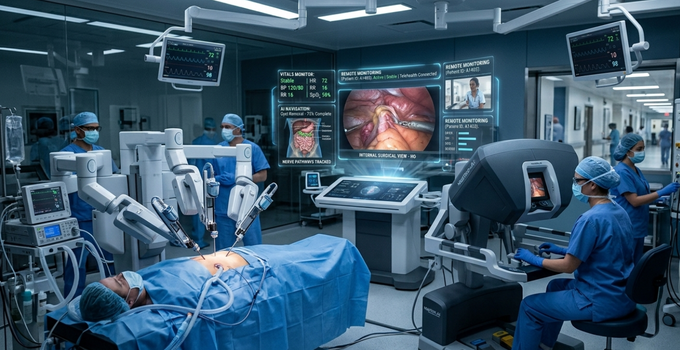
1. Robotic surgery systems operated by AI
2. Better predictive health models to support clinicians’ decision-making
3. AI-Driven personalised treatment programs based on predictive analysis of data
4. The use of secure remote patient monitoring systems improves medical care and saves time.
5. Clinical decision-support tools have a positive impact on healthcare teams, leading to fewer misdiagnoses and shorter treatment delays.
As technological advances continue, artificial intelligence’s presence in healthcare is likely to increase across many disciplines.
What Do Experts Say About AI in Healthcare?
Healthcare professionals and technology experts believe AI is likely to be a more effective assistant to clinicians than a substitute for physicians.
AI can enable more rapid access to healthcare, reduce human error in healthcare, and help doctors gather the appropriate clinical data to make better treatment decisions.
Physicians will still be a necessary component of healthcare, as healthcare is inherently personal, requires ethical treatment of patients, and relies on significant physician-patient interaction.
In general, AI is viewed by the majority of healthcare professionals and industry experts as capable of improving the quality of care delivered worldwide by working collaboratively with physicians.
According to Sudhir Srivastava, artificial intelligence will collaborate with doctors to improve healthcare delivery rather than replace medical professionals.

Frequently Asked Questions
1. Is it true that AI will replace doctors?
No, at least many experts do not think AI will replace doctors. AI can corroborate doctors by analysing medical observations and improving diagnostic precision, but in clinical care, it is still vital to involve human expertise and patient interaction.
2. How is AI being used in healthcare?
AI is also used for medical image diagnosis, disease prediction, personalised treatment planning, hospital management, drug research and remote patient monitoring.
3. How is artificial intelligence transforming healthcare?
These are just a few of the current applications of AI in healthcare that are already having a meaningful impact.
4. Will AI replace doctors in the future?
Doctors are only expected to be assisted by AI, not replaced by it. The future of healthcare combines the strengths of both AI systems and medical professionals.
5. How does artificial intelligence help doctors?
Artificial intelligence helps doctors analyse medical data, detect diseases earlier, and support faster and more accurate diagnosis and treatment decisions.
What's Worth Remembering?
AI Technology is a growing asset in today’s health care. AI technology is primarily used to assist physicians with diagnostics and treatment and to enhance medical professionals' research capabilities.
The possibility of AI completely replacing physicians is unrealised; human empathy and ethics, along with the clinical knowledge of experienced physicians, are beyond the reach of machines.
The future will likely involve significant collaboration between physicians and AI, with the technology assisting physicians in making better decisions for patients.
.png "MrMed")
Read Also
References
Briganti G, Le Moine O. Artificial intelligence in medicine: today and tomorrow. Front Med (Lausanne). 2020;7:27. Available from: https://www.frontiersin.org/articles/10.3389/fmed.2020.00027/full
Topol EJ. High performance medicine: the convergence of human and artificial intelligence. Nat Med. 2019;25(1):44–56. Available from: https://www.nature.com/articles/s41591-018-0300-7
Davenport T, Kalakota R. The potential for artificial intelligence in healthcare. Future Healthc J. 2019;6(2):94–98. Available from: https://www.ncbi.nlm.nih.gov/pmc/articles/PMC6616181/
Firstpost. AI will collaborate, assist, not replace doctors: Dr Sudhir Srivastava on AI in healthcare. 2024. Available from: https://www.firstpost.com/tech/ai-will-collaborate-assist-not-replace-doctors-dr-sudhir-srivastava-on-ai-in-healthcare-13988264.html
Disclaimer: The content in this blog is for general informational purposes only and is not a substitute for professional medical advice, diagnosis, or treatment. Always consult your doctor or a registered dietitian before making any changes to your diet, especially if you have a medical condition or are taking prescribed medication. While the information is based on trusted sources, individual needs and results may vary. MrMed does not promote or endorse any specific food or treatment mentioned unless explicitly stated.











Comments