Quick Summary
Invega Sustenna 150mg Injection

Last updated on 23 Oct 2026 | 10:27 AM (IST)
₹4975
MRP: ₹5793.75
(You Save ₹818.75)
1 PREFILLED SYRINGE(s)


Invega Sustenna 150mg Injection
Salt Composition
PALIPERIDONEMarketer
JOHNSON & JOHNSON PVT LTD
14% OFF
₹4975
MRP: ₹5,793.75
Inclusive of all taxes
14% Off



Dispatch: Today
Care delivered without the wait. Your order is prioritized for rapid dispatch to ensure it reaches your doorstep on time.
Better Service Satisfied Customers
Introduction
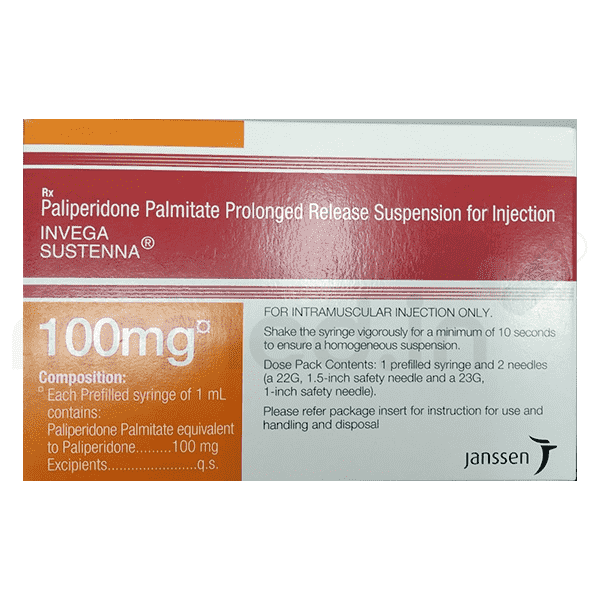
Invega Sustenna 150mg Injection contains Paliperidone palmitate, a long-acting antipsychotic medicine. After injection into a muscle, it dissolves slowly and releases Paliperidone, the active medicine, over several weeks. This allows treatment to be given once a month after the starting doses. Each single-dose prefilled syringe contains paliperidone palmitate equivalent to 150 mg of Paliperidone.
Uses of Invega Sustenna 150mg Injection
Invega Sustenna 150mg Injection may be prescribed to:
Treat schizophrenia: It helps reduce symptoms such as hallucinations, delusions, disorganised thinking and withdrawal, and helps keep symptoms under control over time.
Treat schizoaffective disorder: It may be used on its own, or together with mood stabilisers or antidepressants, in adults who have both psychotic and mood symptoms.
Support regular treatment: Because it is given once a month rather than taken daily, it may suit people who find it hard to take tablets every day.
Your doctor will decide the starting doses and the monthly dose that suit you. People who have never taken Paliperidone or Risperidone are usually first given a tablet form to check that they tolerate it.
How Invega Sustenna 150mg Injection Works
Invega Sustenna 150mg Injection contains Paliperidone palmitate, which the body converts into Paliperidone. Paliperidone is the main active form of Risperidone.
The exact way it works is not fully known. It is thought to act by blocking dopamine and serotonin receptors in the brain, which helps reduce the symptoms of psychosis. The injection is released slowly from the muscle, so the medicine stays in the body for weeks, and traces can remain for several months after the last injection.
Interaction of Invega Sustenna 150mg Injection with Other Medicines
Tell your doctor about all prescription medicines, over-the-counter medicines, supplements and herbal products you are taking.
Medicines that act on the brain: Sedatives, sleeping pills, opioid painkillers, anti-anxiety medicines and other antipsychotics can add to drowsiness and dizziness.
Alcohol: Alcohol can increase drowsiness and affect judgement and alertness.
Blood pressure lowering medicines: The effect on blood pressure can add up and cause dizziness or fainting on standing.
Carbamazepine, rifampicin and St. John’s wort: These can lower Paliperidone levels and make the injection less effective. They should be avoided where possible.
Medicines for Parkinson’s disease: Levodopa and similar medicines may work less well when used with Paliperidone.
Medicines that affect heart rhythm: Medicines such as amiodarone, sotalol, quinidine, chlorpromazine, thioridazine and some antibiotics can increase the risk of a heart rhythm problem and should be avoided.
Risperidone or Paliperidone tablets: These contain the same active medicine, so using them together for a long period needs caution.
Do not start or stop any medicine without medical advice.
Storage Conditions
Invega Sustenna 150mg Injection is stored by the pharmacy or clinic. Store it at room temperature, not above 25°C.
Keep the prefilled syringe in its original carton until it is used.
Keep it out of the reach of children.
Do not use the injection after the expiry date printed on the pack.
Do not use it if the pack or syringe looks damaged.
Follow the storage instructions printed on the product packaging.
How to Use Invega Sustenna 150mg Injection
Invega Sustenna 150mg Injection must be given only by a healthcare professional. Do not inject it yourself.
It is given as a slow, deep injection into the muscle of the upper arm (deltoid) or the buttock (gluteal). It must not be given into a vein or by any other route. The full dose is given as a single injection, and the syringe is shaken well before use.
Treatment usually starts with two injections given a week apart in the upper arm. After that, the injection is given once a month in the arm or buttock.
Your doctor will decide the dose and may adjust it over time. The full effect of a dose change may take several months to appear.
Keep your monthly appointments. If you miss an appointment, contact your clinic as soon as possible. There is a set window for injections, and the plan for catching up depends on how long it has been.
People with mild kidney problems may need a lower dose. It is not recommended in moderate or severe kidney impairment.
Keep taking any other medicines exactly as your doctor has advised.
Safety Advice

Pregnancy
Paliperidone can stay in the body for months after an injection. Untreated psychosis also carries risks for mother and baby. Tell your doctor if you are pregnant or planning a pregnancy so the benefits and risks can be weighed.

Breast Feeding
Paliperidone has been found in breast milk in limited reports. Babies exposed to the related medicine Risperidone through breast milk have shown sleepiness, poor feeding, jitteriness and abnormal movements. As this injection stays in the body for months, discuss feeding options with your doctor before starting.
Lungs
Antipsychotic medicines can affect swallowing and increase the risk of food or liquid entering the lungs, which can cause pneumonia. Tell your doctor if you have difficulty swallowing or a lung condition, and report any cough, fever or breathing difficulty.
Liver
Invega Sustenna has not been studied in severe liver impairment. No dose change is needed in mild or moderate liver impairment. Raised liver enzymes have been reported, so tell your doctor if you have liver disease.

Alcohol
Alcohol can increase drowsiness, dizziness and poor judgment when combined with this medicine. It is best avoided. Discuss it with your doctor if you are unsure.

Driving
Invega Sustenna can cause drowsiness, dizziness and blurred vision, and can affect thinking and reaction time. Do not drive or use machinery until you are sure how the injection affects you.
Side Effects
Common side effects of Invega Sustenna 150mg Injection may include:
Pain, swelling, redness or a lump at the injection site
Drowsiness or sedation
Dizziness
Restlessness and an urge to keep moving (akathisia)
Stiffness, tremor or slowed movements
Headache
Weight gain
Agitation or anxiety
Nausea, vomiting or diarrhoea
Cough and cold-like symptoms
Back pain
Raised prolactin levels, which can cause missed periods, breast tenderness or milk production, or sexual difficulties
Serious side effects
Seek medical attention if you develop:
High fever, severe muscle stiffness, confusion, sweating and a fast heartbeat, which may be signs of neuroleptic malignant syndrome.
Uncontrollable movements of the face, tongue or limbs, which may be tardive dyskinesia.
Fainting, severe dizziness on standing, or a fast or irregular heartbeat.
Increased thirst, passing urine more often or unusual hunger, which may be signs of high blood sugar.
Fever, sore throat or repeated infections, which may be signs of low white blood cells.
A seizure.
Difficulty swallowing or breathing.
A painful erection lasting more than a few hours.
Swelling of the face, lips, tongue or throat, or a severe allergic reaction.
Sudden weakness, confusion or speech difficulty, especially in older people with dementia.
Overheating and not being able to cool down.
Expert Tips
Attend every scheduled injection, as the monthly schedule is important for steady treatment.
Do not stop the injections or change the schedule without speaking to your doctor.
Tell your doctor about all your medicines, especially sedatives, blood pressure medicines and Parkinson’s medicines.
Avoid alcohol and recreational drugs.
Stand up slowly to reduce dizziness.
Keep your weight, blood sugar and cholesterol checked as your doctor advises.
Tell your doctor if you have diabetes, heart disease, epilepsy, kidney problems or a history of low white blood cell counts.
Drink enough fluids and avoid overheating in hot weather.
Tell your doctor promptly about any new movements, stiffness or restlessness.
Use effective contraception if you can become pregnant, and tell your doctor if you plan a pregnancy.
FAQs
Q1.
What is Invega Sustenna 150mg Injection used for?
Invega Sustenna 150mg Injection contains Paliperidone palmitate and is used in adults to treat schizophrenia and schizoaffective disorder.
Q2.
Who gives Invega Sustenna 150mg Injection?
It must be given by a healthcare professional as an injection into the muscle of the upper arm or buttock. It should not be self-injected.
Q3.
How often is Invega Sustenna 150mg Injection given?
Treatment usually begins with two injections a week apart, followed by one injection every month. Your doctor will decide the exact schedule and dose.
Q4.
How long does one injection last?
Each injection releases Paliperidone over about a month, and some of the medicine stays in the body for weeks to months after the last injection. This is why side effects can last after stopping.
Q5.
What should I do if I miss my appointment?
Contact your clinic as soon as possible. There is a time window around each injection date, and the plan for the next injection depends on how long it has been since the last one.
Q6.
Do I need to take tablets before starting Invega Sustenna 150mg Injection?
If you have never taken Paliperidone or Risperidone, your doctor may first give you a tablet to check that you tolerate the medicine.
Q7.
Can Invega Sustenna 150mg Injection cause weight gain?
Yes. Weight gain, higher blood sugar and changes in cholesterol can occur. Your doctor may check your weight, blood sugar and cholesterol during treatment.
Q8.
Do I need a prescription for Invega Sustenna 150mg Injection?
Yes. Invega Sustenna 150mg Injection is a prescription medicine and should be used under medical supervision.
Fact Box
Molecule name | Paliperidone (as palmitate) |
Therapeutic class | Antipsychotic |
Pharmacological class | Atypical antipsychotic (benzisoxazole derivative) |
Indications | Schizophrenia and schizoaffective disorder in adults |
References
Disclaimer
MrMed’s primary intention is to ensure that its consumers get information that is reviewed by experts, accurate and trustworthy. The information and contents of this website are for informational purposes only. They are not intended to be a substitute for professional medical advice, diagnosis, or treatment. Please seek the advice of your doctor and discuss all your queries related to any disease or medicine. Do not disregard professional medical advice or delay in seeking it because of something you have read on MrMed. Our mission is to support, not replace, the doctor-patient relationship.
Did you find this information helpful?
Author Details

Written By
Vishishta
M.Sc Microbiology

Reviewed By
Dr. Tejashwin Adiga
MBBS
Last updated : 23 Oct 2026 | 10:27 AM (IST)

Want to know more?
Read Our Editorial Policy