

Air Pollution in India and Respiratory Diseases: Why the Numbers Are Rising Every Year





Last updated on 09 Jan 2026
Key Takeaways
|
If you’ve ever stepped outside and felt like the air is heavier, dustier, or simply harder to breathe, you’re not imagining it. Air Pollution in India has quietly turned into an everyday threat. Cities that once discussed pollution only in winter now struggle year-round. And with each passing year, the number of people suffering from respiratory diseases keeps rising.
This blog explains what’s going on, why it’s getting worse, and how it affects your lungs in the simplest way possible, so every reader can understand.
What Is Happening to India’s Air?
Air pollution happens when harmful particles and gases mix with the air we breathe. These pollutants come from vehicles, factories, dust, smoke, and even indoor activities like cooking with certain fuels. Over time, these pollutants accumulate, especially when the weather traps them near the ground.
The air quality index in India is a daily indicator that shows how clean or polluted the air is. It has colours from green (Ranges 0-50)(good) to red(Ranges 301-400) and maroon(Ranges 401 - 500) (very bad to severe). Today, even on normal days, many cities report AQI levels in the poor or very poor range.
When we compare air pollution data in India over the past 10 years, one thing becomes clear our pollution levels are not just staying high; they are getting worse. And the air pollution in Delhi today is an extreme example. Several months in a year show “severe” AQI levels, meaning the air is unsafe for everyone, not just sensitive groups. Because of this constant exposure, more people are falling sick with breathing problems.
Also Read: How To Get Rid Of Lung Diseases & Breathing Problems
Expert Insight: Dr. Maria Neira (Director, Environment, Climate Change and Health, WHO) said, Outdoor and household air pollution cause diseases such as chronic obstructive pulmonary disease, lung cancer and respiratory infections millions of deaths globally are linked to polluted air.
Why Is Air Pollution Rising in India?
There is no single reason. Many everyday activities and seasonal patterns together make the air worse. Let’s break them down clearly:
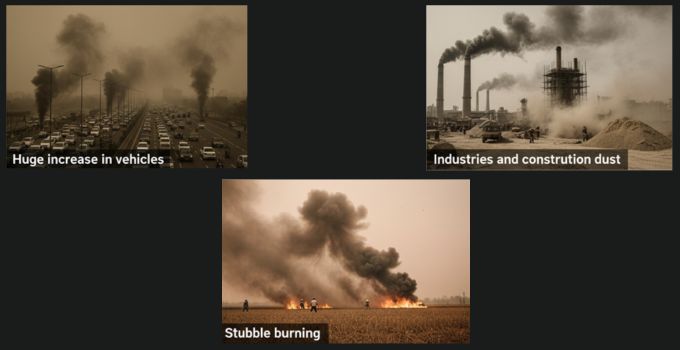
1. Huge increase in vehicles
India adds lakhs of new vehicles every year. More cars and bikes mean more exhaust smoke. This is one of the biggest air pollution causes in Indian cities.
2. Industries and construction dust
Factories release smoke, and construction sites release dust. In rapidly developing cities, these pollutants remain in the air for a long time.
3. Stubble burning
Farmers burn leftover crop stubble to clear fields faster. The stubble burning effect on Delhi air pollution is massive. The smoke travels across states and settles over Delhi-NCR.
4. Household fuels
In many homes, people still use wood, coal, or kerosene for cooking or heating. These produce thick smoke. Indoor air pollution in Indian household fuels are a major but often unnoticed health risk.
5. Weather conditions
In winter, cold air traps pollutants close to the ground. This is why pollution spikes every winter across North India.
6. Slow implementation of policies
There are many air pollution government schemes in India, but the enforcement varies across states. Rules exist, but applying them properly is still a challenge.
How Polluted Air Damages Your Lungs
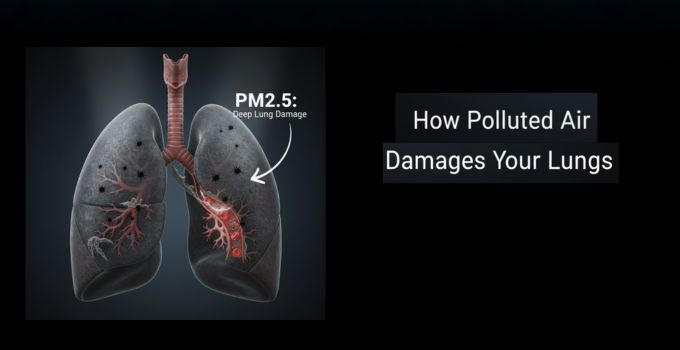
When you breathe polluted air, particles can enter your lungs and irritate your airways. The smaller the particles, the deeper they go.
PM 2.5 health effects in India
PM 2.5 is the most dangerous pollutant. These particles are so tiny that they can bypass your nose, enter your lungs, and even reach your bloodstream. Exposure to PM 2.5 can cause:
Constant irritation in the throat
Chest tightness
Reduced lung strength
Higher risk of infections
Air pollution effects on the lungs
Polluted air inflames the lungs, making breathing difficult. Over time, this can lead to long-term lung diseases, especially for people who already have breathing issues.
When this happens year after year, the chance of chronic bronchitis air pollution India cases, asthma attacks, and lung infections goes up.
AQI Range (India – CPCB Standard) | Air Quality Category | What the Air Contains | Impact on Lungs & Breathing (Simple Explanation) |
0 – 50 | Good | Clean air with very low pollutant levels | No breathing problems. Safe for children, seniors, and people with asthma. |
51 – 100 | Satisfactory | Slight increase in dust and fine particles | Mild irritation possible in sensitive people, but generally safe for normal outdoor activity. |
101 – 200 | Moderately Polluted | Noticeable rise in PM10 and PM2.5 | People with asthma, allergies, or weak lungs may experience cough, slight breathlessness, or throat discomfort. |
201 – 300 | Poor | High levels of harmful particles that stay suspended in the air | Longer exposure can irritate the airways, trigger wheezing, increase coughing, and reduce lung strength over time. |
301 – 400 | Very Poor | Very high PM2.5 and PM10 that penetrate deep into the lungs | Greater risk of asthma attacks, bronchitis flare-ups, and chest tightness even in healthy people. Children and seniors are highly affected. |
401 – 500 | Severe | Toxic air with concentrated pollutants that enter the lungs quickly | Serious risk for everyone. Increased chances of lung infections, chronic bronchitis, asthma emergencies, reduced lung capacity, and long-term respiratory diseases. Staying outdoors becomes unsafe. |
Why Respiratory Diseases Are Increasing Every Year
Doctors across India report more patients with breathing trouble than ever. Here’s why the problem is growing so fast:
1. Long-term exposure is catching up
The long-term respiratory effects of bad air quality weaken the lungs slowly. After years of exposure, the damage becomes visible.
2. Children are at higher risk
Air Pollution and Asthma in Indian children are becoming a major concern. Children breathe faster, their lungs are still developing, and they play outdoors all of which make them more exposed.
3. COPD in non-smokers is rising
COPD treatment due to air pollution is now common even among young adults who have never smoked. Earlier, COPD was mostly linked to smoking.
4. More cases of chronic bronchitis
Regular coughing, phlegm, and breathlessness are becoming common even in healthy individuals.
5. Asthma flare-ups increasing
Pollution is one of the strongest triggers for asthma attacks in India.
According to the WHO, air pollution is responsible for about 4.2 million premature deaths worldwide each year due to ambient (outdoor) air, and 3.2 million deaths due to household air pollution together amounting to roughly 7 million annual deaths.
Most Polluted Cities in India Today
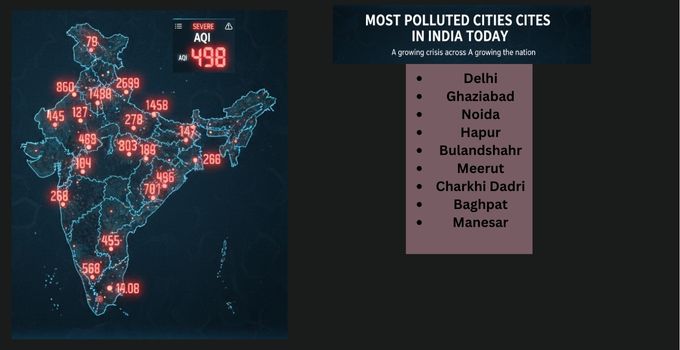
As per The Indian Express, air pollution in Delhi today often shows “severe” levels, especially in winter. But Delhi is not the only city suffering. Other Highly Polluted Cities Include:
Ghaziabad
Noida
Hapur
Bulandshahr
Meerut
Charkhi Dadri
Baghpat
Manesar
Government Initiatives: What’s Working? What Needs More Work?
India has introduced several steps to control pollution.
National Clean Air Programme India latest updates
NCAP aims to reduce PM 2.5 and PM 10 levels by improving monitoring and reducing emissions. Some cities have shown early improvements, but many still need stronger action.
Other air pollution government schemes in India include:
Switching to BS6 fuel
Promoting electric vehicles
Reducing industrial emissions
Increasing green zones
More air quality monitoring stations
However, complete change will take time, and enforcement needs to be consistent.
Healthcare Response to Pollution-Linked Diseases
As respiratory diseases rise, the healthcare system is adapting.
Respiratory clinics for air pollution in Delhi
Delhi now has dedicated respiratory clinics to treat asthma, COPD, and pollution-triggered breathing issues.
Telemedicine for respiratory diseases in India
Online consultations help people access lung specialists from anywhere, especially in smaller towns.
Care for COPD and bronchitis
More centers now offer structured treatment for chronic bronchitis air pollution in India cases and COPD related to poor air quality.
Indoor Air Pollution: The Hidden Enemy
We often think pollution only comes from outside, but indoor pollution can be just as harmful.
Common indoor sources include:
Chulha smoke
Mosquito coils
Incense sticks
Lack of ventilation
Dust and mould
Strong chemical cleaners
This is why indoor air pollution in India household fuels are considered a major health risk by experts.
Ways to Protect Your Lungs from Pollution
Here are simple, practical ways to prevent lung damage from pollution:
1. Wear a proper mask
Use the best N95 masks for air pollution in India to filter PM 2.5.
2. Use an air purifier
A basic HEPA purifier can reduce indoor pollutants.
3. Check pollution levels before going out
The air quality index in India can help you choose safer times to go outdoors.
4. Follow natural lung care remedies
Some of the best natural remedies for polluted lungs include steam inhalation, ginger tea, turmeric milk, warm water, and breathing exercises.
5. Keep your home well-ventilated
Open windows only when AQI is low.
6. Reduce indoor smoke
Avoid burning waste, incense, or mosquito coils every day.
7. Keep your surroundings clean
Regular dusting and mopping can reduce indoor pollutants.
Long-Term Air Pollution Solution India Approaches
Long-lasting solutions need cooperation between the government and the public.
1. Cleaner urban planning
More green belts, dust-free construction, and wider footpaths.
2. Better public transport
More metros, electric buses, and cycling lanes.
3. Strict law enforcement
Industries and vehicles must follow emission rules without exceptions.
4. Citizen participation
Reporting local pollution sources and supporting clean habits.
5. Better medical access
More screenings, lung tests, and telehealth support.
FAQs
1. What causes air pollution in Indian cities?
Vehicles, factories, stubble burning, dust, and household fuels together cause rising pollution levels.
2. How does air pollution affect the lungs?
It irritates the airways, reduces lung capacity, weakens immunity, and increases the risk of asthma, COPD, and bronchitis.
3. Why are children more affected?
Children breathe faster, spend more time outdoors, and have developing lungs, making them more vulnerable.
4. What are natural remedies for polluted lungs?
Steam inhalation, turmeric milk, ginger tea, warm water, and breathing exercises.
5. Can N95 masks protect against pollution?
Yes, N95 masks filter PM 2.5 particles effectively and offer better protection than cloth masks.
6. Why is air pollution rising in India every year?
Air pollution in India keeps rising due to growing vehicles, industry emissions, construction dust, crop burning and reduced green cover, combined with high fossil fuel dependence and weak enforcement.
Wrapping Up
Air Pollution in India is no longer just an environmental issue it affects our daily breathing, our children’s health, and the long-term strength of our lungs. The rise in respiratory diseases is closely linked to the poor air we inhale every day, whether outdoors or inside our homes. While big solutions may take time, small steps like checking the air quality index India, using the best N95 masks for air pollution India, improving indoor air, and following simple precautions can make a real difference in protecting your lungs. Understanding the problem is the first step, and taking everyday actions is the next.
Read Also
References
Dutta, A., Jinsart, W., 2022. Air pollution in Delhi, India: It’s status and association with respiratory diseases. PLoS ONE 17. doi:10.1371/journal.pone.0274444.
Jindal, S.K., Aggarwal, A.N., Jindal, A., 2020. Household air pollution in India and respiratory diseases: Current status and future directions. Current Opinion in Pulmonary Medicine. doi:10.1097/MCP.0000000000000642.
Khilnani, G.C., Tiwari, P., 2018. Air pollution in India and related adverse respiratory health effects: Past, present, and future directions. Current Opinion in Pulmonary Medicine. doi:10.1097/MCP.0000000000000463.
Disclaimer: The information shared in this blog is meant for general educational purposes only and should not be taken as medical advice. Always consult a qualified healthcare professional for diagnosis, treatment, or medical guidance related to your health. The content is based on reliable sources, but it may not be suitable for every individual’s condition. We do not assume responsibility for any actions taken based on this information. Readers are encouraged to exercise caution and use their discretion when making healthcare decisions.












Comments