

Myths Patients Still Believe About Their Medicines





Last updated on 05 Jan 2026
Key Takeaways
|
It usually starts with a simple assumption. Many people believe they are using medicines correctly, but a common misunderstanding quietly leads them to misuse them. Maybe a family member suggested it. Maybe it worked once before. Maybe it came from a WhatsApp message or a neighbour’s advice. Over time, these beliefs turn into habits.
This is why common myths about medications still affect everyday health decisions. Some of these myths delay recovery, while others quietly increase health risks. Understanding health myths and facts helps patients use medicines safely and with confidence.
Why do medicine myths spread so easily?
Most medications come with instructions, warnings, and unfamiliar terms. Some individuals may not fully understand these written materials and may rely on their own experiences or on others for guidance. Over time, these explanations often become simplified, distorted, or exaggerated.
Fear of side effects, long-term use, or dependence often fuels common misconceptions about medicines. Many people stop taking medicines or change doses instead of asking questions. This will continue to reinforce and perpetuate an overall lack of understanding and, very likely, perpetuate many health-related myths and misconceptions.
Top 5 Medication Myths You Should Stop Believing
Myth 1: Generic drugs are less effective than branded drugs
This belief is one of the biggest myths about generic medicines.
Patients often believe that higher-priced medicines offer better quality. Actually, generic medications contain the same active ingredient as their brand-name counterparts and work in the same way. Pharmaceutical regulatory agencies require that generics be manufactured to the same strict safety and efficacy standards as the branded medication.
When doctors discuss the difference between generic and branded medicines in India, many of them recommend generics because patients can save money over the long term while still achieving positive clinical outcomes. Generic medicines work the same way, regardless of the brand name.
This confusion around generic and branded medicines in India often leads patients to overspend without added benefit.
Myth 2: Over-the-counter medicines are always safe
Because OTC (over-the-counter) medications can be purchased without a doctor's prescription from most pharmacies, many individuals believe these products aren't harmful.
If taken too frequently, OTC pain relievers/cold treatments/antacids have the potential to impact the digestive system (stomach), as well as the kidney, liver and blood pressure.
OTC medicines can also interact negatively when taken with prescription medications.
People should use OTC medicines with the same care they give prescription medicines.
Myth 3: Natural supplements are always safe because they're “natural”
This is one of the 12 health myths you can ignore.
The perception that natural supplements are always safe because they are "natural" has led many people to underestimate their risks and potential interactions with medications (e.g., diabetic medications, blood-pressure medications, anticoagulants). This belief often fuels debates about Ayurvedic vs Allopathic medicine.
Both systems can offer advantages, but the safety of each relies on appropriate utilisation, the individual's state of health at the time of treatment, and dosing, rather than on their designation as "natural" or not.
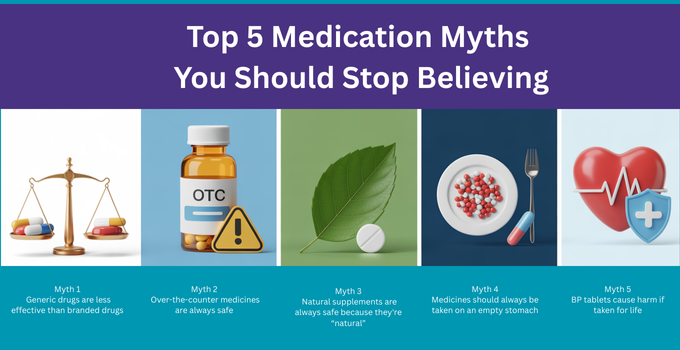
Myth 4: Medicines should always be taken on an empty stomach
The instruction that medicines are to be taken on an empty stomach does not apply to all medicines.
Some medicines are absorbed better on an empty stomach, while others irritate the stomach. Ignoring this can reduce effectiveness or cause side effects like acidity or nausea. Each medicine has its own timing, and following it correctly makes a real difference.
Myth 5: BP tablets cause harm if taken for life
Many people who start using blood pressure medicines eventually quit treatment because they fear that these drugs will cause them side effects that will last for their entire lives.
The use of heart rate control (hypertension) medications will help control hypertension; however, when patients discontinue the use of their hypertension medications due to fear, they will experience elevated blood pressure, and the uncontrolled hypertension will cause a higher risk of heart attack, stroke, and kidney disease.
Continuing treatment under a doctor’s guidance is the safest way to protect long-term health.
A study published in PubMed on OTC analgesics shows that patients often use these medicines without a full understanding of active substances, which highlights the need for awareness of proper use and possible side effects.
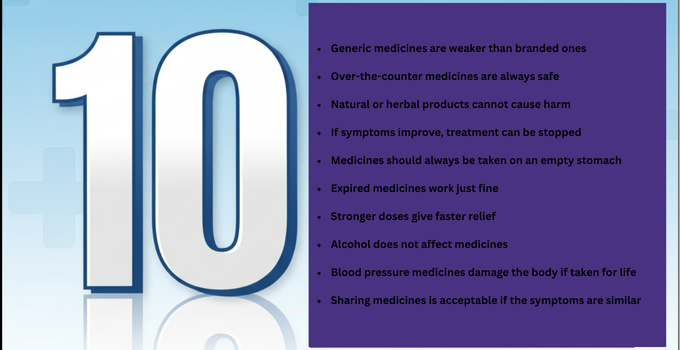
10 Medical Myths Patients Still Believe
Generic medicines are weaker than branded ones
Over-the-counter medicines are always safe
Natural or herbal products cannot cause harm
If symptoms improve, treatment can be stopped
Medicines should always be taken on an empty stomach
Expired medicines work just fine
Stronger doses give faster relief
Alcohol does not affect medicines
Blood pressure medicines damage the body if taken for life
Sharing medicines is acceptable if the symptoms are similar
These are common health myths that are not true, yet many patients still follow them without questioning.
The Indian Pharmaceutical Association’s handbook on Responsible Use of Medicines emphasises that medicines save lives when used appropriately, but misunderstandings about their use are widespread.
Rare medical myths that still circulate
These include taking higher doses for faster relief, sharing medicines with someone who has similar symptoms, or stopping treatment as soon as symptoms improve.
Each person’s body responds differently. These shortcuts often lead to complications rather than quicker recovery.
Why believing health myths can be dangerous
Ignoring facts and following myths can:
Delay proper treatment
Increase the risk of side effects
Worsen chronic conditions
Create avoidable health emergencies
Understanding health myths and facts helps patients make safer choices.
How patients can protect themselves from misinformation
Patients can reduce risk by:
Asking clear questions during doctor visits
Reading medicine labels carefully
Avoiding unverified advice
Storing medicines correctly
Completing prescribed courses
Breaking common myths about medications starts with awareness and communication.

FAQs
1. Are generic medicines safe to use in India?
Yes. Approved generic medicines meet safety and quality standards and work the same as branded drugs.
2. Can over-the-counter medicines cause side effects?
Yes. Incorrect or frequent use of over-the-counter medicines can cause side effects and drug interactions.
3. Is it safe to mix Ayurvedic and allopathic medicines?
Not always. Mixing treatments without guidance can cause interactions. Inform your doctor about all medicines you take.
4. Should I stop medicines once I feel better?
No. Stopping early can cause relapse or complications. Follow the full course unless advised otherwise.
5. Do expired medicines still work?
Expired medicines may lose effectiveness and can sometimes be unsafe. Avoid using them.
6. Is a sleeping pill safe for daily use?
Sleeping pills are not meant for daily long-term use unless a doctor supervises them, as regular use can reduce effectiveness and cause dependence.
7. Are psychiatric medicines addictive?
Most psychiatric medicines are not addictive when taken as prescribed, though some require gradual dose changes to avoid withdrawal effects.
Final Thoughts
Medicines play a vital role in keeping us healthy, but they work best when we understand them correctly. Most problems arise not because medicines are harmful, but because myths influence how people use them. By questioning assumptions, following medical advice, and staying informed, patients can avoid unnecessary risks and get the full benefit of their treatment. Clear knowledge, not fear or hearsay, helps medicines work the way they should.
Read Also
Fake Medicines Are on the Rise - Here’s How MrMed Keeps You Safe
Top Generic Anti-Cancer Drugs And Their Oncology Indications
Affordable cancer care: Can generic oncology drugs close the gap?
References
Kesselheim AS, Misono AS, Lee JL, Stedman MR, Brookhart MA, Choudhry NK, et al. Comparative effectiveness of generic and brand-name medication use: A database study of US health insurance claims. PLoS Med. 2019 Mar 13;16(3):e1002763. doi: 10.1371/journal.pmed.1002763
Westerlund T, Andersson IL, Marklund B. Self-care and use of over-the-counter drugs: A population-based study. BMC Fam Pract. 2017 Aug 22;18(1):1–8. doi: 10.1186/s12875-017-0650-8
Izzo AA, Ernst E. Interactions between herbal medicines and prescribed drugs: A systematic review. Drugs. 2009;69(13):1777–1798. doi: 10.2165/11317010-000000000-00000
Disclaimer: The content in this blog is for general informational purposes only and is not a substitute for professional medical advice, diagnosis, or treatment. Always consult your doctor or a registered dietitian before making any changes to your diet, especially if you have a medical condition or are taking prescribed medication. While the information is based on trusted sources, individual needs and results may vary. MrMed does not promote or endorse any specific food or treatment mentioned unless explicitly stated.










Comments