

Types of Seizures in Epilepsy: How to Recognize the Signs Before They Strike





Last updated on 02 Jan 2026
If you think seizures always look like dramatic shaking or someone collapsing, you’re not alone. But here’s the surprising truth: many seizures in India go completely unnoticed because they look like simple staring, brief silence, or sudden confusion. Most families think the person is tired, stressed, or “lost in thought.” In reality, the brain often sends warning signals long before a seizure strikes and learning to spot them early can genuinely protect lives.
This blog breaks down the types of epilepsy seizures, how to recognise early signs, how seizures differ in adults and children, and why Indian families often miss the symptoms.
What Is Epilepsy Really? Understanding It in Simple Terms
Epilepsy is a condition where the brain’s electrical signals become irregular, causing repeated episodes called seizures. These episodes can be mild or intense, predictable or random.
Common epilepsy symptoms include:
Sudden episodes of blank staring
Brief confusion
Jerky movements in arms or legs
Loss of awareness
Strange sensations or smells
Memory gaps or “missing time”
Types of Seizures: The Two Big Categories
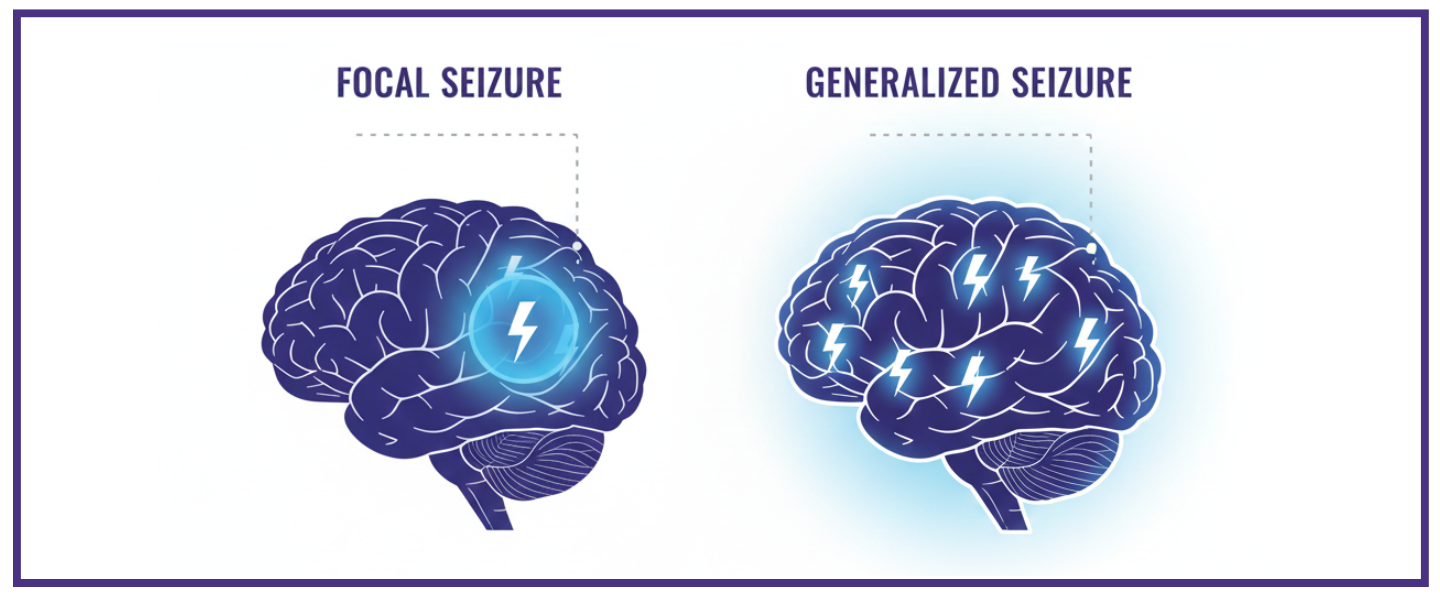
Seizures broadly fall into two groups based on where they begin in the brain.
1. Focal Seizures: When the Problem Starts in One Part of the Brain
These can be so subtle that people mistake them for daydreaming or absent-mindedness.
Focal Aware Seizures
The person stays conscious.
Signs include:
Tingling in one arm or leg
Twitching on one side of the face or body
Strange tastes or smells
Sudden intense emotions (fear, panic)
A déjà vu sensation
Focal Impaired Awareness Seizures
Awareness is partially or fully affected.
Signs include:
Staring without response
Repetitive actions like lip-smacking or rubbing fingers
Repeating words or phrases
Wandering without awareness
Sudden pause in activity
Duration: 30 seconds to 2 minutes
Focal seizures are extremely common in India and are often the most misdiagnosed.
2. Generalised Seizures: When the Entire Brain Is Involved
These tend to be more visible and dramatic.
Absence Seizures (very common in children)
Signs include:
Sudden blank stare
Rapid blinking
Stopping mid-sentence
No response for a few seconds
Often mistaken for “daydreaming” in classrooms.
Tonic-Clonic Seizures
The classic seizure most people imagine.
Signs include:
Sudden collapse
Body stiffening (tonic stage)
Strong jerking movements (clonic stage)
Irregular breathing
Excess saliva
Deep confusion afterwards
Other generalised types:
Tonic: Body stiffens suddenly
Atonic: Sudden drop or fall
Myoclonic: Quick jerks of muscles
As per the PMC Cureus, a large EMR-based cohort (2001–2019) of Indian epilepsy patients found that focal epilepsy (i.e. seizures starting in one area) was far more prevalent than generalised epilepsy 81% of cases vs 19% generalised.
Seizure Aura: The Early Warning Sign You Should Never Ignore
Before many seizures, especially focal seizures, the body gives a seizure aura, an early signal that something is about to happen.
Auras are medically classified as focal aware seizures, not separate events.
Common aura sensations:
Burning or smoky smell
Metallic or bitter taste
A sudden rising “roller-coaster” feeling in the stomach
Flashing lights or blurry vision
Tingling in limbs
Déjà vu or unfamiliarity with familiar things
Understanding auras can help people move to a safe place, lie down, or call someone, reducing injury risk significantly.
Quick Comparison Table: Seizure Type, Signs & Common Age Group
Seizure Type | Key Signs | Duration | Common In |
Focal Aware | Déjà vu, tingling, odd smells, twitching | 10–60 seconds | Adults & children |
Focal Impaired Awareness | Staring, repetitive actions, no response | 30 sec–2 minutes | Adults |
Absence | Blank stare, blinking | 5–10 seconds | Children |
Tonic-Clonic | Collapse, stiffness, jerking | 1–3 minutes | Adults & children |
Atonic | Sudden fall | 1–3 seconds | Children |
Myoclonic | Fast jerks | 1–2 seconds | Teens & young adults |
Common Triggers of Seizures in India
Trigger | Why It Happens |
Sleep deprivation | Disturbs brain electrical stability |
Missed meals / fasting | Common during festivals or busy workdays |
Heat exposure | Indian climate increases dehydration risk |
Heightens electrical activity in the brain | |
Missed medication | Very common among adults with irregular routines |
Alcohol consumption | Triggers withdrawal-related seizures |
Early Signs of Epilepsy in India You Should Not Ignore
These early symptoms are commonly missed in Indian households:
Frequent staring episodes
Brief confusion or “zoning out”
Repeated jerking in arms or legs
Strange smells or tastes
Feeling disconnected or blank
Sudden mood changes
Memory lapses
Unexplained falls
Tingling sensations
If these occur repeatedly, it’s time to speak to a neurologist.
As per the PubMed Published Article: Prevalence of pediatric and adolescent epilepsy in India: A systematic review and meta-analysis
Epilepsy in Adults vs Children: How It Looks Different
In Children
Absence seizures are mistaken for inattention
Jerky movements are seen as clumsiness.
Delayed speech or learning difficulties
Drop in school performance.
Teachers are often the first to notice
In Adults
Stronger aura experiences
Tonic-clonic seizures are more common.
Confusion and memory gaps after events
Triggers include stress, fasting, late nights, and alcohol.
Higher chance of seizures during sleep
How to Recognise a Seizure: AEO-Friendly Snippet
A seizure may be happening if someone:
Suddenly stiffens or jerks
Stares without responding
Repeats movements
Falls without warning
Has eyes rolled upward
Doesn’t respond to their name
Is confused after an episode
Seizure First Aid in India
Do NOT do these:
Don’t hold the person down
Don’t put anything in their mouth.
Don’t splash water
Don’t give food or medicine during a seizure.
Do this instead:
Stay calm
Turn them to their side.
Move objects away
Loosen tight clothing
Time the seizure
Stay until they regain full awareness.
Call emergency help if:
Seizure lasts > 5 minutes
A second seizure starts immediately.
The person gets injured.
They have trouble breathing.
These steps follow first-aid guidelines commonly used in AIIMS, NIMHANS, and major Indian hospitals.
Seizure vs Fainting vs Panic Attack
Fainting (Syncope)
Triggered by heat or low blood pressure
A person wakes up quickly.
Minimal jerking
Panic Attack
Fast heartbeat
Chest tightness
The person stays aware.
No confusion afterwards
Seizure
Loss of awareness
Jerking or stiffness
Confusion after the episode
Possible aura before the event
When to See a Doctor
Book a check-up if you notice:
Repeated staring spells
Jerking movements
Strange smells, tastes, or sensations
Memory gaps
First-time seizure
Seizures during sleep
Family history of epilepsy
FAQs
1. What are the early signs of epilepsy in India?
Repeated staring, memory gaps, jerks, strange smells/tastes, and confusion.
2. Can epilepsy be cured?
Most cases are controlled with medication; some require surgery.
3. Is epilepsy common in India?
Yes, around 10 million people have it.
4. What triggers seizures in Indian weather?
Heat, dehydration, fasting, stress, missed meals.
5. How do I help someone having a seizure?
Turn them to the side, move objects out of the way, stay calm, and call for help if needed.
6. Are absence seizures dangerous?
They are usually brief but need treatment to avoid academic issues in kids.
7. Does epilepsy affect adults and children differently?
Yes, seizure types and triggers vary by age.
8. When should I visit a neurologist?
After any first-time seizure or recurring episodes.
9. Is epilepsy a mental illness?
No, it is a neurological condition.
10. Can stress cause seizures?
Yes, stress and lack of sleep are major triggers.
11. How can I tell the difference between focal vs generalised seizures?
Focal vs generalised seizures differ in symptoms: focal seizures cause localised or brief awareness changes, generalised seizures usually involve full-body movements and loss of consciousness.
Key TakeAways
Epilepsy is far more common than most Indian families realise, and early signs are often subtle. But with awareness, modern treatment, and the right first-aid steps, most people with epilepsy can live completely normal lives. If you or someone you know experiences repeated staring spells, jerks, or unusual sensations, don’t wait, speak to a neurologist and get the right guidance early.
Read Also
References
Epilepsy: Indian perspective. Santhosh NS, Sinha S, Satishchandra P, Ann Indian Acad Neurol. Ann Indian Acad Neurol. 2014 Mar;17(Suppl 1):S3–S11. doi: 10.4103/0972-2327.128643
Demographic Profile and Prescribing Patterns of Anti‑Epileptic Drugs in Indian Epilepsy Patients: A Nationwide Retrospective Cohort Study. Das S, Sharma A, et al. Cureus. 2022 Mar 31;14(3):e23676. doi: 10.7759/cureus.23676
Disclaimer: The information shared in this blog is meant for general educational purposes only and should not be taken as medical advice. Always consult a qualified healthcare professional for diagnosis, treatment, or medical guidance related to your health. The content is based on reliable sources, but it may not be suitable for every individual’s condition. We do not assume responsibility for any actions taken based on this information. Readers are encouraged to exercise caution and use their discretion when making healthcare decisions.












Comments