

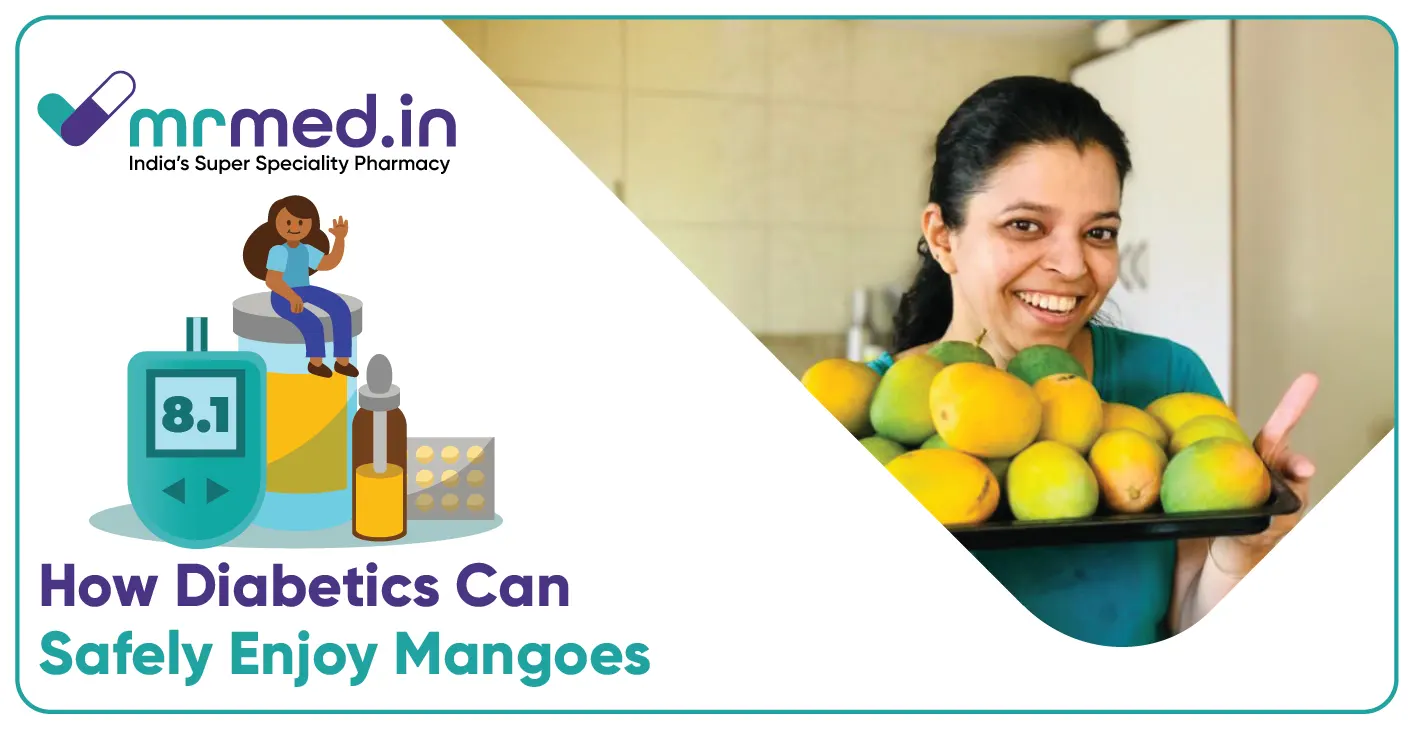
Can Diabetics Eat Mangoes





Last updated on 09 Jul 2026
Mangoes, often called the "king of fruits," are beloved across India for their sweetness, nutrition, and versatility. However, people with diabetes often wonder whether they can safely enjoy mangoes given their natural sugar content. The answer is not a simple yes or no: diabetics can eat mangoes, but portion control, timing, and preparation methods are critical. India accounts for approximately 77 million people with diabetes, making diabetes management an important public health concern.
This comprehensive guide examines mango's nutritional profile, explains glycemic index and glycemic load, discusses safe consumption amounts for diabetics, identifies the best mango varieties for blood sugar management, and provides practical strategies for incorporating mangoes into a diabetes-friendly diet.
Key Takeaways
|

Understanding Diabetes and Blood Sugar Management
According to ICMR data, approximately 42 percent of Indians with diabetes have poor glycemic control, often related to dietary factors including excessive fruit consumption without portion awareness.
Effective diabetes management requires understanding how different foods affect blood glucose levels.
Types of Diabetes and Carbohydrate Sensitivity:
Type 1 diabetes: The pancreas produces little or no insulin; requires insulin therapy and careful carbohydrate counting.
Type 2 diabetes: The body cannot effectively use insulin; it accounts for approximately 90 percent of diabetes cases in India.
Gestational diabetes develops during pregnancy and requires careful dietary management to prevent complications.
Pre-diabetes: Blood sugar levels are elevated but not yet diagnostic of diabetes; dietary intervention can prevent progression.
Blood Sugar Management Principles:
Managing blood glucose requires understanding how carbohydrates, particularly simple sugars and refined carbohydrates, affect blood sugar levels. Glycemic Index (GI) and Glycemic Load (GL) are important tools for predicting blood sugar response to foods.
Mango Nutrition Profile: What Diabetics Need to Know
Understanding mango's nutritional composition helps diabetics make informed decisions about consumption.
Nutritional Content per 100 grams of Raw Mango:
Calories: 60,
Carbohydrates: 15 grams,
Sugars: 11 grams (natural sugars including glucose, fructose, and sucrose),
Fibre: 1.6 grams,
Protein: 0.8 grams,
Fat: 0.3 grams,
Vitamin C: 36 mg (60% of daily requirement),
Vitamin A: 54 mcg (6% of daily requirement),
Potassium: 168 mg (5% of daily requirement).
Ripe vs. Unripe Mango:
Ripeness significantly affects sugar content and glycemic response:
Unripe mangoes: Lower sugar content (approximately 8 grams per 100g), higher fibre (2 to 3 grams), more tart taste.
Ripe mangoes: Higher sugar content (approximately 13 to 15 grams per 100g), lower fibre (1 to 1.5 grams), sweeter taste.
Mango Glycemic Index and Glycemic Load
According to the Indian Association of Diabetologists, a GL of less than 10 is considered low, 10 to 20 is medium, and greater than 20 is high. This suggests that a 100- to 150-gram serving of ripe mango falls within acceptable ranges for diabetics, while larger portions increase the risk of blood sugar spikes.
The glycemic index (GI) measures how quickly a food raises blood glucose levels, while glycemic load (GL) accounts for portion size.
Mango Glycemic Values:
Glycemic Index: 41 to 60 (varies by ripeness, variety, and preparation).
Unripe mango: GI approximately 41 (low).
Ripe mango: GI approximately 55 to 60 (medium).
Mango juice (unsweetened): GI approximately 70 to 75 (high).
Dried mango: GI approximately 70+ (high).
Glycemic Load Calculation:
For a 100-gram serving of ripe mango:
GL = (GI × carbohydrate content) ÷ 100.
GL = (55 × 15) ÷ 100 = 8.25 (medium GL).
For a 150-gram serving (one medium mango):
GL = 12.4 (approaching high GL).
Can Diabetics Eat Mangoes? Evidence-Based Guidance
The evidence supports mango consumption by diabetics when portion control and timing are carefully managed.
Research on Mango and Diabetes:
Research indicates that consuming mango with protein and healthy fats (such as almonds or yoghurt) significantly reduces blood sugar spikes compared to mango alone.
Fibre content in mangoes, while modest, helps slow glucose absorption.
Can Type 2 Diabetics Eat Mango?
Yes, people with type 2 diabetes can eat mangoes with proper portion control. The key is to treat mango as a carbohydrate serving rather than as unlimited fruit.
Can Diabetics Eat Ripe Mango?
Ripe mangoes have higher sugar content than unripe mangoes, but diabetics can still eat ripe mangoes in smaller portions (approximately 100 grams or less). Semi-ripe mangoes represent a compromise option with moderate sugar content.
How Much Mango Can a Diabetic Eat?
Portion control is the critical factor determining whether mango consumption is safe for diabetics.
Recommended Mango Portions:
Small mango serving: 100 grams (approximately half a medium mango).
Moderate serving: 150 grams (one small mango).
Maximum recommended: 150 grams per serving.
Frequency: 2 to 3 times per week (not daily).
Consumption Timing:
Best time: With a meal containing protein and healthy fats (never on an empty stomach).
Avoid mango immediately after other high-carbohydrate meals.
Post-meal consumption: 30 to 60 minutes after the main meal may reduce glycemic spike through known post-meal glucose absorption mechanisms.
Best Mango Varieties for Diabetics
According to Dr Deepak Bhardwaj, Chief Endocrinologist at Max Healthcare and the Indian Association of Diabetologists, mangoes are not forbidden fruits for diabetics, contrary to common misconception. Mango's modest fibre content and medium glycemic index make it acceptable for diabetics who practice portion control.
Some mango varieties have lower sugar content or more favourable carbohydrate profiles.
Low-Sugar Mango Varieties:
Langda: Lower sugar content (approximately 10 to 11 grams per 100g), pleasant taste, commonly available.
Dusehri: Moderate sugar content (approximately 11 to 12 grams per 100g), good flavour.
Kesar: Slightly higher sugar but excellent flavour profile; serve in very small portions (75 to 100g).
Banganapalli: Moderate sugar content; popular in South India.
Varieties to Limit:
Alphonso: Higher sugar content (approximately 14 to 15 grams per 100g); limit to 75 grams per serving.
Chaunsa: Very sweet, high sugar content; small portions only.
Unripe/Green Mangoes:
Unripe mangoes used in curries, pickles, or chutneys have significantly lower sugar content and may be safer options for diabetics.
Best Fruits for Diabetics: Comparison with Other Options
Not all fruits are equally suitable for diabetes management. Understanding alternatives helps diabetics make optimal choices.
Best Fruits for Diabetics (Low Glycemic Index/Load):
Berries (Strawberries, Blueberries, Raspberries): GI 25-40, very low GL, high fibre and antioxidants.
Citrus Fruits (Orange, Mosambi, Lemon): GI 30-50, low GL, high vitamin C.
Guava: GI 28, excellent fibre content (5.4 grams per 100g), very low GL.
Papaya: GI 60 but low GL due to the large portion size typically needed for satiety.
Watermelon: GI 76, but very low GL due to high water content and the large serving size required.
Pomegranate: GI 35, antioxidant-rich, moderate GL.
Fruits Diabetics Should Limit or Avoid:
Mango: Medium GI, requires portion control.
Pineapple: GI 66, moderate to high GL.
Grapes: High sugar density, easy to overconsume.
Dried Fruits (Raisins, Dates): Very high GI (70+), very high GL due to sugar concentration.
Fruit Juices: Extremely high GI (70-75+), no fibre to slow absorption.
Canned Fruits in Syrup: Added sugars dramatically increase GL.
Foods Diabetics Should Avoid: Broader Context
Beyond mangoes, several food categories require careful management in diabetes.
Foods Diabetics Should Strictly Limit or Avoid:
Refined carbohydrates (white bread, white rice, refined flour products).
Sugar-sweetened beverages (regular soft drinks, fruit juices, sweetened tea).
Processed foods high in trans fats and sodium.
High-fat meats and processed meats.
Full-fat dairy products (in large quantities).
Alcohol (increases hypoglycemia risk).
Fried foods (increase inflammation and cardiovascular risk).
Mango Pickle, Chutneys, and Prepared Mango Products
Prepared mango products have different glycemic profiles from fresh mangoes.
Can Diabetics Eat Mango Pickle?
Yes, but in very small quantities. Mango pickle (raw mango pickle) is made from unripe mangoes with minimal added sugar. A small serving (1 to 2 tablespoons) with a meal is acceptable.
However, commercially prepared pickles may contain added sugars; check labels for sugar content.
Other Mango Products:
Mango Chutney: Often contains added sugars; limit to 1-2 tablespoons.
Dried Mango: Extremely high sugar concentration; avoid or use very sparingly as flavouring.
Mango Leather/Bars: Often contain added sugars; check labels.
Mango Juice: High GI (70+); avoid or consume in very small quantities (100 ml or less) with protein.
Practical Strategies for Diabetics Enjoying Mangoes
Implementing practical strategies allows diabetics to safely enjoy mangoes while maintaining blood sugar control.
Tips for Safe Mango Consumption:
Always pair mango with protein (yoghurt, nuts, paneer) and healthy fats (coconut, nuts, seeds).
Consume mango with meals rather than as a standalone snack.
Choose unripe or semi-ripe mangoes over fully ripe varieties.
Monitor portion sizes strictly (100-150 grams maximum).
Check blood glucose levels before and 2 hours after consuming a mango to understand individual response.
Limit frequency to 2-3 times per week.
Avoid mango juice; eat whole fruit instead.
Substitute unripe mango pickles or chutneys for fresh mango to reduce sugar intake.
Plan mango consumption into daily carbohydrate allocation.
You Can Enjoy Mango – Just Be Smart About It
So, can diabetics eat mangoes? The answer is yes – but with a plan. Mango is a nutrient-rich fruit that offers tons of benefits for your skin, digestion, and even metabolism. However, portion size, timing, and food pairing are everything.
If you’re diabetic, don’t deprive yourself. Enjoy mango mindfully – and remember to test your blood sugar to see how your body reacts. Everyone is different.
FAQs
Q1. Do mangoes raise blood sugar?
Yes, mangoes contain natural sugars and will raise blood sugar, but the amount depends on portion size. A small mango (100 grams) consumed with a meal has a moderate effect. A large mango or a glass of mango juice causes larger blood sugar spikes. Diabetics can eat mangoes by limiting portions to 100 to 150 grams, 2 to 3 times per week, and pairing with protein and healthy fats.
Q2. What two fruits should a diabetic avoid?
Dried fruits (raisins, dates) and fruit juices should be avoided or strictly limited because they have very high sugar concentration and a high glycemic index. Other fruits to avoid or severely limit include grapes and canned fruits in syrup due to their high sugar content and the risk of overconsumption.
Q3. Which fruit is best for diabetes?
Berries (strawberries, blueberries), citrus fruits (oranges, mosambi), guava, and watermelon are best for people with diabetes. These have low to medium glycemic index, low glycemic load, high fibre content, and high micronutrient density. Guava is particularly excellent, with a low glycemic index and high fibre content.
Q4. Which mango is best for diabetes?
Unripe or semi-ripe mangoes are best for diabetics because they have lower sugar content than fully ripe mangoes. Langda, Dusehri, and Banganapalli varieties have moderate sugar content. Avoid Alphonso and Chaunsa, which are very sweet and high in sugar. When possible, choose unripe green mangoes used in curries or pickles, which have significantly lower sugar content.
.png "mrmed")
Read Also
References
Disclaimer: The content in this blog is for general informational purposes only and is not a substitute for professional medical advice, diagnosis, or treatment. Always consult your doctor or a registered dietitian before making any changes to your medicines or diet, especially if you have diabetes or any other medical condition or are taking prescribed medication. While the information is based on trusted sources, individual blood sugar responses and dietary needs may vary. MrMed does not promote or endorse any specific food or treatment mentioned unless explicitly stated.
















Comments