

Prediabetes Doesn't Have to Become Diabetes. If You Act Now.





Last updated on 28 Aug 2026
Prediabetes is a stage that is usually reversible, characterised by higher-than-normal blood sugar levels but lower than those of diabetes. The risk of progression can be considerably reduced through early lifestyle modifications, especially diet and physical activity. Frequent monitoring and sustained microhabits help regulate glucose levels back to baseline and prevent complications down the road.
Key Takeaways
|
The moment a doctor says "borderline diabetic", or you see your HbA1c sitting at 6.1 on a blood report, your mind tends to jump to the worst. Insulin injections. Lifelong medicine. Everything that comes with a diabetes diagnosis.
But here is the thing most people don't hear in that moment: prediabetes is not diabetes. And for a very large number of people, it does not have to become diabetes either.
That is not false hope. That is actually what the science says.
What Is Prediabetes, Really?
Every time you eat, your body breaks down the food into sugar, which enters your bloodstream. Your body then releases a hormone called insulin to move that sugar out of the blood and into your cells, where it gets used as energy. Blood sugar rises after a meal, insulin does its job, and levels return to normal. That is the normal cycle.
In prediabetes, the body's cells stop responding properly to insulin. Insulin is still being produced, but it is not working as effectively. So blood sugar stays a little higher than it should after meals, and takes longer to come back down. Over time, if nothing changes, this puts real pressure on the pancreas, the organ that makes insulin, and that is when the situation can move into type 2 diabetes.
The tricky part is that prediabetes almost never causes symptoms. No pain, no obvious warning signs. Most people find out through a routine blood test. Many don't find out at all, which is part of why it's underdiagnosed.
But here is what matters: at the prediabetes stage, the body is still capable of correcting itself. The damage is not done. That is what makes this moment worth paying attention to.
Dr. Rahul Parashar, Consultant Endocrinologist at Kailash Hospital, Noida, puts it plainly: "Pre-diabetes is often a silent condition, showing no obvious symptoms in its early stages. Many people only discover they have it during routine blood tests.
.png "MrMed")
What Those Numbers Actually Mean
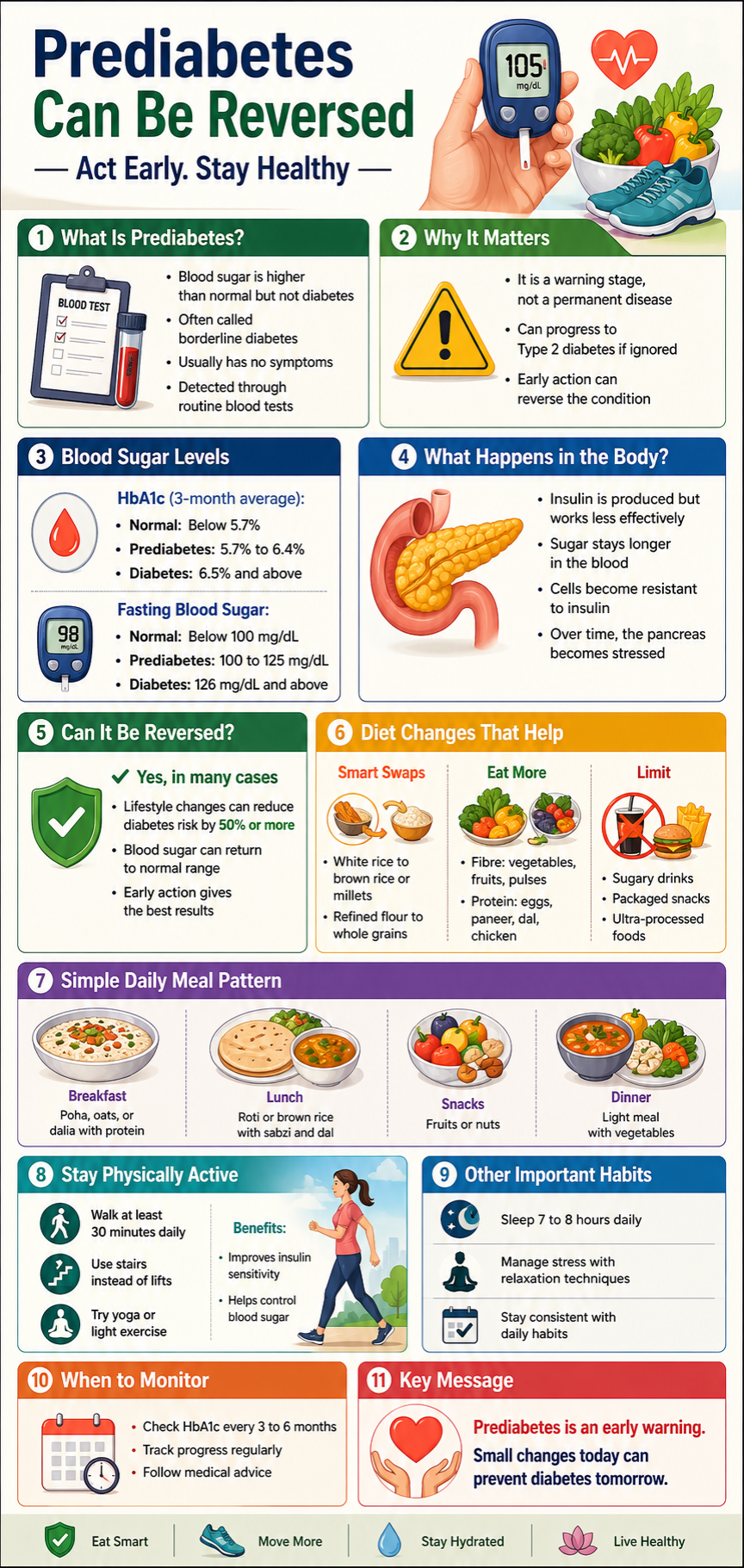
Your HbA1c (glycated haemoglobin) gives your doctor a picture of your average blood sugar over the last three months. Here is how the ranges break down:
Normal: below 5.7%
Pre diabetic condition: 5.7% to 6.4%
Diabetes: 6.5% and above
Fasting blood glucose tells a similar story:
Normal: below 100 mg/dL
Prediabetes: 100 to 125 mg/dL
Diabetes: 126 mg/dL and above
If your numbers fall in that middle range, your body is starting to struggle with insulin, the hormone that keeps blood sugar in check. But you have not yet crossed into diabetes. That window matters more than most people realise.
According to the ICMR-INDIAB 2025 study, 15.3% of Indian adults are living with prediabetes. That is more than 10 crore people.
When you add that to the number already diagnosed with diabetes, over a quarter of Indian adults are at risk right now. The scale is significant. But it also means this is not unusual and that you are not facing it alone.
.png "MrMed")
Can Prediabetes Actually Be Reversed?
Yes. This is the part that tends to surprise people.
Research, including large-scale studies from India and globally, consistently shows that lifestyle changes can reduce the risk of progressing from prediabetes to type 2 diabetes by more than 50%. Some studies put the number even higher. At the prediabetes stage, the body still responds well to change. HbA1c levels can return to the normal range with the right habits in place, and they often do.
The two things that make the biggest difference are what you eat and how much you move.
.png "MrMed")
What a Pre Diabetic Diet Actually Looks Like
You do not have to give up everything you love or only eat salads. A smarter way of working with what you already have is helpful. A pre-diabetes diet is about keeping your blood sugar levels from rising too high after meals. On a practical level, here is what that means:
Change White Rice and Maida with Whole Grains. Brown rice, millets like jowar, bajra, and ragi, or whole-wheat roti, have a more gradual rise in blood sugar. You do not need to eliminate rice completely. Having a smaller portion but a larger amount of protein and vegetables helps so much.
Add more fibre. Good options include dal, rajma, chickpeas, vegetables, and fruits (guava, pear & jamun). Eating fibre reduces the speed at which sugar is released into the blood.
Watch portions of high-GI foods. Foods with a high Glycaemic Index, such as white rice and white bread, starchy vegetables, and piquant beverages, cause rapid blood glucose spikes. Less is more; use lower quantities and periodicity; it helps much more than rationalist eyes can see.
Have protein at every meal. Food high in protein, like eggs, paneer, curd, chicken, fish and pulses, takes longer to digest, satiates you for a longer time and keeps your blood sugar levels from rising sharply soon after meals.
Cut back on ultra-processed foods. Hidden sugars are present in packaged biscuits, soft drinks, chips, and most store-bought fruit juices. Getting these down, even slowly, has a real impact.
A typical Indian day, pre diabetic diet chart will include:
8 am Breakfast: Poha with vegetables and a serving of boiled egg, Dalia with curd.
12 noon Lunch: 2 rotis or a small portion of brown rice, sabzi & dal;
5 pm Evening Snacks: Small fruit, handful of nuts;
10 pm Dinner: Less rice(rice + a plateful of vegetables as a snack).
You dont have to follow something complicated. Working your way down to one swap per day is a practical and achievable starting point.
.png "MrMed")
Movement Is the Other Half of the Picture
Walking 30 minutes a day, five times a week, can meaningfully lower blood sugar over time. You do not need a gym. A walk after dinner, taking the stairs, or a short yoga session adds up. When muscles are active, the body uses insulin more efficiently. That is exactly what a pre diabetic body needs more of.
Sleep and stress matter here too. Poor sleep and chronic stress both raise cortisol levels, which, in turn, raise blood sugar. Getting consistent sleep and finding simple ways to manage stress, even briefly, supports the rest of your effort.
As Dr. Abhay G, Endocrinologist at Sagar Hospitals, Bengaluru, explains: "This is the stage where the body is signalling gently. It is not shouting yet. If people act now, they can pull their numbers back. The body is very cooperative in the prediabetic phase.
How Often Should You Get Tested?
If you have been told you are borderline diabetic or at risk, checking your HbA1c every six months is a reasonable habit. This gives you and your doctor a clear picture of whether things are improving, stable, or moving in the wrong direction. For most people, the right lifestyle changes begin to show up in blood tests within 3 to 6 months.
Early action gives you real options. Waiting gives the condition time to move forward on its own.
Frequently Asked Questions
1. Can prediabetes be cured permanently?
Prediabetes can be reversed, meaning your blood sugar levels can return to the normal range through diet, exercise, and lifestyle changes. Whether it stays reversed depends on whether those habits are maintained long-term.
2. What foods should a prediabetic avoid completely?
Sugary drinks, white bread, maida-based foods, packaged biscuits, and fruit juices with added sugar are best avoided as they spike blood sugar quickly. Ultra-processed snacks and deep-fried foods should also be reduced as much as possible.
3. Is prediabetes the same as being borderline diabetic?
Yes, borderline diabetic and prediabetic refer to the same condition, where blood sugar is higher than normal but not yet in the diabetic range. Both terms describe HbA1c between 5.7% and 6.4%, or fasting glucose between 100 and 125 mg/dL.
4. How long does it take for prediabetes to turn into diabetes?
Without any lifestyle changes, prediabetes can progress to type 2 diabetes within 3 to 5 years for many people. However, with the right changes to diet and activity, this progression can be significantly slowed or stopped altogether.
5. Can a prediabetic eat rice?
Yes, rice does not need to be eliminated completely. Eating smaller portions, switching to brown rice or millets when possible, and pairing rice with vegetables, dal, and protein help reduce blood sugar spikes.
6. What is the best exercise for prediabetes?
Brisk walking for 30 minutes a day, five days a week, is one of the most effective and accessible options. Strength training a couple of times a week also helps the body use insulin more efficiently over time.
What's Worth Remembering?
Prediabetes is a warning sign rather than an irreversible condition. Your physiology has signalled to you that change is needed now, and the warning is real. For millions of Indians, who are currently lying on the borderline of prediabetes, the biggest question is not if they can change but rather whether they are aware of that ability to change and whether or not they have access to assistance in order to make that change happen.
If you have any questions about your medications for chronic diseases or need assistance coordinating care for yourself or your family members (no matter where you live), we will do everything we can to make life easier for you as you navigate a change.
We create a way. For you.
Read Also
Type 1, Type 2, and Other Diabetes Types: What Makes Them Different
How Diabetes Medications Support Blood Sugar Control Beyond Diet
References
Anjana RM, Deepa M, Pradeepa R, Mahanta J, Narain K, Das HK, et al. Prevalence of diabetes and prediabetes in 15 states of India: results from the ICMR-INDIAB population-based cross-sectional study. Lancet Diabetes Endocrinol. 2017;5(8):585-596. Available from: https://pubmed.ncbi.nlm.nih.gov/28601585/
Anjana RM, Pradeepa R, Deepa M, Unnikrishnan R, Mohan V. Prevalence of diabetes in urban and rural India: ICMR-INDIAB study. ResearchGate [Internet]. 2025. Available from: https://www.researchgate.net/publication/387612153_Prevalence_of_diabetes_in_urban_and_rural_India-ICMR-INDIAB_study
American Diabetes Association. 2. Diagnosis and classification of diabetes: Standards of Care in Diabetes 2025. Diabetes Care. 2025;48(Supplement_1):S27-S49. Available from: https://diabetesjournals.org/care/article/48/Supplement_1/S27/157566/2-Diagnosis-and-Classification-of-Diabetes
Tripathi P, Tiwari D, Kadam N, Vyawahare A, Sharma B, Kathrikolly T, et al. Retrospective analysis of the efficacy of integrated lifestyle modifications in managing prediabetes in the Indian population. J Diabetes Res. 2025. Available from: https://www.ncbi.nlm.nih.gov/pmc/articles/PMC12367371/
Das AK, Unnikrishnan R, Bhansali A, Mohan V, et al. An expert group consensus statement on approach and management of prediabetes in India. J Assoc Physicians India. 2022;70(12):11-12. Available from: https://pubmed.ncbi.nlm.nih.gov/37355974/
Disclaimer: The content in this blog is for general informational purposes only and is not a substitute for professional medical advice, diagnosis, or treatment. Always consult your doctor or a registered dietitian before making any changes to your medicines or diet, especially if you have a medical condition or are taking prescribed medication. While the information is based on trusted sources, individual needs and results may vary. MrMed does not promote or endorse any specific food or treatment mentioned unless explicitly stated.












Comments