


Playing Safe This Holi: What You Need to Know About Skin Allergies, Eye Care, and Asthma Triggers





Last updated on 05 Mar 2026
Synthetic Holi colours contain heavy metals, industrial dyes, and fine particulate matter, all of which pose serious health risks. Skin allergies, ranging from contact dermatitis to chemical burns, affect millions of players each year. Eyes remain especially vulnerable to abrasion and infection when powders or liquid colours make contact. People living with asthma face an elevated risk of bronchospasm triggered by airborne colour particles. Switching to organic or herbal colours, pre-moisturising skin, wearing protective eyewear, and keeping rescue inhalers on hand are the most effective evidence-based precautions.
Key Takeaways
|
Every spring, Holi transforms Indian neighbourhoods into a colourful canvas. This festival celebrates renewal, community and the ultimate triumph of good over evil. But beneath the vibrant colours lies a growing public health concern that dermatologists, ophthalmologists, and pulmonologists consistently raise each festival season.
A 2024 Times of India health feature highlighted that synthetic Holi colours continue to pose risks such as skin allergies, rashes, and eye injuries. It noted that harmful substances such as lead, chromium, and mercury are still present in unregulated powders and recommended shifting to natural, plant-based alternatives for safety.
This guide discusses the specific risks posed by synthetic Holi colours to the skin, eyes, and airways, and provides clear, actionable steps to enjoy the festival safely.
Understanding Holi colours side effects helps families make safer choices before stepping out to celebrate.
Holi and Skin Allergies: What the Colours Actually Contain
Most commercially available Holi colours fall into two categories:
Dry Powder (gulal)
Wet Colour (liquid preparations).
Both these forms of Holi essentials usually contain synthetic dyes such as malachite green, rhodamine B, and auramine, which were originally formulated by industrial manufacturers for textiles, not for human skin.
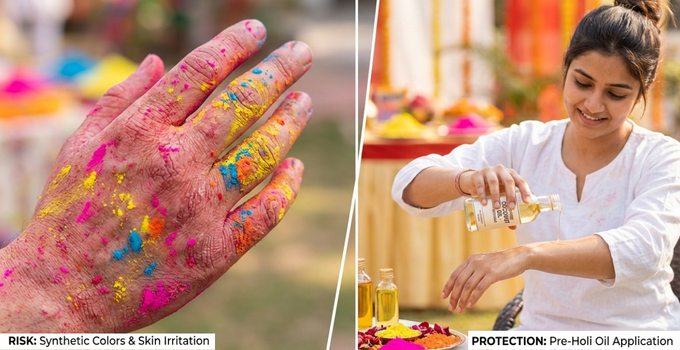
Contact dermatitis is the most common outcome. It manifests as redness, itching, hives, and in severe cases, blistering or chemical burns. People with pre-existing eczema or psoriasis face an amplified risk because their skin barrier is already compromised. Heavy metals like lead and chromium in synthetic colours penetrate intact skin and accumulate in superficial tissue layers, triggering delayed hypersensitivity reactions that appear 24 to 72 hours after exposure.
Seeking timely Holi skin allergy treatment can prevent complications and reduce long-term skin damage.
If you or your loved ones are facing these issues, the next section will help you.
How to Protect Your Skin
Apply a generous layer of coconut oil, petroleum jelly, or a thick moisturiser to all exposed skin to create a barrier and reduce direct chemical contact.
Wear full-sleeve clothing to minimise skin exposure.
Choose BIS-certified, certified organic colours or homemade alternatives.
After playing Holi, rinse with cool water first, then use a gentle pH-balanced cleanser.
These simple steps often act as an effective Holi rash remedy when followed promptly after exposure.
Eye Care During Holi: Preventing Colour-Induced Injury
The eyes are among the most vulnerable organs during Holi. Chemical compounds in synthetic powders elevate the risk of conjunctivitis, keratitis, and, in rare but documented cases, vision loss.
A report from AIIMS Ophthalmology documented a rise in emergency eye issues during and immediately after Holi, with chemical conjunctivitis and corneal foreign body cases peaking within 24 hours of the festival.
So what are the symptoms you should watch out for? These include redness, tearing, photosensitivity, blurred vision, a gritty feeling, or visible discolouration of the whites of the eye. Eye irritation after Holi should never be ignored, especially if symptoms worsen rather than improve within a short time. Remember to visit an eye specialist if you face any of these issues.
Protective Measures for Your Eyes
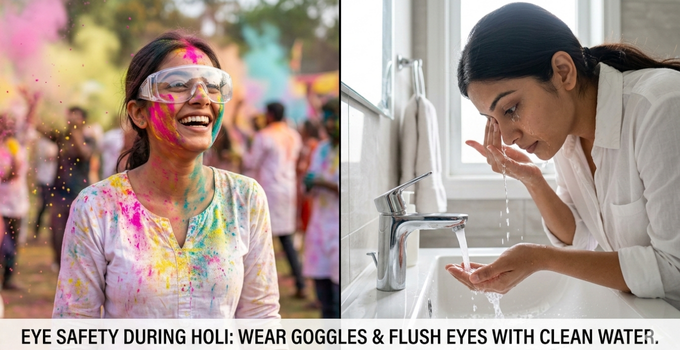
Wear protective goggles throughout outdoor celebrations.
Remove contact lenses before play. Colour particles lodge beneath lenses and concentrate chemical exposure directly on the corneal surface.
If colour enters the eye, flush immediately with large amounts of clean, room-temperature water for at least 15 minutes. Do not rub.
Apply lubricating eye drops (artificial tears) after flushing to soothe the surface.
Visit an ophthalmologist promptly if discomfort, blurred vision, or redness persists beyond an hour after rinsing.
Asthma and Holi: Managing Airborne Colour Triggers
For the estimated 30 million people living with asthma in India, Holi celebrations carry respiratory risks that many underestimate. Dry gulal creates dense clouds of fine particulate matter when thrown into the air. Particles smaller than 10 microns (PM10) travel deep into the bronchial passages, while ultrafine particles below 2.5 microns (PM2.5) reach the alveoli and trigger inflammatory responses.
Research published in the journal Respiratory Medicine has linked festival-related deterioration in air quality to measurable increases in emergency presentations for bronchospasm. Synthetic colour particles carry surface-adsorbed chemicals that act as irritants, compounding the physical obstruction caused by particulate inhalation.
During festivals, the amount of dust and fine particles in the air rises sharply. This has been linked to more people rushing to hospitals with breathing problems like bronchospasm. The powders used in synthetic colours often carry harmful chemicals on their surface, which irritate the airways and make breathing even harder.
For people with allergic asthma, the risk is greater because some colours are mixed with substances like starch, talc, or perfumes. These can trigger allergic reactions through the body’s immune system.
Asthma Management Tips for Holi
Consult your pulmonologist before Holi if your asthma is not well-controlled. Your doctor may recommend a short course of preventive medication.
Always carry your rescue inhaler (SABA) and ensure it has a full dose count. Do not leave it indoors during celebrations.
Wear a well-fitting N95 respirator mask. Standard surgical masks do not effectively filter fine particulate matter.
Choose wet celebrations over dry gulal. Liquid colours produce fewer airborne particles.
Participate in indoor or smaller-group celebrations rather than large outdoor gatherings, where air colour density is highest.
If you experience chest tightness, wheezing, or breathlessness, step away from the crowd immediately, use your rescue inhaler, and seek medical attention if symptoms do not resolve within 20 minutes.
Following these Holi health tips can significantly lower the risk of respiratory complications during celebrations.
Who Needs Extra Caution?
Children have thinner, more permeable skin and narrower airways than adults, which amplifies chemical absorption and increases respiratory impact.
Pregnant women should avoid prolonged exposure to synthetic colour chemicals, particularly those containing heavy metals with documented teratogenic potential.
Elderly individuals and those on immunosuppressive therapy face a higher risk of secondary skin infections if the skin barrier breaks down after colour exposure.
Anyone with a known drug allergy should check whether colour ingredients might cross-react with their sensitising compound.
Can Holi Colours Damage Your Hair?
Yes, Chemical colours in Holi can damage hair. The same heavy metals and industrial dyes that irritate skin also strip the hair's natural protective lipid layer, leaving the cuticle rough and porous.
Repeated or prolonged exposure to synthetic gulal has been associated with hair fall, scalp irritation, dry brittle strands, and in some cases, scalp dermatitis that resembles dandruff or psoriasis.
To protect your hair, apply a generous coat of coconut or almond oil from roots to tips before playing. Tuck your hair into a braid or bun, then cover it with a scarf or bandana.
After celebrations, rinse with lukewarm water before shampooing, as hot water opens the hair shaft, allowing deeper penetration of residual chemicals.
Is Talcum Powder in Gulal Harmful?
Many dry powder preparations use talcum powder as a base filler because it is inexpensive and gives colour a smooth, lightweight texture. While cosmetic-grade talc is considered low-risk, its use in unregulated Holi colour manufacturing raises two concerns. Many people ask, is gulal safe, but the answer depends largely on whether the product is regulated and free from industrial-grade fillers.
First, industrial-grade talc is not subject to the same purity standards as cosmetic talc and may contain trace asbestos-like fibres. Second, when talc-based gulal becomes airborne in large quantities, the ultrafine particles contribute to PM2.5 load in the immediate environment, aggravating the respiratory risk already posed by synthetic dyes. People with asthma or COPD should treat talc-based gulal with the same caution as any other synthetic powder.
Are Herbal Holi Colours 100% Safe? The Honest Answer
Herbal and organic colours are significantly safer than synthetic alternatives, but the claim of being 100% safe demands closer scrutiny. Truly natural colours made from turmeric, palash flowers, indigo, and beetroot carry minimal risk for most people.
However, some individuals are allergic to specific plant compounds. People with a known sensitivity to the Asteraceae (daisy) family may react to certain botanical colour bases.
The word "herbal" on packaging is also unregulated in India unless the product carries BIS certification (IS 16008), meaning some products labelled as herbal may still contain synthetic binders or fragrance additives.
If you or your child has known plant allergies, do a patch test on the inner forearm 24 hours before Holi. Homemade preparations remain the most transparent and controllable option.
Frequently Asked Questions
1. What to do if colour goes in eye?
Rinse the eye immediately with clean, room-temperature water for at least 15 minutes. Do not rub. Remove contact lenses if worn. If redness, pain, blurred vision, or irritation continues beyond an hour, consult an eye specialist.
2. How to remove Holi colour from skin?
First rinse with plain water to remove loose colour. Then apply coconut or almond oil to loosen pigments, then wash with a mild, pH-balanced cleanser. Avoid harsh scrubbing as it can worsen irritation.
3. How to remove Holi colour naturally?
Massage natural oils, such as coconut or olive oil, onto the skin and leave it on for 10 to 15 minutes. Wash gently with lukewarm water and a mild cleanser. Reapply moisturiser to restore the skin barrier.
4. Can Holi colours trigger asthma?
Yes. Dry gulal releases fine particles that can irritate airways and trigger wheezing or breathlessness, especially in people with asthma. Wearing an N95 mask and carrying a rescue inhaler is strongly advised.
5. Are herbal Holi colours 100% safe?
Herbal colours are generally safer than synthetic ones, but they are not completely risk-free. Some people may still react to plant ingredients. Always check certification and consider a patch test before use.
6. Is talcum powder in gulal harmful?
Unregulated talc used in gulal may contain impurities and fine particles that irritate the lungs when inhaled. People with asthma or respiratory issues should avoid heavy exposure.
7. Can Holi colours damage hair?
Yes. Synthetic colours can strip natural oils from the scalp and hair, leading to dryness, irritation, and hair fall. Applying oil before playing and washing gently afterwards helps reduce damage.
Read Also
References
Ghosh S, Mukhopadhyay S, Sarkar R, et al. Dermatoses among children following the Holi festival in India. Indian J Dermatol. 2016;61(6):633–636.
Available from: https://www.ncbi.nlm.nih.gov/pmc/articles/PMC5029238/Bossmann K, Bach S, Höflich C, et al. Holi colours contain PM10 and can induce pro-inflammatory responses. J Occup Med Toxicol. 2016;11:42.
Available from: https://pubmed.ncbi.nlm.nih.gov/27617025/Chakraborty R, et al. Assessment of toxic metals and endotoxins in synthetic Holi colours sold in India. Biol Trace Elem Res. 2022;200(8):3562–3570.
Available from: https://pubmed.ncbi.nlm.nih.gov/35463105/Bureau of Indian Standards. IS 16008:2012. Safety requirements for Holi colours. New Delhi: BIS; revised 2019. Available from: https://www.services.bis.gov.in
Disclaimer: The content in this blog is for general informational purposes only and is not a substitute for professional medical advice, diagnosis, or treatment. Always consult your doctor or a registered dietitian before making any changes to your diet, especially if you have a medical condition or are taking prescribed medication. While the information is based on trusted sources, individual needs and results may vary. MrMed does not promote or endorse any specific food or treatment mentioned unless explicitly stated.












Comments