

Mental Health vs Mental Illness: What Is the Difference?





Last updated on 05 Jul 2026
These two terms get used interchangeably every day in conversations, on social media, and in doctors' offices, but they do not mean the same thing. Confusing them creates real problems: people with diagnosable mental illness may assume they just need to "think more positively", while people in genuine psychological distress assume they are "not sick enough" to deserve help. Getting the distinction right matters.
This blog explains the difference between mental health and mental illness clearly, without medical jargon, and in a way that is actually useful.
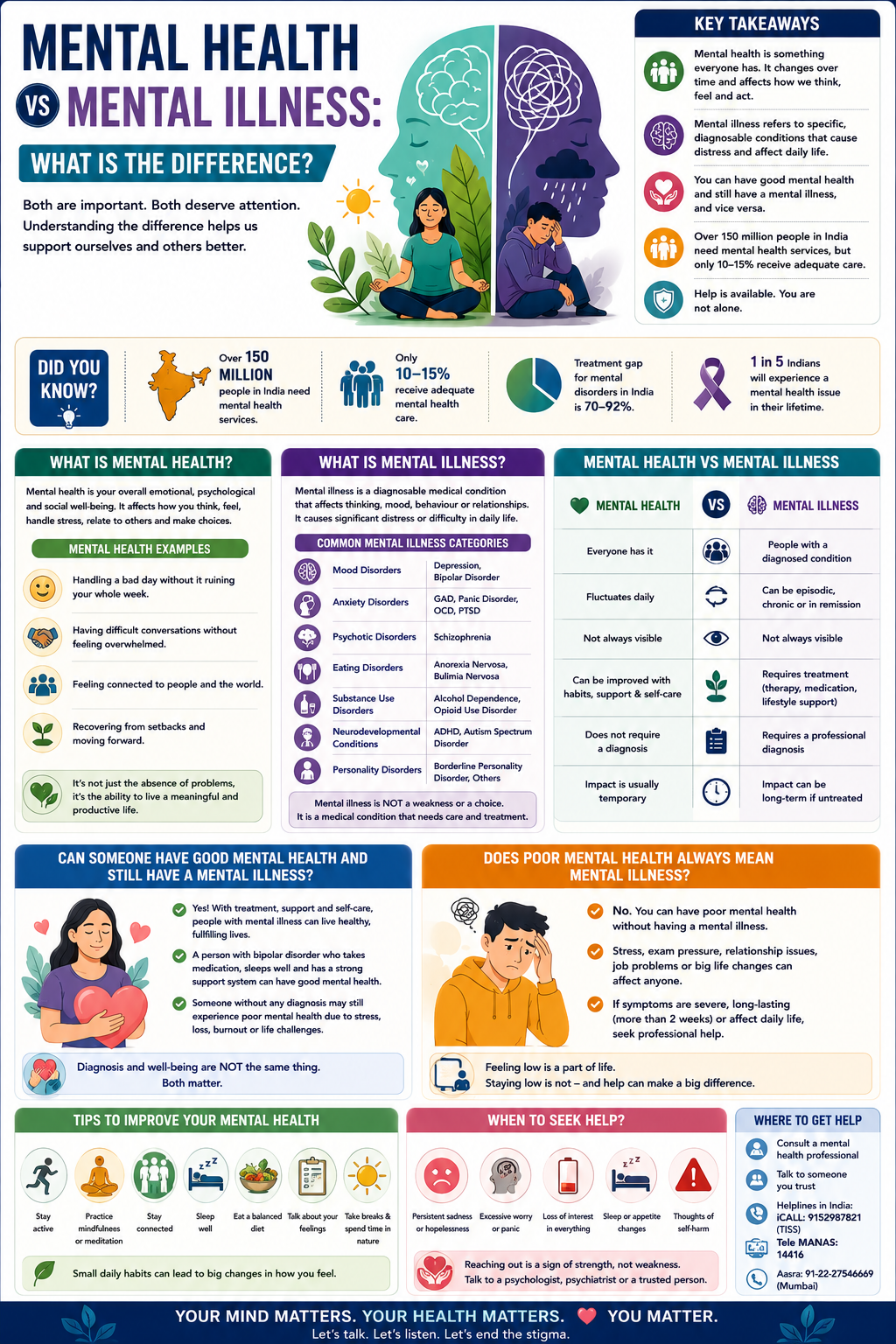
Key Takeaways
|
What Is Mental Health?
Mental health meaning, is the degree of psychological and emotional wellness of an individual. According to the World Health Organisation, Mental Health is not only the absence of disorder or ill health, but also the individual's ability to realise their full potential, cope with normal day-to-day stressors, perform productively, and contribute to the community.
Mental health examples: General examples of what mental health may appear like in day-to-day life is equal to being able to get over a bad day or a bad event without your entire week being ruined; being able to have difficult conversations without becoming so overwhelmed as to lose your ability to respond; feeling as though you are connected to other people in the world; being able to overcome or recover from a setback after an event has occurred.
Mental health awareness: As a result of the COVID pandemic, the issue of mental health in India has become an increased focus area; however, many people still only perceive mental health issues in the instance that something "bad" occurs. The reality is that everyone's mental health is placed somewhere on a spectrum, and we all go through this spectrum at different points throughout our lives.
What Is Mental Illness?
Mental illness meaning: A mental illness is a diagnosed medical condition. It has established diagnostic criteria, affects thinking, feelings, behaviour, and/or interpersonal relations, and causes functional impairment or distress. Mental illness is not caused by some character flaw, lack of character or being weak. Mental illness is a condition with clear diagnostic criteria, physical and emotional treatments based on evidence, and has physical, emotional, and social causes.
The mental disorders list recognised internationally includes:
Category | Examples |
Mood disorders | Depression, bipolar disorder |
Anxiety disorders | Generalised anxiety disorder, panic disorder, OCD, PTSD |
Psychotic disorders | Schizophrenia |
Eating disorders | Anorexia nervosa, bulimia nervosa |
Substance use disorders | Alcohol dependence, opioid use disorder |
Neurodevelopmental conditions | ADHD, autism spectrum disorder |
Personality disorders | Borderline personality disorder, narcissistic personality disorder |
As per the National Mental Health Survey of India (NMHS, 2015/2016), almost 10.6% of adults are affected by a mental issue, and approximately 13.7% of people have experienced some form of mental issue throughout their lifetime. The biggest issue remains the problem of access to mental health services, which is one of the largest gaps in the world.
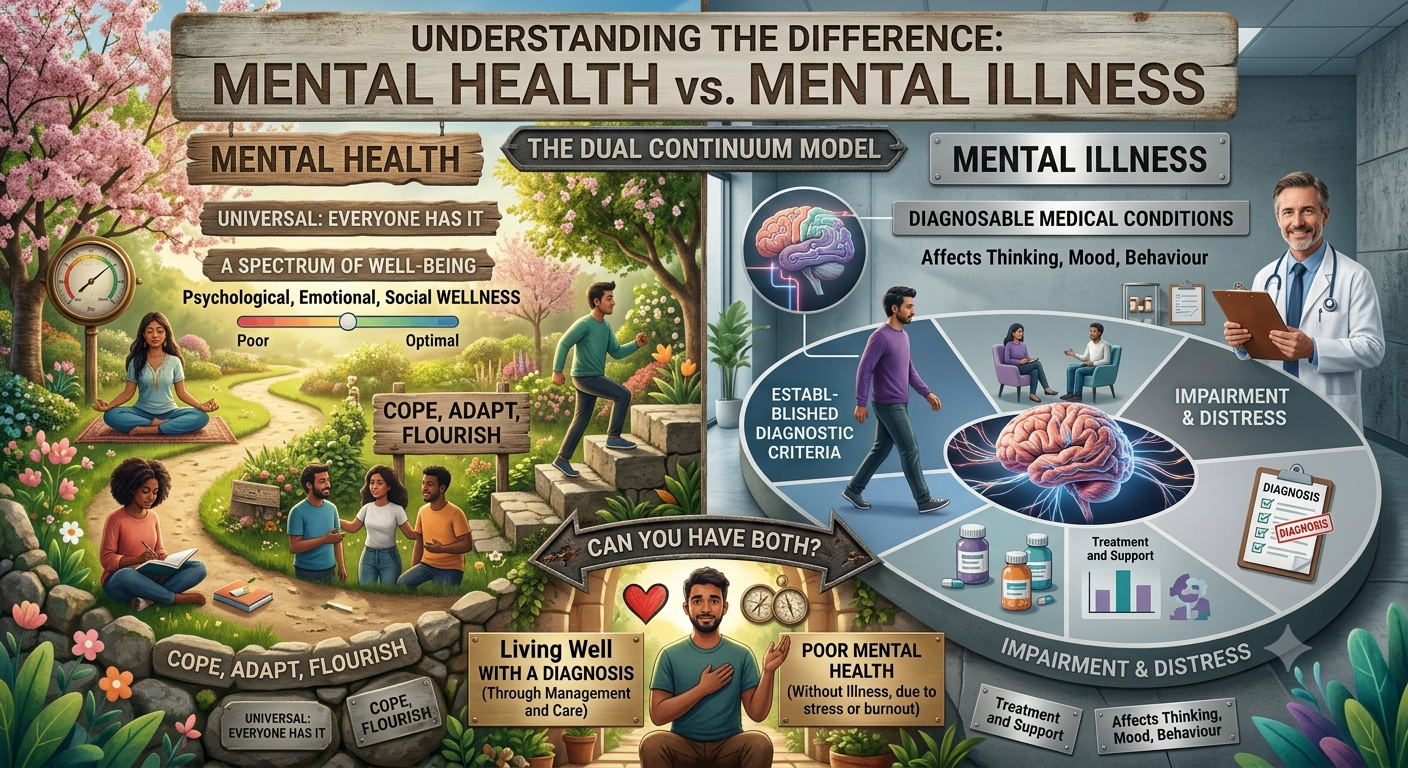
Mental Health Is Same as Mental Illness: True or False?
False, and this is one of the most important things to understand.
Mental health is not the same as mental illness. Here is the clearest way to understand the distinction :
Mental Health | Mental Illness | |
Who has it? | Everyone | People with a diagnosed condition |
Is it fixed? | No, it fluctuates constantly | Can be episodic, chronic, or in remission |
Is it visible? | Not always | Not always |
Can it be improved? | Yes, with consistent habits and support | Yes, with treatment and care |
Requires diagnosis? | No | Yes |
The difference between mental health and mental illness is essentially this: mental health is a continuum that everyone sits on. Mental illness is a clinical diagnosis that describes a specific condition affecting how the brain functions.
Can Someone Have Good Mental Health and Still Have a Mental Illness?
Yes, and this surprises many people. Can someone have good mental health and still have a mental illness? Absolutely.
Someone who has a diagnosis of bipolar disorder, takes their medications as prescribed, attends therapy regularly, sleeps well on a regular schedule, has a good support system, and practices self-care can have a significant level of mental well-being most days. On the other hand, someone who does not have a diagnosis of any mental disorder may or may not have any mental health problems, but can sometimes experience poor mental health due to factors such as chronic stress, social isolation, experiencing the loss of a loved one or experiencing workplace burnout.
These two aspects of a person's mental health each function independently of one another. Therefore, treating a diagnosis as the sole avenue for obtaining support is ineffective, nor is it effective to assume that the absence of a diagnosis means a person is doing fine.
Does Poor Mental Health Always Mean Mental Illness?
No, it does not.
Dr Vikram Patel, Paul Farmer Professor at Harvard Medical School and co-founder of Sangath, one of the most cited Indian voices in global mental health, identifies stigma as the central barrier: "Stigma is an enormously important factor for global mental health as it influences whether people identify and come for treatment." In India, that stigma is compounded by a system where the overwhelming majority of mental health professionals remain concentrated in a handful of urban centres.
After experiencing different situations of loss, relationship break-ups, financial issues, or work overload, many people will experience times of low mental health. All of these situations cause difficulty and pain for all parties involved and deserve attention; however, they do not automatically qualify for clinical diagnoses.
This distinction is significant, as the way one responds differs. While an individual with low mental health may benefit from various lifestyle modifications, resting, socialising, or talking with someone he/she trusts, an individual with a diagnosis will typically need to see a professional for treatment (e.g., therapy, medication, or a combination).
What Are the Signs of Poor Mental Health?

What are the signs of poor mental health as opposed to a specific diagnosable condition? Here are the early markers worth paying attention to:
Persistent low mood that does not lift after a few days
Difficulty sleeping or sleeping far more than usual
Withdrawing from friends, family, or activities you usually enjoy
Difficulty concentrating on ordinary tasks
Physical symptoms without a clear cause: headaches, stomach problems, fatigue
Feeling overwhelmed by situations that previously felt manageable
Increased use of alcohol, food, or other substances to cope
These signs of mental illness overlap with signs of poor mental health, which is why a professional assessment matters when symptoms persist or worsen.
Mental Illness Symptoms and Causes
Mental illness symptoms vary considerably depending on the condition, but common themes across many diagnoses include:
Marked changes in mood, sustained low mood, extreme highs, or rapid shifts
Distorted thinking, paranoia, intrusive thoughts, or disconnection from reality
Changes in appetite, sleep, and energy levels
Difficulty maintaining relationships or fulfilling responsibilities
Thoughts of self-harm or suicide
Causes of mental illness: Most conditions are created by a variety of things and are not just one. Conditions develop from a combination of genetic factors, brain chemistry, life experiences, especially childhood trauma, physical health, being alone, and environmental stressors. According to India's National Mental Health Survey, mental health illnesses occur in greater numbers in cities (13.5%) than in the country (6.9%), which shows the effect of the surroundings, being able to access medical care, and social pressures on mental health.
How to Improve Mental Health: Practical Starting Points

This is not wishful thinking. An umbrella review published in the British Journal of Sports Medicine (2023), covering 97 systematic reviews, 1,039 trials, and over 128,000 participants, found that physical activity, including walking, yoga, and strength training, produced medium-to-large reductions in depression, anxiety, and psychological distress compared to usual care, across healthy adults and people with chronic conditions alike.
How to improve mental health does not require a diagnosis, a therapist, or a dramatic lifestyle overhaul. It starts with small, consistent choices:
Sleep consistently: poor sleep is both a symptom and a driver of poor mental health
Move your body: even 20 minutes of walking daily has measurable effects on mood
Stay connected: isolation compounds every mental health challenge
Limit alcohol: it is a depressant and worsens anxiety over time
Talk to someone: a friend, a family member, or a professional
Reduce screen time before bed, particularly social media
Seek help early: the earlier a problem is addressed, the easier it is to resolve
Mental Health Facts Worth Knowing
Some mental health facts that often go unspoken in India:
India has approximately 0.75 psychiatrists per 100,000 population; the WHO recommends at least 3.
40 per cent of Indian teenagers report stress and anxiety as their biggest concerns, according to a 2024 Indian Psychiatric Society study.
The economic burden of mental health conditions in India is estimated at 2,443 disability-adjusted life years (DALYs) per 100,000 population.
Is everyone affected by mental health? Yes. The WHO is explicit: mental health is a universal human experience, not a niche concern.
FAQs
Q1. What is the difference between mental health and mental illness?
Mental health is the state of your psychological well-being. Everyone has it, and it changes over time. Mental illness is a specific, diagnosable condition that significantly affects how a person thinks, feels, or functions.
Q2. Can someone have good mental health and still have a mental illness?
Yes. A person managing a diagnosed condition well with treatment and support can have strong mental well-being. They are not the same thing.
Q3. Does poor mental health always mean mental illness?
No. Grief, burnout, and stress can cause poor mental health without meeting the criteria for a clinical diagnosis. Both deserve care.
Q4. What are the signs of poor mental health?
Persistent low mood, withdrawal from others, difficulty concentrating, disrupted sleep, and physical symptoms without a clear cause are common early signs.
Q5. Is mental health the same as mental illness? True or false?
False. Mental health is a spectrum everyone sits on. Mental illness is a clinical diagnosis. The two overlap but are not interchangeable.
Final Thoughts
One of the primary benefits of this distinction is that it broadens the access point for groups that fall into both categories. Not only does it affirm to those who do not have a diagnosis that their struggles are true and valid, but it also affirms to those who do have a diagnosis that living well with true, healthy mental health is possible and an achievable goal of treatment.
Mental health being promoted in India is continuing to move forward; however, raising mental health awareness alone is closing the loop too quickly without any action. If you have had an ongoing history of mental health issues, for whatever reason, seek out a qualified person and talk to them. Speaking to a doctor, counsellor, or trusted individual is an acceptable action to take, and it is not the last option to consider.
Read Also
https://www.mrmed.in/health-library/womens-health/mental-health-tips-for-women
https://www.mrmed.in/health-library/mental-wellness/tips-for-working-professionals
https://www.mrmed.in/health-library/mental-wellness/mens-mental-health
References
World Health Organisation [Internet]. Geneva: WHO; [cited 2026 Jun 25]. Mental health: India. Available from: https://www.who.int/india/health-topics/mental-health
Ministry of Health and Family Welfare, Government of India [Internet]. New Delhi: Press Information Bureau; 2025 Feb 7 [cited 2026 Jun 25]. Advancing mental healthcare in India. Available from: https://www.pib.gov.in/PressReleaseIframePage.aspx?PRID=2100706
Ministry of Health and Family Welfare, Government of India [Internet]. New Delhi: Press Information Bureau; 2024 Oct 9 [cited 2026 Jun 25]. World Mental Health Day 2024: enhancing mental wellbeing. Available from: https://www.pib.gov.in/PressNoteDetails.aspx?NoteId=153261&ModuleId=3
Disclaimer: This article is for general informational and awareness purposes only. If you or someone you know is experiencing mental health difficulties, please consult a qualified mental health professional. In a crisis, contact iCall on 9152987821 or Vandrevala Foundation Helpline on 1860-2662-345.











Comments