

HIV Prevention Explained: The New Medicine Moving Closer to India





Last updated on 03 Nov 2026
For India, the development is particularly significant. The country has a large population living with HIV, and stigma, privacy concerns and unequal access to healthcare can make prevention and testing more difficult.
HIV prevention may be entering a new era. A medicine called lenacapavir has shown remarkable results in clinical trials, offering protection against HIV with injections given just twice a year. For people who find it difficult to take a PrEP (Pre-Exposure Prophylaxis) preventive tablet every day, this could offer an important new option.
Generic versions of lenacapavir could eventually make this long-acting option more affordable, although its final approval and launch for HIV prevention in India remain to be confirmed.
But what exactly is lenacapavir? How does it prevent HIV, and could it change the way India approaches HIV prevention?
Key Takeaways
|
Understanding HIV Beyond the Myths
Human immunodeficiency virus (HIV) attacks the immune system, particularly CD4 cells, which help the body fight infections. Without effective treatment, HIV can gradually weaken the immune system and progress to acquired immunodeficiency syndrome (AIDS), the most advanced stage of HIV infection.
HIV is not the same as AIDS. A person can live with HIV for many years without developing AIDS, particularly when they receive appropriate treatment.
HIV can be transmitted through certain body fluids, including blood, semen, vaginal fluids, rectal fluids and breast milk. It can spread through sexual contact, sharing contaminated needles, and from a mother to her child during pregnancy, childbirth or breastfeeding. Effective treatment and preventive interventions can substantially reduce these risks.
HIV does not spread through hugging, shaking hands, sharing meals, using the same toilet or sitting beside someone. Everyday social contact is safe.
Despite these facts, HIV continues to carry a social burden in many communities. Fear of judgement may prevent people from seeking testing, discussing prevention with a healthcare professional or disclosing their status to others.
This matters in India, where HIV prevention must address more than the virus itself. People also need confidential services, accurate information, respectful healthcare and freedom from discrimination. This is where lenacapavir comes in.
What Is Lenacapavir and How Does It Prevent HIV?
Lenacapavir is a long-acting antiviral medicine that targets HIV's capsid, the protein shell that surrounds and protects the virus's genetic material.
The capsid helps HIV complete several steps in its life cycle, including transporting its genetic material into a host cell and assembling new virus particles. By interfering with the capsid's normal function, lenacapavir disrupts processes the virus needs to replicate.
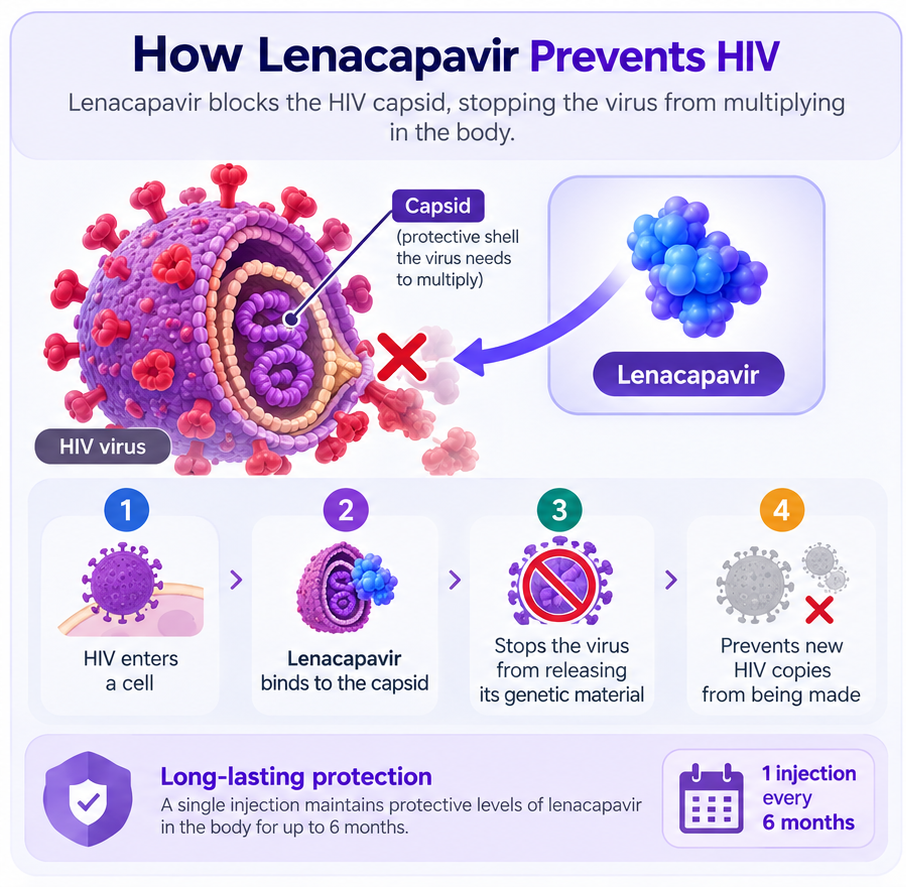
The most important difference from daily oral PrEP is its dosing schedule. The approved US prevention regimen begins with oral tablets and injections, followed by a maintenance injection every six months. The exact initiation regimen and eligibility requirements must be followed under medical supervision.
This does not mean someone can simply receive an injection without testing or follow-up. HIV testing before starting treatment and at subsequent visits is essential. Taking lenacapavir for prevention when someone already has an undiagnosed HIV infection can increase the risk of developing drug resistance.
Lenacapavir is also not a cure for HIV and does not replace antiretroviral treatment for people already living with the infection.
What Clinical Trials Have Shown
The evidence behind lenacapavir is particularly encouraging.
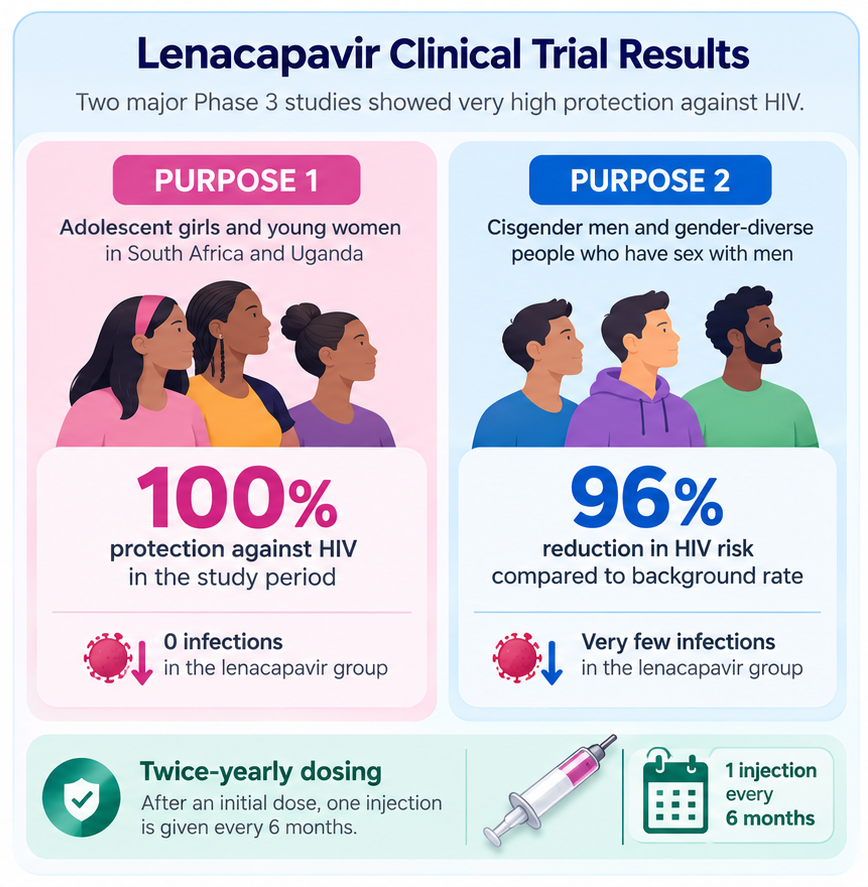
Two major Phase III clinical trials, PURPOSE 1 and PURPOSE 2, evaluated lenacapavir for HIV prevention in different populations.
Lenacapavir in India: The Latest Regulatory Update
As of 22 October 2026, the key development is progress towards generic lenacapavir for HIV prevention, not confirmed commercial availability.
At its meeting on 11 August 2026, the CDSCO Subject Expert Committee recommended waiving local Phase III clinical trials and bioequivalence studies for generic injectable lenacapavir applications submitted by Dr Reddy's Laboratories and Emcure Pharmaceuticals for PrEP.
A bioequivalence study checks whether a generic medicine behaves sufficiently like the reference medicine in the body. A Phase III clinical trial evaluates a medicine's safety and effectiveness in a larger group of people.
The price of lenacapavir is also a major part of the access question. Reports in September 2026 cited an indicative target of approximately US$40 per person per year for generic supply in eligible markets. This is a reported target, not a confirmed retail price for lenacapavir in India.
The eventual lenacapavir price in India will depend on regulatory approval, manufacturing costs, supply capacity, competition and how the medicine is distributed. It would be misleading to present the US$40 figure as a guaranteed Indian price.
The Social Impact Could Extend Beyond the Injection
The significance of lenacapavir goes beyond its dosing schedule.
For some people, taking daily PrEP can raise concerns about privacy. A medicine associated with HIV prevention may be misunderstood by family members, partners or others who see it. Someone may worry that taking it will lead to assumptions about their HIV status or sexual behaviour.
A twice-yearly injection could reduce the need to store and take daily preventive tablets. For people who prefer this approach, it may offer greater convenience and a degree of privacy.
It could also give healthcare professionals another way to support people who have difficulty maintaining daily medication routines.
However, lenacapavir will not automatically remove stigma. Someone may still fear visiting a clinic, discussing their sexual health or being judged by healthcare workers. An injectable medicine also requires reliable access to a provider and follow-up care.
For India, the wider opportunity lies in combining scientific progress with better awareness, confidential services and non-judgemental healthcare. Effective prevention should be accessible without requiring people to justify their personal lives or face discrimination.
HIV in India: Progress and the Work That Remains
India has made considerable progress in HIV prevention and treatment. However, the epidemic has not ended.
According to the National AIDS Control Organisation's India HIV Estimation 2025 Technical Report, an estimated 25.61 lakh people were living with HIV in India in 2024, including women who accounted for 44% of this population. The report also recorded an estimated adult HIV prevalence of 0.20%.
These figures show why continued investment in testing, treatment and prevention remains essential. A relatively low national prevalence does not mean that every community faces the same level of risk or has equal access to care.
India's HIV response includes testing services, antiretroviral therapy (ART), condom promotion and targeted prevention programmes. However, barriers such as stigma, limited awareness and concerns about confidentiality can affect whether people use these services.
New prevention options could help address some of these gaps, particularly when they give people more control over how they protect their health.
What Still Needs to Happen
Several steps will determine whether generic lenacapavir can make a meaningful difference in India:
Regulatory approval: The relevant authorities must grant final marketing authorisation for the prevention indication.
Affordable pricing: Generic production needs to translate into a price that people and public health programmes can realistically afford.
Reliable supply: The complete regimen must be available, with the necessary infrastructure for administration and follow-up.
Accessible testing and counselling: People need appropriate HIV testing before starting PrEP and during follow-up.
Public awareness: Clear information must explain who can benefit from PrEP, how it works and why HIV-related stigma is harmful.
The availability of a medicine is only one part of effective prevention. It must also reach the people who could benefit from it.
Conclusion
The global goal of ending AIDS as a public health threat by 2030 is not the same as promising a cure for HIV by that date.
Antiretroviral therapy has transformed HIV from an often fatal infection into a manageable chronic condition for many people who can access and adhere to treatment. Effective treatment can suppress the virus to undetectable levels, protect health and prevent sexual transmission. However, treatment does not routinely eliminate HIV from the body.
Research into HIV cures and vaccines continues, but there is no widely available cure that can reliably eliminate HIV in everyone living with it. Lenacapavir is a major development in prevention, not a cure.
The more realistic near-term goal is to reduce new infections, expand access to testing and treatment, prevent avoidable deaths and ensure that people living with HIV can lead healthy lives without stigma or discrimination.
FAQs
Q1. What is lenacapavir, and how does it prevent HIV?
Lenacapavir is a long-acting antiviral medicine that targets HIV's capsid, a protein shell the virus needs to complete key steps in its life cycle. When used as pre-exposure prophylaxis (PrEP), it reduces the risk of acquiring HIV. The prevention regimen involves an initial dosing phase followed by injections every six months.
Q2. Is generic lenacapavir available in India?
No. As of 22 October 2026, final Indian marketing authorisation and commercial availability for generic lenacapavir for HIV prevention have not been confirmed in the regulatory records reviewed.
Q3. How much will lenacapavir cost in India?
The Indian price has not been confirmed. Reports have cited a target of around US$40 per person per year for generic supply in eligible markets, but this should not be treated as a confirmed Indian retail price. Actual costs will depend on approvals, supply arrangements and pricing decisions.
Q4. Who can use lenacapavir for HIV prevention?
In the United States, Yeztugo is approved for adults and adolescents weighing at least 35 kg who are at risk of sexually acquired HIV-1. People must test HIV-negative before starting it and undergo appropriate follow-up testing. The applicable eligibility criteria in India will depend on the eventual Indian authorisation and clinical guidance.
Q5. Will HIV be curable by 2030?
There is no confirmed timeline for a widely available HIV cure. Research continues, and effective treatment already allows many people living with HIV to maintain good health. Ending AIDS as a public health threat by 2030 is a broader public health goal, not a promise that HIV will be cured by that year.
Read also
References
https://www.who.int/news/item/14-07-2025-who-recommends-injectable-lenacapavir-for-hiv-prevention
https://www.accessdata.fda.gov/drugsatfda_docs/label/2025/220018s000lbl.pdf
https://www.moneycontrol.com/news/business/drugmakers-move-closer-to-launch-landmark-hiv-drug-as-cdsco-eases-approval-process-14034536.html
Medical Disclaimer: This article is intended for general educational purposes and does not replace medical advice, diagnosis or treatment. Lenacapavir should be used for HIV prevention only under appropriate medical supervision and in accordance with local regulatory guidance.












Comments