

How Epilepsy Is Diagnosed: Tests, Scans, and What to Expect from Your Doctor





Last updated on 02 Jan 2026
Key Takeaways
|
Epilepsy is a neurological condition that causes recurring seizures, but diagnosing it is not always straightforward. No single test can confirm epilepsy in every case. Doctors need to evaluate symptoms, medical history, and brain activity to determine whether seizures are truly epileptic or caused by other unrelated issues like fainting, psychological stress, heart rhythm problems, or metabolic disturbances.
This guide explains how epilepsy is diagnosed, the role of modern brain tests, how doctors classify seizure disorders, and what patients and families can expect during the evaluation process.
Why Timely and Accurate Diagnosis Matters
According to the NIMHANS National Mental Health Survey, in 2016, India had 10 million people living with epilepsy. The report emphasises the need for early diagnosis, better access to neurological care, and improved public awareness to reduce treatment delays.
Early diagnosis can help:
Identify the right treatment strategy
Reduce seizure frequency and severity.
Prevent injury or complications.
Improve quality of life.
Identifying the correct seizure type is critical because treatment differs for different types of epilepsy disorders, and some medications are harmful if given incorrectly.
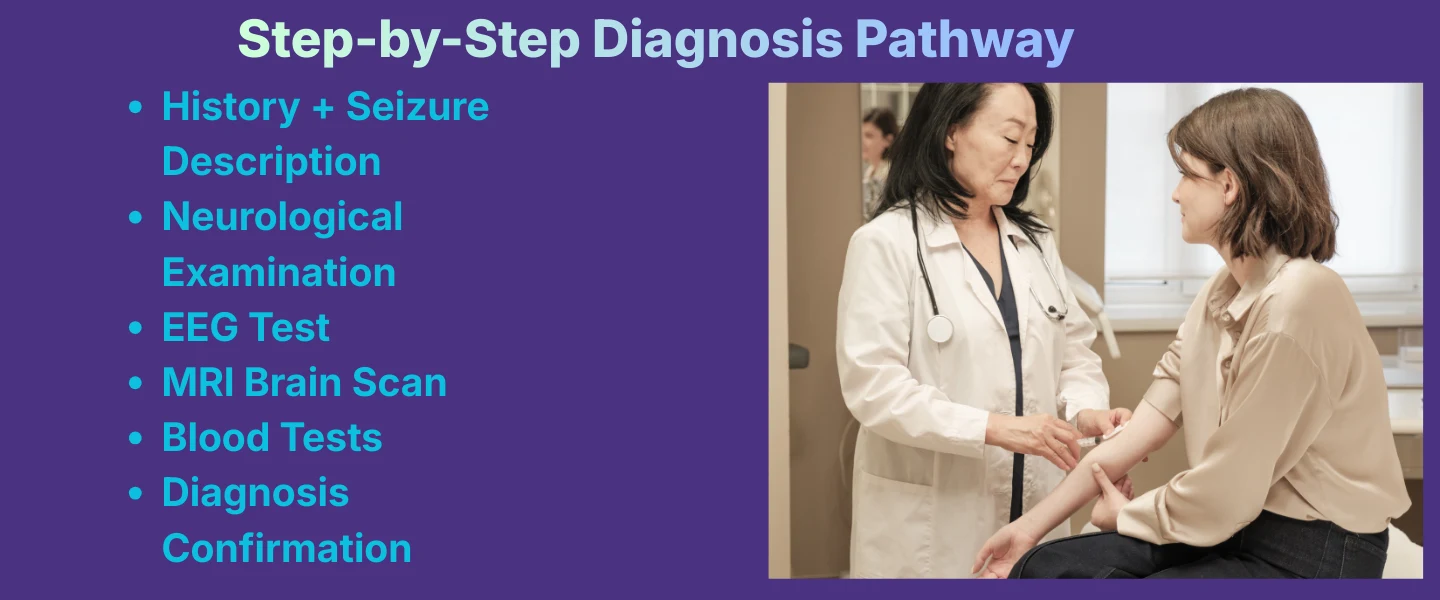
Step 1: Detailed Medical History and Symptom Review
Before any scans or tests, a neurologist will ask about:
What the seizure looked like (movement, awareness, breathing changes)
How long did it last
What the person felt before and after
History of head injury, infections, or developmental issues
Family history of seizures
Witness observations are extremely useful because a person may not remember their episode. Keeping a seizure log with date, time, triggers, and symptoms helps speed up the epilepsy diagnosis process.
Step 2: Physical and Neurological Examination
Doctors assess:
Reflexes
Muscle strength and coordination
Vision and speech
Memory and cognition
These assessments help identify which brain pathways might be affected.
Step 3: EEG Test – The Most Important Tool in Diagnosing Epilepsy
Dr Manjari Tripathi, Professor of Neurology, AIIMS New Delhi, explained that a correct diagnosis requires careful evaluation beyond a single seizure event. EEG and MRI complement each other in identifying the true cause.
One of the first tests doctors recommend is an EEG test for epilepsy.
EEG (Electroencephalogram) records the brain’s electrical signals through small electrodes placed on the scalp.
What the EEG shows:
Whether abnormal electrical activity is present
Which part of the brain does it come from
Seizure pattern and risk of recurrence
Sometimes, a standard EEG may appear normal because brain activity can vary throughout the day. In that case, a doctor may suggest:
Sleep-deprived EEG
Long-term video EEG monitoring
Ambulatory EEG at home
Video EEG also helps differentiate non-epileptic events, such as stress-related pseudo-seizures.
Step 4: MRI Scans – Looking for Physical Brain Changes
The Indian Council of Medical Research (ICMR) recommends EEG + MRI for the diagnosis of new-onset seizures.
An MRI epilepsy scan checks whether seizures are triggered by:
Brain injuries
Tumors
Congenital abnormality
Scarring in the temporal lobe
Epilepsy-specific MRI with high-resolution imaging is preferred because it can detect structural causes that a regular MRI may miss. Correct identification of a lesion can determine whether surgery is an option later.
CT scans may be used in emergencies, but are less detailed for epilepsy evaluation.
Step 5: Blood Tests and Metabolic Screening
Blood tests help rule out conditions that imitate epilepsy, such as:
Electrolyte imbalance
Infections
Genetic disorders
These tests do not directly confirm epilepsy, but ensure the doctor does not overlook other medical causes.
Step 6: Epilepsy Classification – Identifying the Type of Disorder
For an accurate treatment plan, doctors must determine epilepsy classification, which includes:
1. Focal Epilepsy
Starts in one part of the brain
Symptoms depend on the affected region (twitching, sensory changes, unusual behaviours)
2. Generalised Epilepsy
Seizures begin across both sides of the brain.
Common in children and genetic epilepsy syndromes
3. Combined Generalised and Focal
A mix of both patterns
4. Unknown Seizure Type
Used when doctors cannot clearly identify the origin
Correct classification guides medication choice, treatment success, and long-term outcomes.
Step 7: Role of Neurologists and Epilepsy Specialists
Not all seizures are the same, so a neurologist for epilepsy or epileptologist plays a crucial role in:
Confirming diagnosis
Interpreting EEGs and MRIs
Managing medications
Offering advanced treatments like nerve stimulation or surgery
Specialists also educate patients on lifestyle changes, including sleep, safety, and seizure triggers.

When Doctors Suspect Another Condition
Some episodes mimic seizures but are not epilepsy:
Syncope (fainting)
Panic attacks
Psychogenic non-epileptic seizures (PNES)
Diagnosing the correct condition prevents unnecessary medications.
What Patients Can Expect During the Process
Diagnosis may take multiple visits because seizures can be unpredictable. Doctors may ask you to:
Bring a family member or witness to appointments
Record videos of any future events
Note patterns like stress, sleep loss, or flashing lights
The goal is to understand your brain’s behaviour in daily life, not just inside a clinic.
Children vs Adults: Differences in Diagnosis
In children, doctors focus more on:
Genetic and developmental history
EEG patterns characteristic of childhood syndromes
In adults, imaging abnormalities are more commonly found, often linked to injury, stroke, or long-standing disease.
Treatment Begins After Confirming Epilepsy
WHO & ICMR-based national estimates India has a 30–50% epilepsy treatment gap, especially in rural regions.
Once seizures are confirmed:
Anti-seizure medications are prescribed
Regular follow-ups monitor progress.
MRI or EEG may be repeated if symptoms change
Early diagnosis improves long-term seizure control and safety.
FAQs
1. How long does an epilepsy evaluation take?
It varies. Some people are diagnosed after the first EEG and MRI, while others require multiple tests and observation.
2. Can epilepsy be diagnosed with MRI alone?
No. MRI shows structural issues but does not detect electrical abnormalities. EEG is required to assess brain activity.
3. Do all seizures mean epilepsy?
No. Seizures caused by fever, low sugar, or alcohol withdrawal do not always indicate epilepsy. Doctors confirm only when seizures are recurrent and unprovoked.
4. Is EEG painful?
No. It is completely safe and non-invasive.
5. Can epilepsy be misdiagnosed?
Yes. Conditions like fainting or stress-related events may resemble seizures. That’s why proper evaluation is essential.
Final Thoughts
Diagnosing epilepsy requires careful observation, detailed testing, and collaboration between patients, families, and neurologists. With accurate testing, seizure logs, advanced EEG interpretation, and modern brain imaging, doctors can classify the condition correctly and create a personalised treatment plan. Understanding the process helps reduce fear, improve acceptance, and empower individuals to take control of their epilepsy care.
Read also
What Causes Epilepsy? Uncovering the Hidden Triggers and Risk Factors
Radiation in Body Scans: CT, MRI, PET Safety Guide for Patients
References
https://www.mayoclinic.org/diseases-conditions/epilepsy/diagnosis-treatment/drc-20350098
https://www.ninds.nih.gov/health-information/disorders/epilepsy-and-seizures
Disclaimer: The information shared in this blog is meant for general educational purposes only and should not be taken as medical advice. Always consult a qualified healthcare professional for diagnosis, treatment, or medical guidance related to your health. The content is based on reliable sources, but it may not be suitable for every individual’s condition. We do not assume responsibility for any actions taken based on this information. Readers are encouraged to exercise caution and use their discretion when making healthcare decisions.
















Comments