

Skin Cancer Symptoms: Early Warning Signs, ABCDE Rule & When to See a Doctor





Last updated on 15 Oct 2026
Skin cancer often begins with subtle changes, such as a new mole, a non-healing sore, a dry, scaly patch, or changing pigmentation. The blog explains early warning signs, the ABCDE rule, symptoms across different skin cancer types, how skin cancer appears on Indian skin tones, and when prompt dermatological evaluation becomes essential for early detection and better outcomes.
Key Takeaways
|
That Spot on Your Skin: Is It Something to Worry About?
Most of us have noticed an unusual spot or mole at some point, and moved on. A rough patch that won't go away. A mole that looks a little different from last year. A small bump that resembles a pimple but never heals.
These moments are easy to dismiss. But they are worth pausing for. Skin cancer is more common than most people realise, including in India,
where the belief that darker skin offers full protection has quietly allowed many cases to go unnoticed until they are harder to treat.
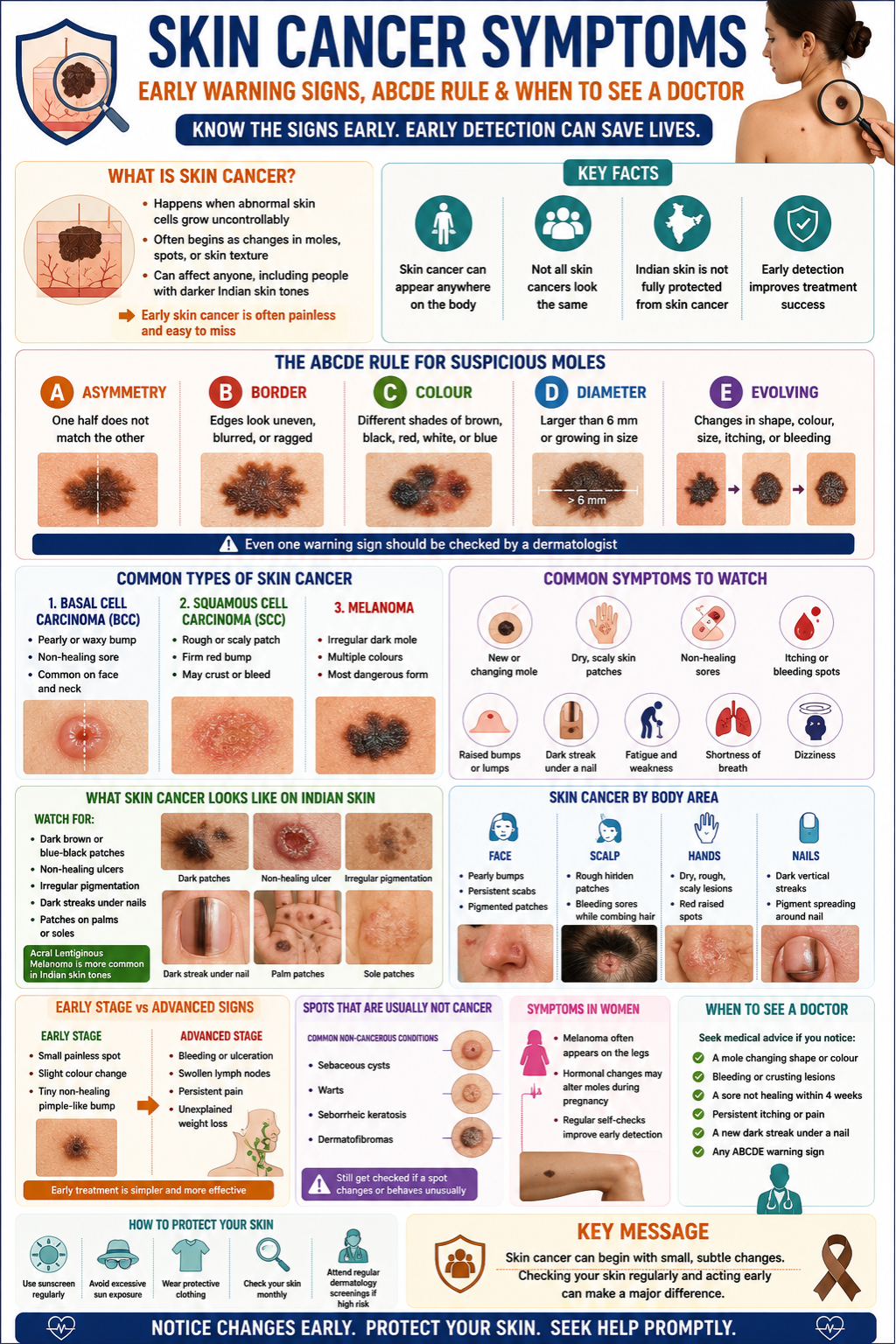
The ABCDE Rule: A Simple Checklist for Suspicious Moles
Dermatologists use the ABCDE rule as their first framework for assessing skin cancer moles. It is designed to be accessible, something anyone can apply during a self-examination.
Letter | Stands For | What to Watch For |
A | Asymmetry | One-half of the spot does not mirror the other |
B | Border | Edges are ragged, blurred, or notched rather than smooth |
C | Colour | Multiple shades in one spot: brown, black, red, white, or blue |
D | Diameter | Larger than 6 mm (roughly the size of a pencil eraser) |
E | Evolving | Any change over weeks: size, colour, shape, or new symptoms like itching or bleeding |
Here is what each letter means in practice:
A: Asymmetry - Draw an imaginary line through the middle of the mole. A healthy mole should be approximately symmetrical on each side. If one side of a mole is rounder than the other, or if the other side of the mole appears flat or jagged, that difference in symmetry would indicate concern. In a normal mole, the two sides should typically be symmetrical.
B: Border - A benign mole will have smooth, well-defined borders. A concerning mole will have borders that are not even, are notched, or fade into the surrounding skin without an obvious or distinct border. Borders of moles that appear scalloped or fuzzy should be examined closely.
C: Colour - A benign mole is typically brown or tan and has uniform colour. Concern arises when a single mole displays multiple colours, such as multiple shades of brown, as well as black, red, white, or blue. Uneven colour distribution across a single mole is an important warning sign of melanoma.
D: Diameter. Most benign moles stay smaller than 6 mm (roughly the size of a pencil eraser). A spot larger than this, or one that is visibly growing in size, warrants evaluation. That said, some melanomas are detected when they are still smaller than 6 mm, so diameter alone should not be the sole criterion.
E: Evolving. This is often the most telling sign. A mole that was stable for years and has now started changing in size, shape, colour, texture, or feel should be assessed promptly. New symptoms, such as bleeding without injury, persistent itching, or crusting that keeps returning, are also signs of evolution that should not be ignored.
If a mole or spot meets even one of these criteria, see a dermatologist. Two or more should prompt an early appointment.
ICMR-NCRP data states skin cancers account for 1–2% of all diagnosed cancers in India, and India's total cancer burden was ~1.39 million in 2020.
.png "MrMed")
Symptoms of Skin Cancer by Type
The three most common types, Basal Cell Carcinoma (BCC), Squamous Cell Carcinoma (SCC), and Melanoma, each present differently.
Feature | BCC | SCC | Melanoma |
Appearance | Pearly or waxy skin cancer bumps; flat flesh-coloured scar-like lesion | Firm red nodule; skin cancer dry scaly patches | Dark, irregular mole; multi-coloured flat patch |
Surface | Smooth, slightly raised | Rough, crusted | Variable |
Common sites | Face, neck, ears | Hands, lower lip, sun-exposed areas | Back, legs, palms, nail beds |
Bleeds easily? | Yes, with minor contact | Sometimes | Occasionally |
Early clue | Looks like a translucent bump or non-healing sore | Wart-like growth; persistent rough patch | A changing or newly appeared irregular mole |
BCC is the most common and least aggressive type. SCC can spread if left untreated. Melanoma is the most serious, but when identified early, outcomes are significantly better.
Dr. Shyam Aggarwal, Chairperson of Medical Oncology at Sir Ganga Ram Hospital, said Moles are very common, and usually they are safe. However, suspicion of cancer should arise if there is evolution in the shape, size, or colour.”
Early Stage vs Advanced Stage: What the Progression Looks Like
Early-stage skin cancer tends to be painless and subtle. It may look like an early stage skin cancer pimple that does not clear up, a slightly discoloured patch, or a mole that has quietly shifted in appearance. At this stage, the cancer remains in the skin's surface layers.
Advanced stage skin cancer presents with more obvious changes: ulceration, bleeding without cause, hardened lymph nodes near the affected area, or systemic symptoms such as fatigue or unexplained weight loss. Treatment becomes significantly more complex.
The difference often comes down to one thing: how early the signs of skin cancer were noticed and acted upon.
What Skin Cancer Looks Like on Indian Skin Tones (Fitzpatrick III–VI)
Darker skin tones carry a lower overall risk of skin cancer, but cases are consistently diagnosed at later stages, largely because warning signs look different and awareness is low.
On Fitzpatrick III–VI skin, watch for:
Hyperpigmented patches that are irregular, growing, or asymmetrical
Deep discolouration appearing blue-black or dark brown rather than the pink-red typical in lighter skin
Non-healing sores or ulcers, even in areas not regularly exposed to sunlight
Acral Lentiginous Melanoma (ALM), the most common melanoma subtype in Indians, presents as a dark streak beneath a nail or a discoloured patch on the palm or sole
The assumption that darker skin is immune to skin cancer is one of the most consequential myths in dermatology. Regular self-checks matter just as much for Indian skin tones.
As per PMC Indian skin types (Fitzpatrick III-VI) have natural melanin protection, but are NOT immune to UV damage; the misconception of immunity leads to delayed diagnosis.
.png "MrMed")
Skin Cancer on Different Body Parts
Skin cancer can develop anywhere, including areas rarely exposed to the sun.
Scalp: A persistent rough or scaly spot hidden beneath hair, or a sore that bleeds when combed. Frequently missed until significant growth occurs.
Face: Pearly bumps, non-healing scabs, or pigmented spots around the nose, eyes, and cheeks. BCC is particularly common here.
Hands: Skin cancer, dry, scaly patches, or firm, raised, red spots on the backs of the hands. SCC frequently develops in chronically sun-exposed areas.
Nails: A dark vertical streak running from the nail base upward, pigment spreading to the surrounding skin, or a nail separating from its bed. These are key ALM warning signs and should never be dismissed as bruising.
Multiple peer-reviewed sources confirm ALM is the most frequently encountered melanoma subtype among Indians and non-Caucasian populations. The mimicry of onychomycosis (fungal nail infection) and subungual haematoma (bruise under nail) is also documented.
Spots That Are NOT Skin Cancer
Several common, harmless skin conditions are frequently mistaken for early stage skin cancer. Knowing the difference reduces unnecessary anxiety.
Sebaceous cysts are soft, slow-growing lumps beneath the skin, movable, painless, and stable. They do not bleed spontaneously.
Seborrheic keratosis appears as waxy, stuck-on brown or black patches in people over 40. Alarming at first glance but benign.
Warts have a rough, cauliflower-like surface caused by HPV. Non-cancerous.
Dermatofibromas are firm brownish bumps on the legs that dimple inward when pinched.
A dermatologist can quickly distinguish these from genuine signs of skin cancer.
.png "MrMed")
When to See a Doctor: A Red Flag Checklist
If you notice any of the following changes in or around your skin, you should see a dermatologist as soon as possible:
A change in size, shape, or colour of a mole.
A sore or lesion not healing within four weeks.
A new growth which is bleeding, crusting, or itching with no apparent cause.
A dark streak appears in the nail of a toe or finger.
Any lesion or growth which meets one or more of the ABCDE criteria for assessing moles.
A solid raised skin (flesh) coloured or red bump with uneven margins.
A new growth or lesion located at the same site several times.
The sooner you identify a change, the better your chances of achieving a successful result. If something seems different, always have it checked.
Skin Cancer Symptoms in Women: Distinct Patterns
Symptoms of skin cancer in women follow specific patterns. Melanoma in women more commonly appears on the legs; in men, more often on the back. Women also tend to detect changes earlier through self-examination, contributing to better early-stage diagnosis rates.
Hormonal changes, including during pregnancy, can cause moles to darken or enlarge. Most such changes are benign, but any evolving mole during this period deserves professional assessment. Women with a history of indoor tanning carry elevated melanoma risk and benefit from routine screenings.
Monthly self-checks in good natural light, including scalp, nail beds, and soles, remain one of the most effective detection habits.
FAQ
1. Is my mole cancerous?
More likely concerning if asymmetrical, irregular borders, multiple colours, diameter over 6 mm, or recent change. The ABCDE rule is a useful starting point, but only a dermatologist can provide the definitive answer.
2. What does skin cancer look like?
It varies by type: a pearly bump, a flat scaly patch, a dark irregular mole, a persistent pimple-like sore, or a stripe under a nail. There is no single appearance, which is why regular monitoring matters.
3. Can dark-skinned people get skin cancer?
Yes. Melanin provides partial UV protection but does not eliminate risk. Acral Lentiginous Melanoma, the form most prevalent in Indians, develops on the palms, soles, and nail beds, areas with minimal sun exposure.
Final Thoughts
Skin cancer is most treatable when caught early, and most warning signs are visible if you know what to look for. Trust your instincts about a changing mole, a sore that will not heal, or a spot that simply looks different from before. Do not wait to see if it resolves on its own. A conversation with a dermatologist is the simplest and most important step you can take today.
Read also
References
American Academy of Dermatology Association. What to look for: ABCDEs of melanoma [Internet]. Rosemont (IL): AAD; cited 2026 May 8. Available from: https://www.aad.org/public/diseases/skin-cancer/find/at-risk/abcdes
The Skin Cancer Foundation. Skin cancer warning signs and images [Internet]. New York: The Skin Cancer Foundation; cited 2026 May 8. Available from: https://www.skincancer.org/skin-cancer-information/skin-cancer-pictures/
American Cancer Society. Signs and symptoms of melanoma skin cancer [Internet]. Atlanta (GA): American Cancer Society; cited 2026 May 8. Available from: https://www.cancer.org/cancer/types/melanoma-skin-cancer/detection-diagnosis-staging/signs-and-symptoms.html
National Cancer Institute. Skin cancer [Internet]. Bethesda (MD): National Cancer Institute; cited 2026 May 8. Available from: https://www.cancer.gov/types/skin
Bradford PT. Skin cancer in skin of color. Dermatol Nurs. 2009;21(4):170-7. Available from: https://pmc.ncbi.nlm.nih.gov/articles/PMC2757062/
Disclaimer: The content in this blog is for general informational purposes only and is not a substitute for professional medical advice, diagnosis, or treatment. Always consult your doctor or a registered dietitian before making any changes to your medicines or diet, especially if you have a medical condition or are taking prescribed medication. While the information is based on trusted sources, individual needs and results may vary. MrMed does not promote or endorse any specific food or treatment mentioned unless explicitly stated.














Comments