

World Thalassemia Day





Last updated on 03 Jun 2026
The prevalence of thalassemia and related disorders in India underscores the need for screening, awareness, and a long-term strategy to combat this condition, as highlighted by World Thalassemia Day 2026. Since many carriers are unaware of their status, testing for prevention is essential. However, the burden on health systems can be diminished through regular treatment and blood donation, as well as improved public education to promote awareness of symptoms.
Key Takeaways
|
A child, depending on blood transfusions every few weeks, is not just facing a medical condition. It reflects a gap in awareness, early testing, and preventive care. In many cases, this situation could have been avoided with timely screening. Yet, thousands of families in India still discover thalassemia only after symptoms begin to affect a child’s health.
World Thalassemia Day 2026 brings this concern into focus. It highlights the need to identify undiagnosed individuals, strengthen screening systems, and ensure that patients already living with the condition receive consistent care and support.
What World Thalassemia Day 2026 Represents
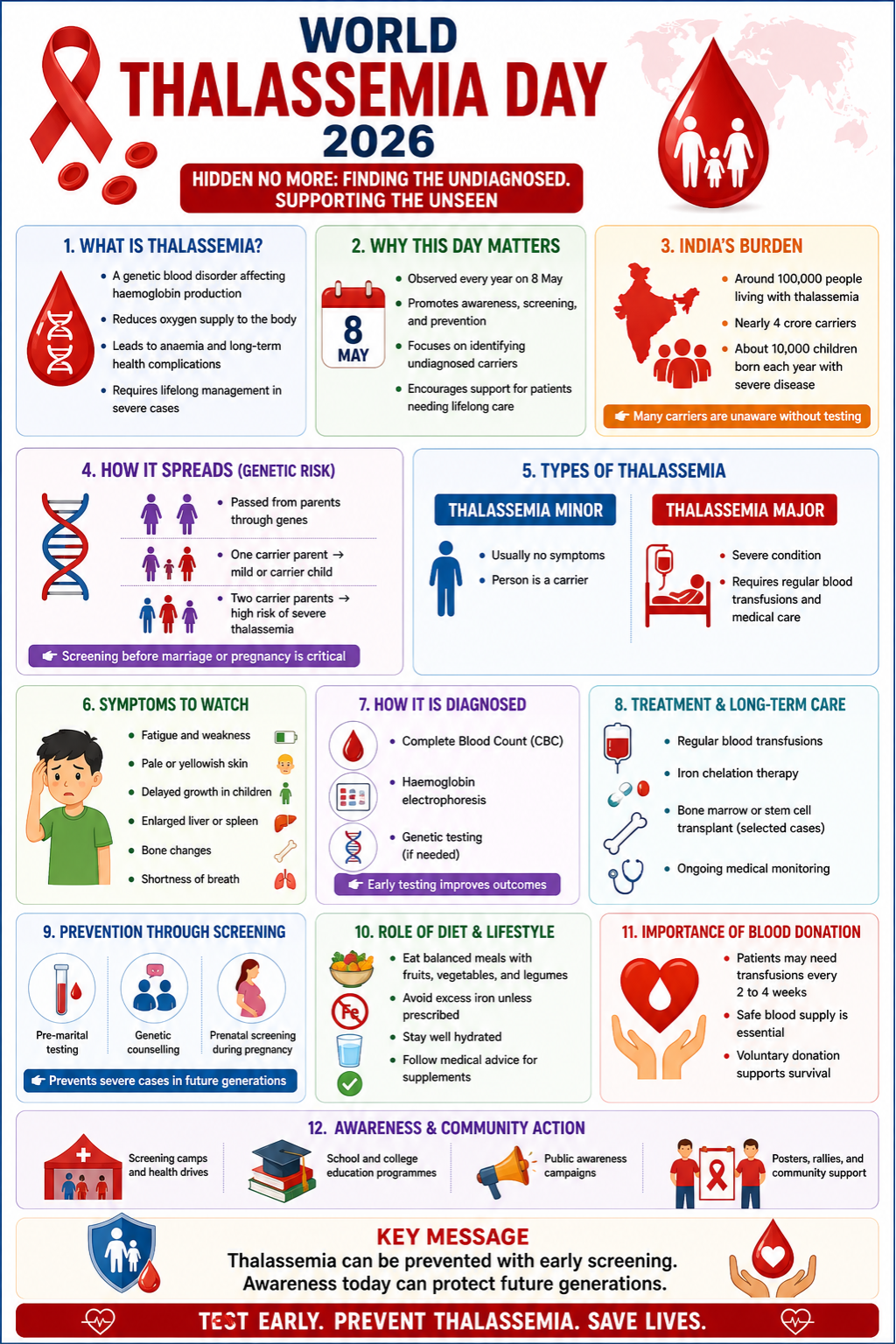
Observed every year on May 8, World Thalassemia Day aims to increase thalassemia awareness, promote early detection, and improve access to treatment.
The World Thalassemia Day theme 2026, “Hidden No More: Finding the Undiagnosed. Supporting the Unseen,” addresses a critical issue. A large number of individuals remain unaware of their status as a thalassemia carrier. These silent cases continue to contribute to new births of severe disease.
This World Thalassemia Day theme places clear focus on:
Expanding access to thalassemia test facilities
Strengthening early thalassemia diagnosis
Improving long-term patient support systems
Across Thalassemia Day India campaigns, hospitals, NGOs, and public health organisations organise World Thalassemia Day activities, such as screening camps, awareness sessions, and community outreach. Educational tools like the World Thalassemia Day poster and the campaigns play a key role in simplifying information for the public.
Why India Needs Stronger Thalassemia Awareness
Thalassemia is a public health concern in India, with a prevalence rate among the highest in the world.
The existing statistics show an estimated:
100,000 constituents of the population who currently have thalassemia,
Approximately 10,000 children are born annually with thalassemia major.
The continuing high prevalence of thalassemia emphasises the need for early screening and diagnosis of the condition.
One of the biggest barriers to early diagnosis of thalassemia is that many people are asymptomatic, and therefore not aware that they might pass the disease on to their children unless they participate in the routinely performed thalassemia test.
.png "MrMed")
What Is Thalassemia and How Does It Affect the Body
Thalassemia refers to a number of inherited blood disorders caused by problems in the production of haemoglobin. The haemoglobin produced by your body carries oxygen throughout your body.
If there is a problem producing adequate haemoglobin, your body will not have enough oxygen to send to body tissues, which results in several symptoms, such as anaemia and fatigue. Long-term complications of thalassemia can impact growth and organ function. Thalassemia is genetic, so it cannot be treated with nutritional interventions like those for common anaemia. Thalassemia requires long-term management.
As per an ICMR-funded study published on PubMed from SGPGI Lucknow (2009), premarital screening among extended family members of thalassemia patients detected carriers in 78.17% of cases, establishing it as the most effective prevention strategy in India.
Thalassemia Causes and Genetic Risk
Thalassemia causes because of the inheritance of specific gene defects responsible for the production of haemoglobin. whereas anaemia can be caused by a variety of factors, such as iron deficiency, vitamin deficiencies, or chronic diseases.
This has a distinct pattern of inheritance:
A child of a carrier parent may be a mild case of thalassemia
A child of two carrier parents has a high chance of being a severe case of thalassemia
This highlights how important early identification of carrier status is to help thalassemia prevention.
.png "MrMed")
Types of Thalassemia
Knowing the different types of Thalassemia can help determine the need for risk assessment and treatment.
Thalassemia Minor
Most people with the minor type do not have any concerning symptoms and lead normal lives, often without knowing they are carriers of the gene for Thalassemia.
Thalassemia Major
Thalassemia Major is very serious and requires ongoing treatment with blood transfusions as well as continuous medical care.
Thalassemia Symptoms You Should Not Ignore
Detecting thalassemia symptoms early can help ensure you are diagnosed and treated sooner rather than later.
Some of the most common symptoms of thalassemia include:
Tiredness and lack of strength
Pale, yellowish skin
Childhood growing problems
Liver or spleen enlargement
Deformed bones
Physicians will often do a thalassemia test if the individual displays these symptoms.
Thalassemia Test and Diagnosis Process
The thalassemia screening process uses a variety of methods, including:
Complete Blood Count (CBC)
Haemoglobin Electrophoresis
Genetic Testing as necessary.
It is crucial to achieve early diagnosis of thalassemia to enable more effective overall management of the condition and to establish preventive measures. Routine screening for thalassemia before marriage or pregnancy reduces the number of new cases diagnosed.
Thalassemia Treatment and Long-Term Care
Thalassemia's treatment approach involves managing symptoms and preventing complications.
Treatments to help manage thalassemia symptoms consist of:
Regular blood transfusions to maintain haemoglobin in order to keep up with low levels
Using iron chelation for the removal of excess iron due to constant blood transfusions
A bone marrow or stem cell transplant may work in selected patients
Although these treatment options improve a patient's overall quality of life, there will still be a significant need for consistent medical attention throughout their lifetime, which can be challenging financially and mentally.
Thalassemia Prevention Through Screening
There are methods to prevent thalassemia that require early intervention.
The first step to prevent thalassemia includes:
Pre-Marital Screening for Thalassemia
Genetic counselling for both partners
Testing for thalassemia in the prenatal stage of pregnancy.
If a couple considers having a baby, getting tested, and being negative for thalassemia, this will prevent severe cases of thalassemia and reduce overall healthcare expenditures in the future.
.png "MrMed")
Thalassemia Diet and Lifestyle Support
Patients with thalassemia can better manage their health with a well-balanced diet.
Foods to include:
Fruit, vegetables, and legumes.
Do not eat too much iron unless your doctor tells you to.
Drink plenty of fluids.
Follow your doctor's instructions for vitamin and mineral supplements.
While diet supports a person's overall health, it does not replace medical care.

Blood Donation for Thalassemia Patients
People with thalassemia major rely heavily on regular blood transfusions, making blood donations crucial for managing the condition.
Many thalassemia patients will need blood transfusions every 2–4 weeks; there are currently major issues related to the lack of a safe blood supply across the country.
One of the main goals of World Thalassemia Day is to promote voluntary blood donation through the various activities held on that day.
Awareness Campaigns and Public Engagement
Successful campaigns take complex medical information and make it easier for everyone to access, allowing them to educate more people about thalassemia.
Examples of standard awareness initiatives are:
Thalassemia awareness posters advertisement
School-based or college-based education initiatives
Internet campaigns promoting thalassemia awareness quotes
Public service announcements using short sentences containing a few words each to promote thalassemia awareness
Commonly used Thalassemia slogans are:
"Test Before Marriage; Prevent Thalassemia"
"Screen Early; Save Lives"
World Thalassemia Day Quotes That Encourage Action
The following World Thalassemia Day Quotes promote awareness:
“Early testing can save the next generation.”
“Hidden cases should be identified better.”
“Awareness leads to prevention.”
These quotes about thalassemia awareness can help influence people's behaviour and motivate them to change.
FAQs
1. Why is World Thalassemia Day celebrated?
It is observed to increase thalassemia awareness, promote early testing, and support individuals living with the condition.
2. What is the theme of Thalassemia Day 2026?
The World Thalassemia Day theme 2026 is “Hidden No More: Finding the Undiagnosed. Supporting the Unseen.”
3. When is Thalassemia Day in India?
It is observed on May 8 every year across India.
4. What is the old name for thalassemia?
Thalassemia was earlier known as Cooley’s anaemia.
5. What is the frequency of blood transfusions for patients suffering from thalassemia?
Thalassemia Major patients require blood transfusions every 2 to 4 weeks to maintain adequate haemoglobin levels and avoid complications of severe anaemia.
6. How prevalent is thalassemia in India?
India has one of the world's highest numbers of thalassemia sufferers, with over 100,000 individuals affected and more than 10,000 new cases diagnosed every year. Awareness and early detection remain very important in controlling thalassemia incidence nationwide.
The Bottom Line
The day of World Thalassemia 2026 shines a light on the essentially overlooked issue of thalassemia and the many undiagnosed people, resulting in a greater risk of the preventable disease.
In India, increased awareness of thalassemia, better access to thalassemia treatment, and encouraging blood donation will all assist individuals currently diagnosed with thalassemia and contribute to a marked reduction in the number of new cases.
A simple thalassemia test today can prevent a lifetime of medical difficulties.
Read Also
References
Colah R, Gorakshakar A, Nadkarni A. Global burden, distribution and prevention of β-thalassemias and hemoglobin E disorders. Expert Rev Hematol. 2010;3(1):103–117. Available from: https://pubmed.ncbi.nlm.nih.gov/24765686/
IAS Hub. World Thalassemia Day – overview, theme and significance. The IAS Hub. Available from: https://theiashub.com/upsc/world-thalassemia-day/
Weatherall DJ. The inherited diseases of hemoglobin are an emerging global health burden. Blood. 2010;115(22):4331–4336. Available from: https://pmc.ncbi.nlm.nih.gov/articles/PMC3552345/
Piel FB, Steinberg MH, Rees DC. Sickle cell disease and thalassemia: global epidemiology and health burden. Ann N Y Acad Sci. 2016;1368(1):45–54. Available from: https://pmc.ncbi.nlm.nih.gov/articles/PMC7510249/
Disclaimer: The content in this blog is for general informational purposes only and is not a substitute for professional medical advice, diagnosis, or treatment. Always consult your doctor or a registered dietitian before making any changes to your medicines or diet, especially if you have a medical condition or are taking prescribed medication. While the information is based on trusted sources, individual needs and results may vary. MrMed does not promote or endorse any specific food or treatment mentioned unless explicitly stated.
















Comments